'A Nihilist’s Guide to Parenthood' by Professor Sam Lipsyte Out with Graywolf Press in March
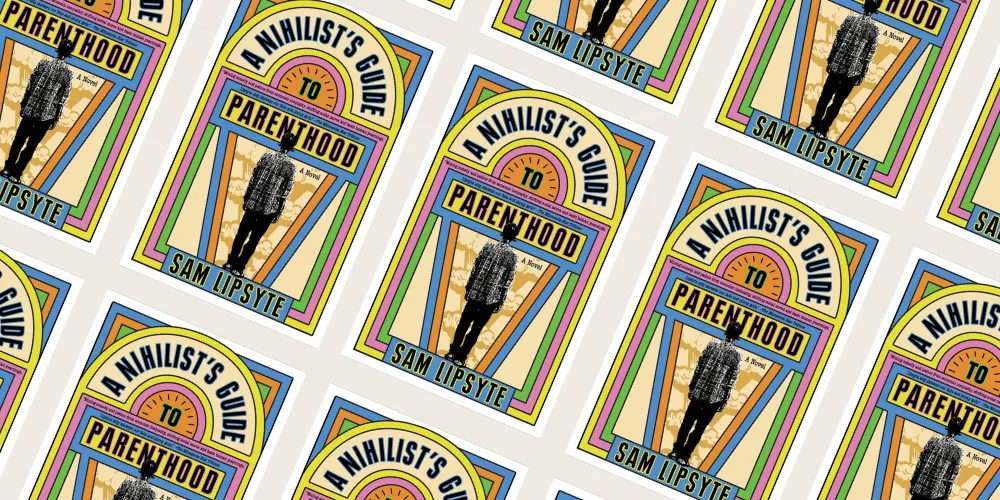
Wyatt Sardo—the protagonist of Professor Sam Lipsyte’s latest novel—is in hiding. When the novel opens, this “washed-up veteran of the last high-flying days of the glossy magazines” has fallen far from mainstream society, taking part in the violent acts of a disillusioned crew called the Planning Committee. Now, from the fringes, he has some things left to say.
A Nihilist’s Guide to Parenthood, out with Graywolf Press on March 2, 2027, takes the form of a letter written by Wyatt to his teenage children, giving a full account of all he has done and taking stock of the “tectonic shifts that technology has wreaked on every aspect of our lives.” In response to a few questions, Lipsyte spoke both to the craft of the novel and its deep-seated humanity; after all, Wyatt’s position is painfully familiar—staring down the death of a promised future while insisting on hope for a new one.
Q: What drew you to the epistolary form (a form with such a long history in the novel), particularly in a story concerned with the tension between parenting and estrangement in the internet age?
SL: As you point out, the epistolary form was central to the English-language novel’s development, from Samuel Richardson onward, and I have always been intrigued by the form. I’ve used it before—in fact, in my novel Home Land, which is presented as a series of updates to the narrator’s high school alumni bulletin. In the case of A Nihilist’s Guide to Parenthood, I was drawn to the form again for different reasons. Home Land was more about a young man ranting at society as represented by his former school cohort. But in this new novel, the narrator, Wyatt, is in a dire situation and feels a special urgency to explain both the world as he sees it and his own actions to the two people who matter most to him: his children. He is doing it with pen and paper, hidden away in a safe house that is increasingly unsafe. A lot of what he has to say concerns how technology has shaped all of them, and his aim is to somehow pierce the fog of the internet age and encourage the kind of human connection that may require a certain sacrifice, at least on his part. The poignancy of a father pouring his heart out in letters his children may never see also struck me as important for the book.
Q: Does writing about the internet—and characters so profoundly impacted by technology—change the way you think about craft or demand a unique sort of generic approach? How does humor play into that?
SL: I tend not to view it as writing about the internet so much as writing about people who live in the time of the internet. Robert Musil’s The Man Without Qualities was written nearly a hundred years ago and is about, among other things, the fall of empire and the failure of humans to keep up with technological change in a way that doesn’t shred them emotionally and spiritually. The themes are not new. But they do have their own special flavor these days, and to meet the moment I wanted to feature a sustained human voice over many pages, one that is by turns ecstatic, frightened, aggrieved, inspired, bitter, and everything else. While there is a large cast of varied characters, the filter remains Wyatt’s. It’s not a message board full of brief anonymous posts. It’s not a scrolling of reels. It’s not vicious, cowardly emoji invective. It’s just a person trying to come to grips over the course of hundreds of pages with his dreams, his failures, his hopes, his pettiness, his fears, his politics, and his deeds as a demonstration for his children of the self-inventory we all require, but which the online life can distort, divert, or thwart. And it’s a sustained story, as well as one full of heartache and humiliation and tragic action and, yes, humor. Humor is a huge part of life, and so also a part of my work. Very few great writers are never funny. Most of my favorite authors have at least a tinge of the comic. There are the jokes we make and the jokes the world plays on us and the jokes we make about the jokes the world has played on us. This last category is where the best work lives.
Several alums have praised the novel in advance of its release: Sophie Kemp '23, author of Paradise Logic, calls A Nihilist's Guide “[f]unny, touching, totally berserk” and hails Lipsyte as “the premier stylist of his generation.” Sophie Madeline Dess '22, author of What You Make of Me, says, “[H]is trick is to make you laugh so hard that the moral imperative behind this novel’s convictions subtly slips past your defenses. Above all, it is a searing indictment of modernity that rumbles with prophetic urgency.” The book is available for preorder now.
Sam Lipsyte is the author of five novels: No One Left to Come Looking for You (2022), Hark (2019), The Ask (2010), a New York Times Notable Book, The Subject Steve (2001), and Home Land (2004), which was a New York Times Notable Book and received the Believer Book Award. He has also written two story collections, Venus Drive (2000) and The Fun Parts (2004), and his work has appeared in The New Yorker, The Paris Review, and The Best American Short Stories, among other places. He is also the recipient of a Guggenheim Fellowship.