'Fail Sons' by Adam Wilson '09 out with Soho Press
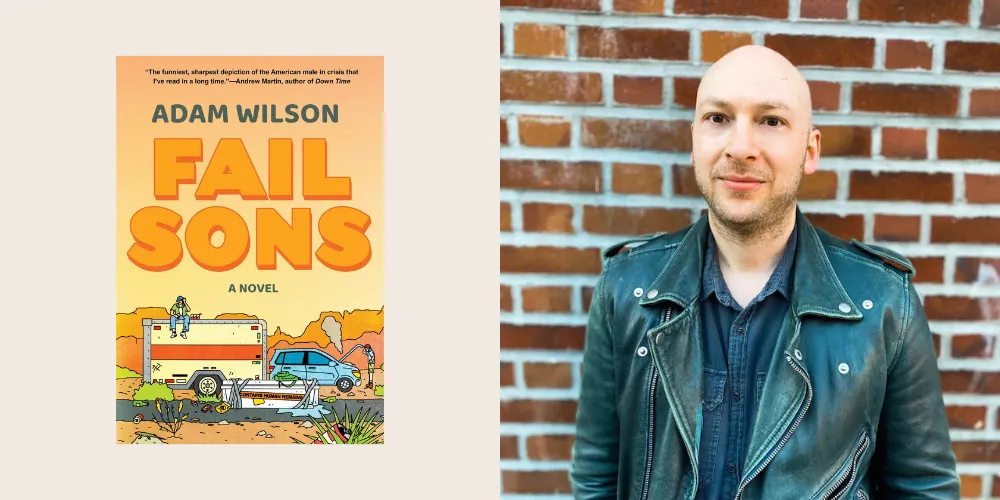
In his latest novel Fail Sons, Adjunct Associate Professor Adam Wilson '09 sets estranged brothers Scott and Nick off on an unconventional road trip. It’s the summer of 2022, and in the wake of the recent pandemic, they must transport their cryonically frozen father from Arizona to a new facility in Massachusetts. Nick remains rigidly cautious, while Scott picks up ex-Mormon hitchhikers and parties at a Gen Z commune, living out his last days of freedom before becoming a father himself. Scott stumbles through grief in many forms: grief for a world he thrived in, for the independence he once had, and for his father slowly thawing in the back of the U-Haul. Wilson offered some insight into his process writing this novel, one that captures the elusive feeling of failure while maintaining a darkly comedic sense of adventure.
The novel’s narrator, Scott, is constantly questioning roles: what it means to be a good father, son, husband. I asked Wilson about the choice to use two brothers as a focal point for exploring all these dynamics. He said he wasn’t thinking explicitly about those larger themes, first focusing on the characters: “The dynamic between the brothers emerged from the writing itself: playing around with their voices, finding the rhythm of the narration. At some point, it became clear that these questions about the roles of fathers, brothers, husbands, and sons in contemporary America were central to the story, which makes sense because they're questions that are close to my heart. I didn't imagine that the novel would answer them, but once they'd presented themselves, I do think I was able to start shaping the novel to more effectively frame them.”
When I asked Wilson what about a road trip novel appealed to him, his reply was both practical and honest: “Well, I'd already written books set in New York and Massachusetts—the two places I've lived—so I needed a new setting.” He had taken a road trip himself through the part of the country described in Fail Sons, and said he found the landscapes “stunningly beautiful.” Though he never got to retrace the route as he intended, there’s a silver lining in piecing together remembered fragments: “I think in a way that was for the best, as I probably would have written way too many long descriptions of like, mountain ranges or whatever, totally screwing up the book's brisk pacing.”
“I teach a class called The Ecstasy of Influence, and one of the main points I try to get across is that art doesn't exist in a vacuum, that all texts are part of an ongoing conversation with texts that came before them,” Wilson said in response to a question about the layered references in the novel. In addition to the book taking its structural conceit from William Faulkner’s As I Lay Dying, Scott is a culture editor by trade; he continuously narrates his grief, joy, and uncertainty through cultural touchstones. “Of course I chose his profession myself, partly because there are only so many professions I can convincingly portray, but also because I wanted to be able to riff on movies and pop music,” Wilson said. “I was mostly just trying to have fun.”
The novel has been praised for its hilarity and heart: Teddy Wayne, author of The Winner, said: “[W]hat begins as a stoner road-trip comedy evolves into something closer to John Williams’s Stoner: a poignant meditation on midlife masculinity, perfectionism, and failure, shot through with Adam Wilson’s signature wit, pathos, and crystalline language.” Erin Somers, author of The Ten Year Affair, called Fail Sons “[h]ilarious and humane … a road trip novel that begins in cynicism and ends in tenderness. It actually made me hopeful for men.”
Adam Wilson is the author of the novels Sensation Machines (Soho, 2020) and Flatscreen (Harper Perennial, 2012), as well as the collection of short stories What’s Important Is Feeling (Harper Perennial, 2014). His fiction has appeared in The Paris Review, McSweeney’s, Tin House, VICE, BOMB, and The Best American Short Stories, among many other publications. His essays, journalism, and criticism have appeared in Harper’s, The New Yorker, The Believer, The Nation, The Baffler, The New York Times Book Review,fs and elsewhere. He is a National Jewish Book Award finalist and a recipient of The Paris Review’s Terry Southern Prize.