‘Der Ring Gott Farblonjet:’ MFA Directing Thesis Delivers A Wild Wagner Send-up
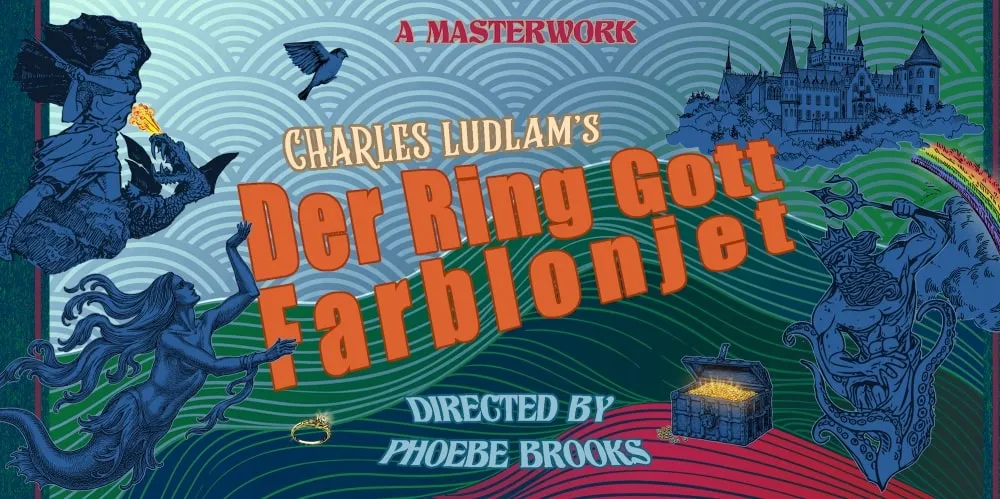
You might say that the show really begins with the ushers encouraging people to go to the bathroom and get water because the only intermission is around hour seven. Audiences are handed programs which indicate that the performance they’re about to see is Richard Wagner’s entire fifteen-hour, four-opera Ring Cycle.
But when the conductor arrives, bowing, he has a mild panic attack when he realizes, as we have, that he is facing a pit of empty chairs instead of an orchestra. Where is everyone? Soon the stage manager (Sage Spitz) is making a flurry of announcements about roles being filled by new performers. Judging by the terrified looks from stage hands emerging from the wings—the new cast are all crew members, including the enthusiastic ushers.
By the time the stage manager realizes she herself has to perform, the stage is in full-blown, furiously whispered pandemonium, as the crew members grab toy instruments from boxes, and outfit themselves with sheets, fake flowers, and plastic helmets. Tentative, pitchy, plainly terrified, they begin to sing.
Der Ring Gott Farblonjet, performed at the Lenfest Center from February 24-27, 2022 and directed by Phoebe Brooks, invites you to imagine what might happen if all the prestige were sucked out of a bastion of culture. What if everything that made a performance of Wagner’s Ring Cycle a thing that audiences pay hundreds of dollars to see—the singers, orchestra, costumes, props—suddenly disappeared? What if an audience in Lincoln Center suddenly realized that Twotan and Brünnhilde were being played by a pair of seriously freaked out assistant stage managers?
Written by Charles Ludlam in 1977, the show gives the world of opera, so rarified and self-serious, so synonymous with melodrama, its best zany send-up since ‘What’s Opera, Doc?’
This production of Der Ring is an exciting revival of Ludlam's work—and a great callback for an important but often overlooked figure in the history of queer theatre. “This play,” Brooks notes in her interview, “like much of Ludlam’s work, hilariously excoriates sexism and homophobia in ways that our cast very much enjoys highlighting.”
Brooks’ interest in audience engagement finds consummate expression with this material. Throughout the show, she finds new ways to annihilate the fourth wall—from the opening gambit with the ushers, to actually getting the audience to sing along to the iconic ‘Ride of the Valkyries’ theme (and we sounded pretty good, if I say so myself).
There is simply too much plot across the four operas of Der Ring des Nibelungen to recount here, but Der Ring Gott Farblonjet packs all of it into a truly bananas three hours. It begins with Das Rhinegold, in which the Nibelung dwarf Alberich (the diabolically funny Ashil Lee) steals the magic gold of the Rhinemaidens (K’yundra Martin, James La Bella, and Sage Spitz) who are wearing plastic shell bras, shuffling back and forth, looking terribly uneasy and unconvincingly repeating “Das Rhein..das gold…”
The gold can be used to fashion a ring that makes the wearer all-powerful, but only if they renounce love. Alberich has no problem with this caveat, and in creating the ring, sets in motion a series of events in which the gods will struggle amongst themselves and with mankind.
The ‘crew members’ are, of course, a cast of very talented actors who must not only convey their discomfort, but also embody the characters of the Ring Cycle itself. They attack this challenge with vaudevillian fervor. As the evening progresses, the stage hands’ self-consciousness falls away, and they immerse themselves in their roles.
Twotan, the king of the gods, is played with hilariously dry affect by Theo McKenna. Clearly fed up from the start, all McKenna has to do is throw up their hands in exasperation or roll their eyes to slay the audience. They have to keep clapping their hand over one eye when they’re reminded that Twotan only has one.
But as the drama unfolds McKenna too gets swept up in the propulsive, preposterous drama, this world of giants and dragons and Nihelumpen and heroes who accidentally hook up with their sisters. McKenna and their scene-mate James La Bella, as Twotan’s wife Fricka, actually manage to have a scene of genuine emotional pathos.
With pylons for fire and yellow solo cups with plastic gems glued on to represent gold, the DIY vibe for props, costumes, and even instruments is strong. There’s an aria about twincest set to a lovely ukulele jam, and I promise you, you have not known Wagner until you’ve heard Wagner played on a kazoo.
One of my favorite scenes involved two all-powerful gods having a serious conversation while doing the chicken dance. It’s choices like this which highlight Brooks’ unique sense of absurdity and play as a director.
Almost its own character, the display screen above the stage helpfully tries to parse the garbled German-English-Yiddish libretto with emojis, but just as often gets confused itself and devolves into a lot of question marks. At some point during the intermission, an error message appears on the screens announcing that ‘Unfortunately, Time has stopped.’
As an audience member, I felt that this was apt and yet untroubling; I was having too much fun.