This is Who We Are: Sable Elyse Smith
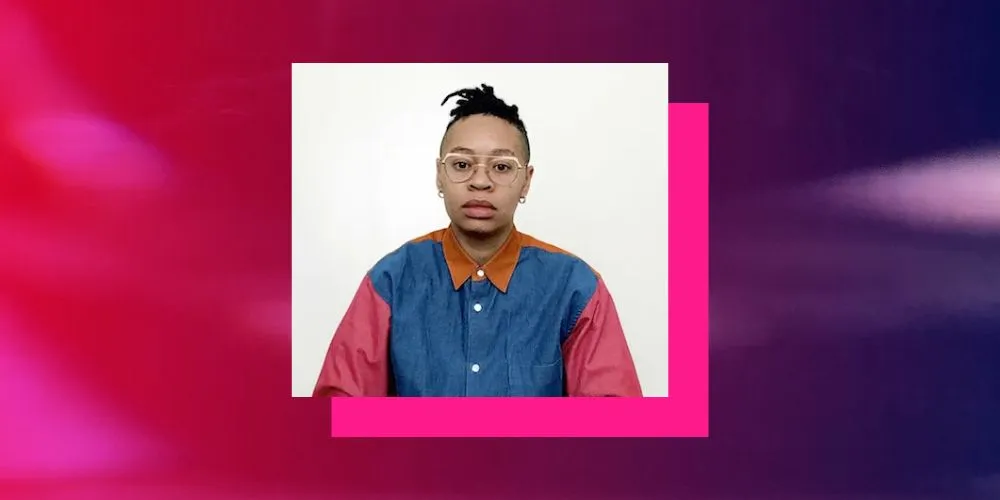
This Is Who We Are is a series featuring Columbia University School of the Arts' professors, covering careers, pedagogy, and art-making. Here, we talk with Associate Professor of Visual Arts Sable Elyse Smith about the inherent information in materials, time, and the myth of the 'art world.'
"Art is constructing, or making things, right?" Sable Elyse Smith said to me. "Being inventive." Her well-behaved companion—a small curly-haired dog named Quincy, who'd hardly made a peep during our conversation—popped his head into the Zoom frame. "So, you can define it all," she said, shaking her head almost incredulously, "and not wait for someone to define you."
Smith, a Los Angeles-born interdisciplinary artist and Associate Professor of Visual Art, is known primarily for her conceptual work in sculpture, though her creative practice spans video, performance, and the visual and literary arts. She has built a practice tracing the threads of violence and power embedded within systems of belief, infrastructure, language, intimacy, the quotidian, and beyond. Her wide-ranging interests reflect her roundabout, self-taught entry to the arts—her willingness to define, for herself, what it is to be an 'artist.'
"It's funny, I was talking to a publisher friend of mine about this last night," Smith said when I asked about her path to becoming an artist. "Early on, I didn't know it was called that, nor was I thinking, that is what I'm aspiring to be."
Having attended four different undergraduate universities as well as an MFA program in Design & Technology at Parson's, Smith's career path was anything but straightforward. Before she had backing from organizations like the Joan Mitchell Foundation or the Studio Museum in Harlem, she used the tools at her disposal, like any young artist: writing, making experimental short films on her laptop, and performing her work at the Poetry Project at St. Mark's Church. Her first encounters with contemporary art were at the Tate Modern in London, fresh out of school. Then she was introduced to Kara Walker's legendary—and divisive—cut-paper silhouettes: "I think that was my art education," she said.
There was no world in which Smith did not end up an artist. "The way that I am as a person—the way that I see and process information—is already through what we might call the lens of an artist…being visual, being hands-on, being curious…dissecting images, sounds, thinking through narrative," she said, making my question sound a little silly. "Naming it came much later in my education."
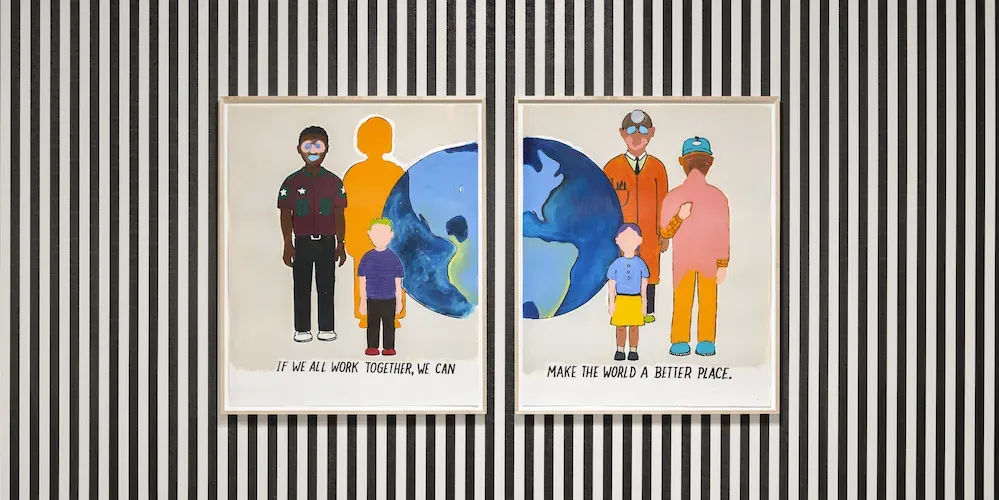
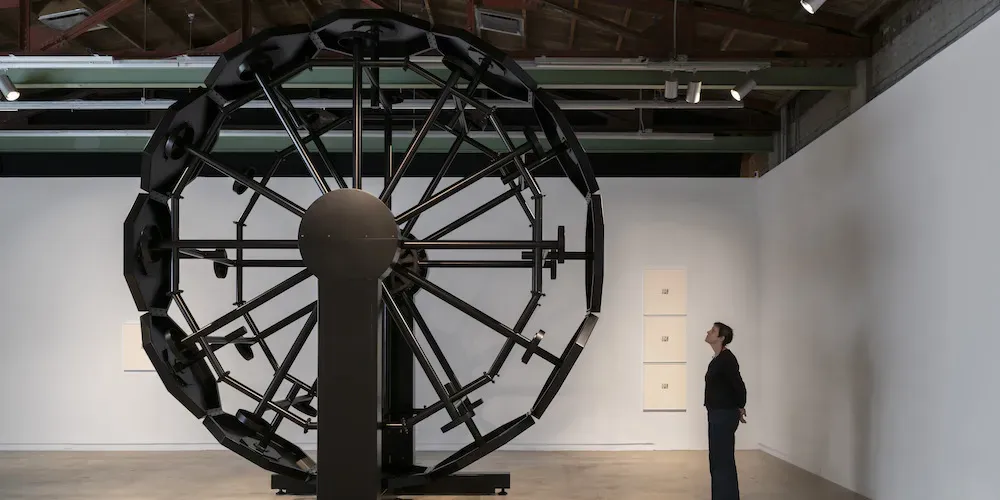
So, why teach art—particularly as someone whose career has been defined by her conceptual sculptures that critique institutions by appropriating their very materials? Smith's ongoing exhibition at The Contemporary Austin, Clockwork, features work from her Coloring Book series—a collection of works on paper that appropriate the punchy, colorful aesthetic of children’s coloring books, highlighting the complicity of the justice and educational systems—as well as her career-defining kinetic sculpture, A Clockwork (175 ½" x 165" x 98", aluminum, steel, motor, 2021): a Ferris Wheel constructed from prison waiting room furniture. Debuted in the 2022 Whitney Biennial, the massive structure churns slowly, making a spectacle of the slow, unrelenting pain made mundane by the carceral state. "Materials are loaded with information," Smith told me. While the tables may appear harmless, mechanisms of power are embedded in their design: they hit right at the knee, an uncomfortable distraction that also prevents things from being easily passed under the table. "Nothing is neutral" is a phrase that comes up again and again in Smith's own work and in her classes. She teaches in the MFA Visual Arts program in addition to advanced sculpture and introductory moving image courses in the undergraduate program, but her primary subject? "Ideas."
For Smith, teaching is about giving students the opportunity to practice being present and attuned to the world around them. Only then can they take that information and translate it into something meaningful: an object, experience, or conversation-starter. This includes being attentive to the space in which they learn. "Art is about ideas, about experimentation and risk, about failure," Smith said. "So those are all possibilities: to push, or expand the name that we give education, or school, or class, or professor…these different kinds of hierarchies. It's a space where new types of knowledge, or new understandings of knowledge can happen, in the immediate, together, as a group—and that feels important to me. That's my goal in a space. If I do that, then I've done something to counteract all the ways that an institution can be fraught."
The assignments Smith gives in her advanced sculpture courses are more like riddles than prompts. In one instance, she asked the class to make a piece that keeps time. "Everyone started talking about the calendar or the clock," she recalled. "Where did this concept of time even come from? That's related to labor…And how are we defining 'keep'?" she asked.
Smith's aim is multilayered: for students to question the definition of the words and the syntax, pull some meaning out of that, and to then formulate a concept, or take up a position in relationship to the prompt, and then translate that into something—primarily physical. She knows it's a big ask. "Thirteen to fifteen weeks, depending on the semester we're in, is quick…the speed at which they have to produce work is almost impossible," she admitted. But that doesn't change her expectations for students. "I feel like every student this semester really pushed themselves, and I could see that evolution from the first assignment to the final crit," she said with a smile.
Smith's cryptic assignments point to her fascination with language, her first medium. "There is inherent information in everything that we touch, so choosing what you're using and curating that selection already has information embedded in it," she told me when I asked how, as an interdisciplinary artist, she finds her way to one medium or another. "It's your positionality or vantage point as the maker that has to be wrestled with in relationship to the things that are already there." Of course, this applies to language, too: "Attaching a name to a thing, or category, can drastically reshape the possibility of it, or where it ends up, or what its impact is." Take Smith, for instance, named one of TIME Magazine's "100 Next"—the publication's annual list of 100 individuals who are shaping the future of their fields. This is a double-edged sword: her opportunities have been so plentiful that she's had little time for her ongoing writing project, something she hopes to prioritize in the coming years.
It was unsurprising, though equally delightful, to hear Smith name the artist and writer Renee Gladman (one of my favorite living artists)—who works across writing and drawing, constructing "prose architectures"—as an influence. She brought up Gladman's recent book, My Lesbian Novel (Dorothy, 2024), which embeds a romance narrative inside of a writer's meta-linguistic examination of her own writing practice, creating something that's simultaneously "intimate and intellectual." As Smith put it, building "a frame within a frame within a frame."
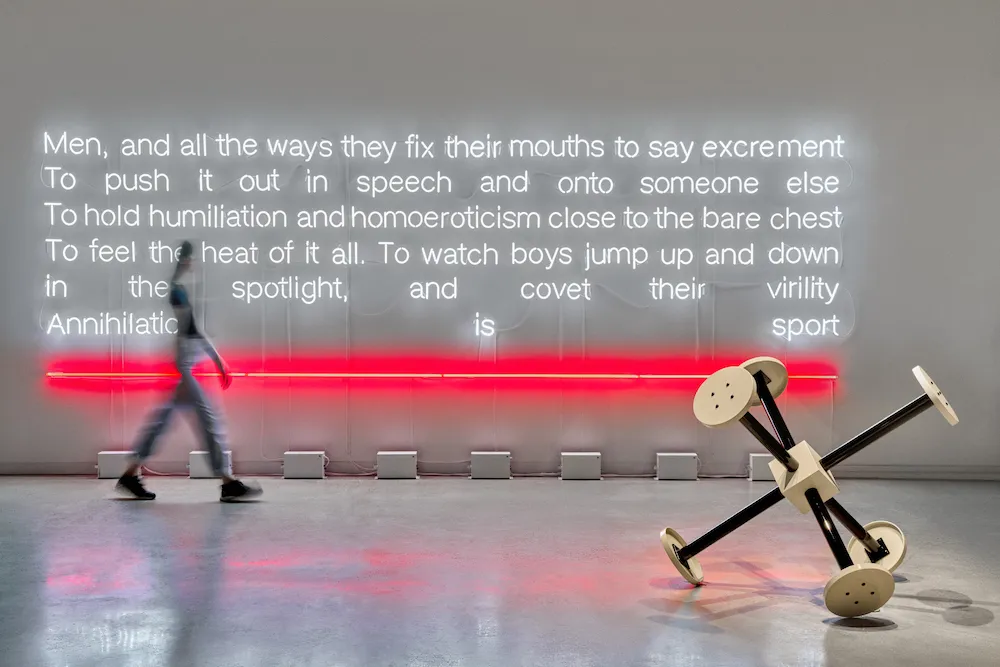
This reminded me of Smith's Clockwork, her most extensive institutional show to date—a perk of receiving the 2026 Suzanne Deal Booth / FLAG Art Foundation Prize, a biannual prize that supports an artist with a $200,000 award and a solo exhibition premiering at The Contemporary Austin and traveling to the FLAG Art Foundation in New York. In it, she uses seriality (or, in writerly speak, repetition), to riff on the concept of 'generics' or 'standards'—again, combating the myth of neutrality. Applying a standard dimension to the individual components making up her sculptures, what once seemed commonplace becomes visually, and cognitively, overwhelming.
In another conversation for This is Who We Are, Smith's colleague, Assistant Professor of Visual Arts Daphne Arthur, told me "everything is drawing." Smith chuckled at that. What it boils down to for her is poetry: "the gaps between things…that resonance, that juxtaposition."
Interested in many types of cultural production, Smith's impulses drive her to the porousness across fields, reaching beyond the sometimes insular 'art world, '"which has its own myth around it—we could spend the whole interview redefining and pulling that apart, too," she noted. In 2024, she collaborated with a composer and a vocalist on an opera, If you unfolded us, which she describes as "a love story between two black queer women and a storm."
I asked her if she had one piece of advice for young artists, what that would be. She laughed and shook her head, before looking into the camera and saying, "You define you. You define what art is, you define what being an artist is, and therefore what you can do in the world."
"See," I said. "I know everyone hates that question, but it's always something good."