This is Who We Are: Daphne Arthur
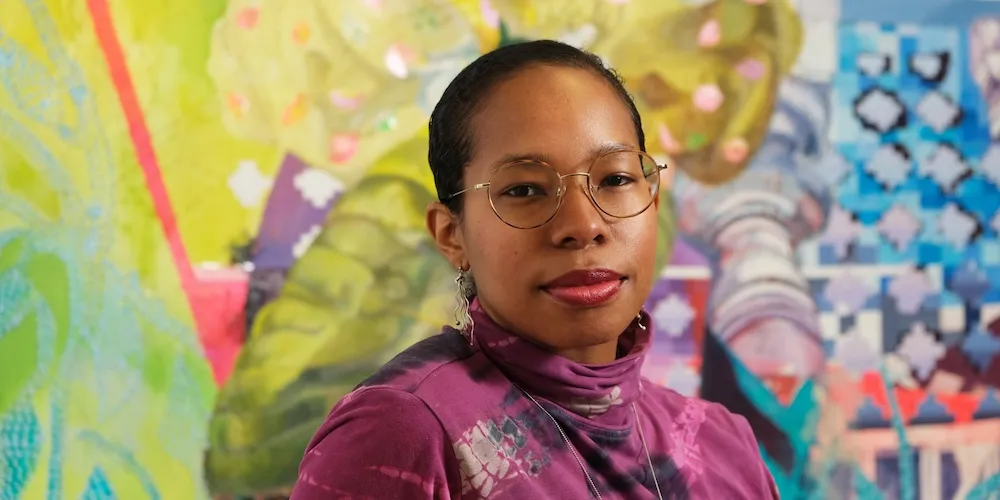
This Is Who We Are is a series featuring Columbia University School of the Arts' professors, covering careers, pedagogy, and art-making. Here, we talk with Assistant Professor of Visual Arts Daphne Arthur about migration, being a student for life, and the conceptual basis of drawing.
Daphne Arthur comes from Caracas, Venezuela, Brooklyn, New York, and these days, from Far Rockaway, Queens—"so my life is like a constant commute," she told me.
Born in Caracas, Arthur was raised by her maternal family who came to Venezuela from Trinidad. In Caracas, she existed within a "confluence of cultures"—by the time she migrated to the United States at age 12, code-switching and multilingualism were already a part of her and her family's "fluid way of existing."
"People who are in this state are constantly waiting for papers to go through, waiting for a phone call, waiting for bureaucracy, waiting, waiting, waiting…and within that space of waiting, you make a life," Arthur told me.
A "fluid way of existing" is also an apt description of Arthur's creative practice, which centers openness, curiosity, and service, and spans drawing, painting, sculpture, and installation. For her, the process often begins with personal or familial inquiry—luckily, her 91-year-old grandmother is happy to help with this—before expanding to the global and political, which requires research to fill in the gaps. It is within these gaps, which provide room for speculation, that the art occurs: "the fantastical can take place—I can begin to weave another type of narrative with the remnants that I have of the historical, the personal, the familial—but expand them."
While Arthur's work is deeply personal, she rejects the notion of individual authorship. "Nobody lives in a vacuum," she said. "What about how your friends have affected the way you work, or your colleagues, or your students? All of those relationships help shape how you see and hopefully produce." Despite long solitary hours in the studio, Arthur's work begins, and hopefully ends, in conversation. "Perhaps that's the most important thing for me," she said with a smile and a shrug. "The catalyst for art is to generate dialogue and support the inclusion of different voices."
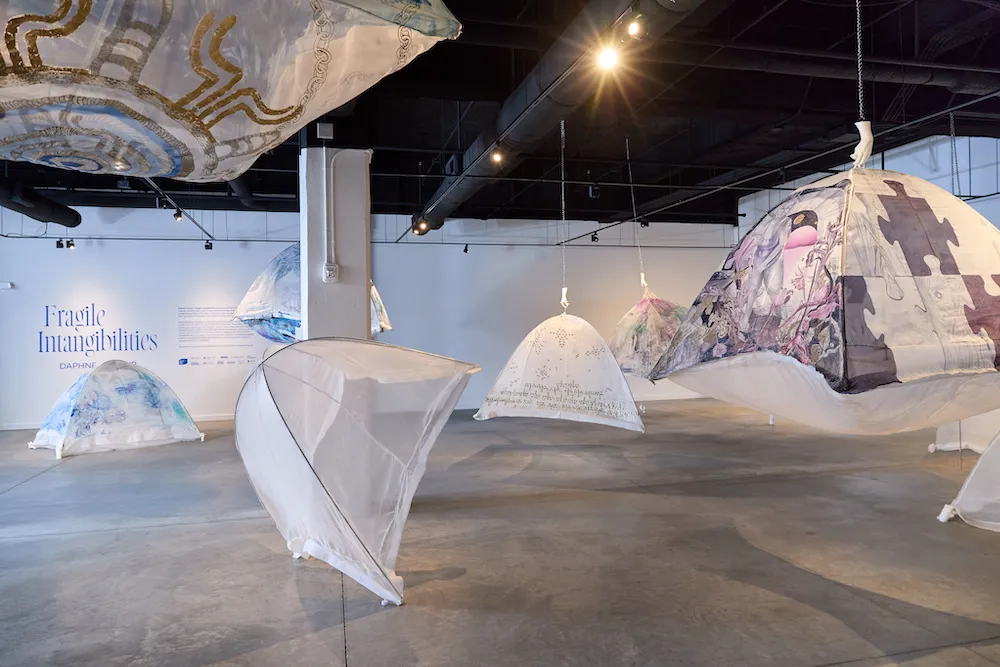
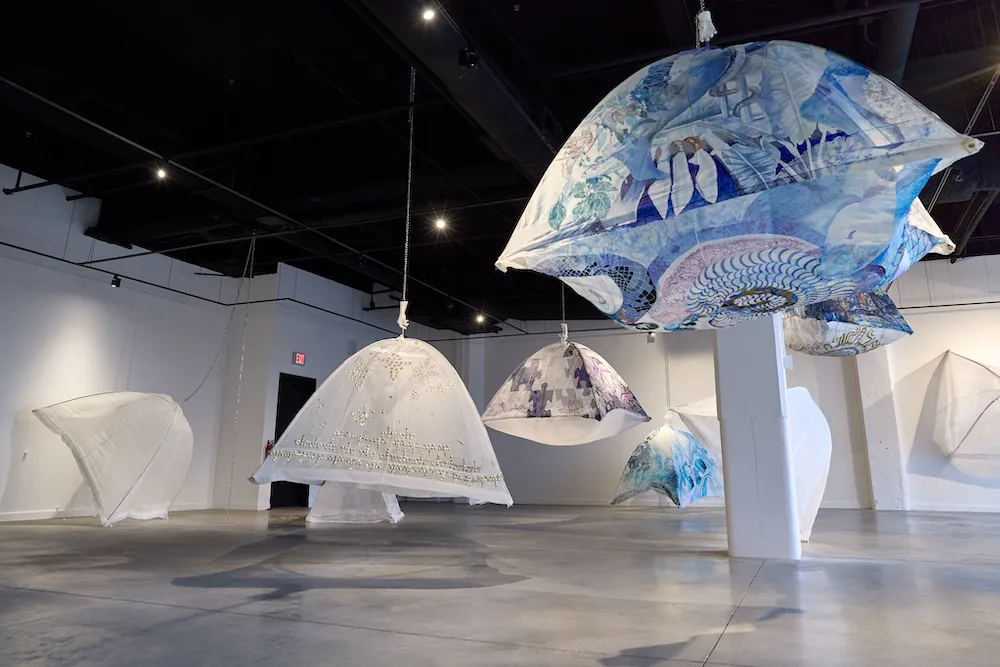
Arthur's 2025 solo exhibition at the Project for Empty Space (which marked the culmination of her two-year residency with the organization), Fragile Intangibilities, comprised 11 hand-sewn silk organza camping tents arranged in various stages of suspension. Decorated with ink drawings inspired by Arthur's interviews with first-generation immigrants and migrants in New York and Connecticut—including a previous student—the mobile homes illustrate diasporic identity as a living, hybrid thing. The exhibition is currently on view at Washington and Lee University's Staniar Gallery through December 12, 2025.
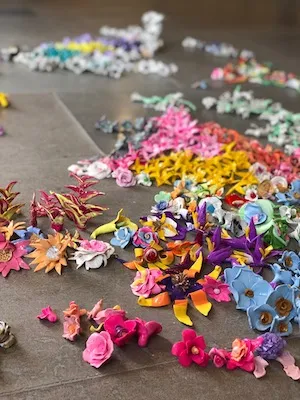
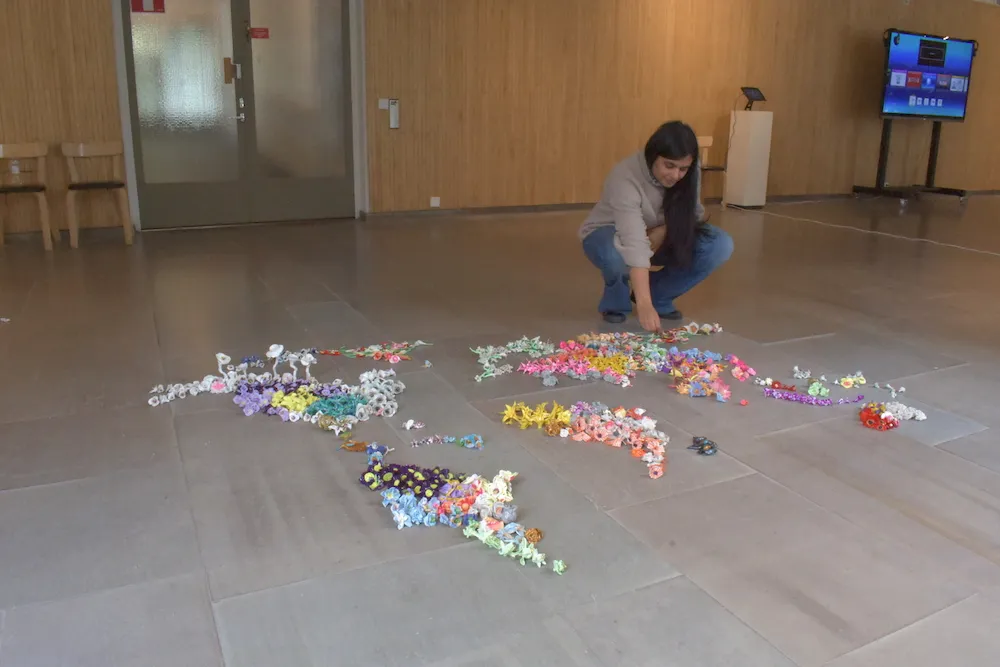
Amplifying individuals' stories is one way to serve her communities; in Appearance Of The Jeweled Lotus—which debuted at The First Global Radical Relevances Conference at Aalto University in Finland in 2018 and was presented on the boardwalk in Arthur's neighborhood at Beach 70th Street in 2019—she took the idea of giving back more literally. 1,000 unique hand-sculpted clay polymer flowers, based on flora she encountered in her travels to South America, the Caribbean, Europe, and India, were all given away to audience members. The artwork was the creation of the flowers, as well as the act of giving them away.
Arthur's approach to teaching is similar. "Every time I go to my classroom, how am I going to be of service to every single student?" Arthur asks herself. She delights in the originality of each student's work as she delights in the individuality of each flower. Describing her Drawing II class's most recent critique to me, she smiled up at the ceiling: "Everybody's doing different things—it's awesome." One student's drawing took the form of a classroom-wide installation, which rigged prints up with twine so as to explore distance in communication—"the distance that's happening between you and I right now because of the medium of the internet." Another student's drawing manifested anxiety in expertly articulated picking fingers—then amplified the feeling through layers of drawing, as though the image were looking at itself in a mirror.
In Arthur's drawing class, anything goes. "You don't even have to make a drawing," she told her students when discussing their final project, "because drawing can be conceptual." Of course, she teaches the foundations—creating three-dimensionality through shading, the illusion of depth, and color theory—but in Drawing II, she expects line, color, and form to be applied with deeper intention. "You're not just using it as a default but thinking about how the form, the shapes, the structures you bring together actually coalesce to make the concept more tangible, more rich," she said, bringing her fingers in and out of a fist as if grasping this very concept.
"Drawing is the basis," she said very slowly, "for everything."
To draw, for Arthur, is to make a physical manifestation of an idea. "I think about drawing sometimes, just the word. To draw something out is to exhume or extract," she said, using her fingers to draw something out of the air. "Everything is drawing. Writing is drawing. The way we think about urban planning, how we move through space, somebody drew that—and they were thinking about how people connect with each other or not, how we create boundaries—all that is drawing."
Arthur's enthusiasm for teaching comes in part from her experience at the School of the Art Institute of Chicago where her professor, or "favorite teacher of all time," Susanna Coffey, introduced her to a holistic teaching style that pulls fluidly from different types of knowledge. Coffey shared the poem "The First Step" by Constantine P. Cavafy with Arthur before she went to pursue her MFA at the Yale School of Art, Coffey's alma mater. The poem, which Arthur returns to on occasion, is about a young Greek poet's aspirations and anxieties upon completing his first idyll, which has taken him two years to write. Though the young poet Evmenis is downcast by the enormity of work ahead of him, Theocritus offers an alternative viewpoint: "Even this first step / is a long way above the ordinary world. / To stand on this step / you must be in your own right / a member of the city of ideas." In other words: what a joy that you have so much work still ahead of you.
"She changed my life," Arthur said. "She gave me the support that sometimes even my family did not give me because they did not understand why I would go to school for art."
I asked Arthur if she could bestow only one lesson on her students, what she would want them to walk away with. "The courage to be free," she said. By this, she means to uncondition, or decolonize the mind in order to make art unhampered by inhibition. "What are ways you can push those signifiers or categorizations to be you in a free, free, free, free, manner?" she asked. While letting go can be scary, "there's always something within the cracks of that rupture—and those are the moments of growth" she said. Then, channeling her inner Theocritus: "Be a student for life. And that means that you're always inquisitive, curious—you're free to explore wherever an idea might lead you."
Lately, Arthur has been exploring the idea of rest. Having been anonymously nominated for and subsequently awarded an $18,000 grant from fortheArtist, she is looking forward to following where her ideas take her, whether that be another country or a new formal technique (or, more likely, both). She's already planned the first stop of this journey: learning to blow glass. Arthur's latest work has been largely sculptural, and while resin has been a useful tool, she feels that there's something "glass-like" about the work. "There's nothing to lose but taking the chance," she tells her students. "You don't know who's looking at the work." Arthur doesn't know the person who nominated her for the grant, but it brings her joy to know that her art is out in the world, making its own connections. "It's a really nice surprise," she said. "It gives me a sense of affirmation, like the universe is saying, keep going!"
–
Daphne Arthur centers her practice on the experimentation and transformation of conventional materials and forms. Drawing from her background, the Afro-Venezuelan artist explores the roles history, memory, and mythology play in the transformation or deterioration of the collective imaginary of the Black diaspora. Arthur received her BFA in Painting and Drawing from the School Of Art Institute of Chicago in 2007, and an MFA from the Yale School of Art in 2009. In 2020, she presented a solo exhibition titled In The Eye of The World, curated by Julia Marsh at Cedar Crest College, Philadelphia. She is the recipient of the Anne Critz fellowship, The Ald Held Fellowship at the American Academy of Rome, the Vermont Studio Center Fellowship and The NYFA Queens Art Fund: New Work Grant.