Rirkrit Tiravanija Invites You to 'The House That Jack Built' at Pirelli HangarBicocca, Milan
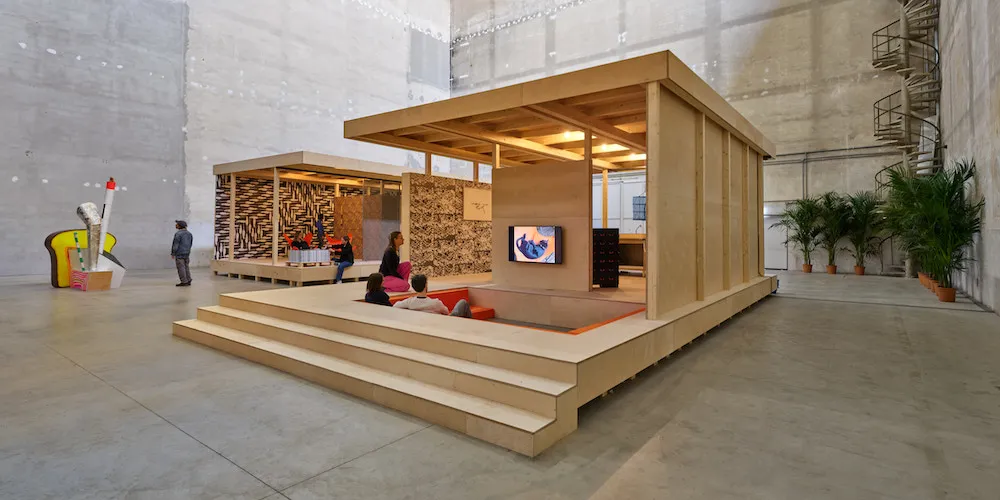
The retrospective exhibit The House That Jack Built at Pirelli HangarBicocca—a former Pirelli tire plant turned contemporary art institution in Milan—aims to introduce the public to thirty years of Professor Rirkrit Tiravanija's research into spatial and architectural practices.
Since the 1990s, Tiravanija—who serves as Professor of Professional Practice in the Visual Arts Program—has centered his practice on social engagement, combining traditional object making, public and private performances, teaching, and other forms of public service. "The House That Jack Built" refers to the famous 18th-century English nursery rhyme of the same name, which, contrary to the title, does not recount the story of the house or its builder, but narrates how the house is indirectly connected to, and interacts with, the people and things around it. Tiravanija's exhibition functions similarly: the value of his structures—which riff on the buildings of iconic Modernist architects, further muddling the idea of "authorship"—is based on how they are used and who inhabits them, rather than their form. To this end, Tiravanija and Pirelli HangarBicocca invited collaborators from various local organizations, schools, and associations to participate in daily activations of the installation through music, performance, theatre, community education and art-making, dance, and more.
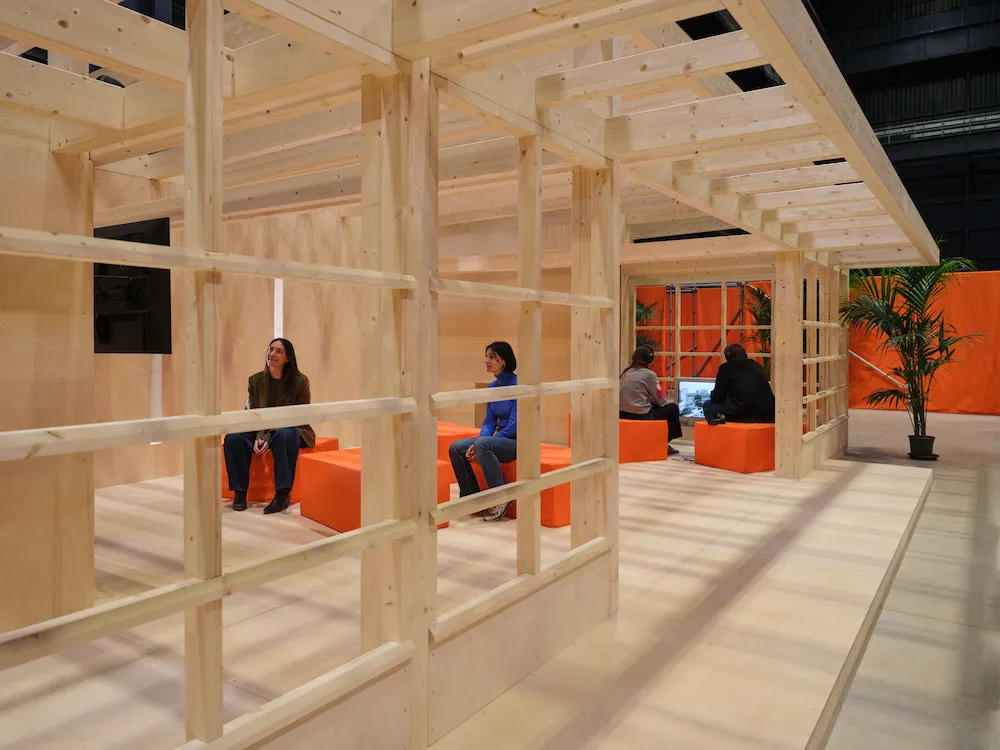
"Growing up in Thailand, the idea of 'modernizing' and becoming 'modern' was always the aspiration," Tiravanija said in an interview for Pirelli HangarBicocca. Grappling with his "disillusionment with the West," the goal of his architectural works is to "put life back into modernism," he said with a laugh.
This ambition is evident in the playfulness Tiravanija employs in his work, from the nursery rhyme inspiration to a reference to another Jack—Jack Nicholson of The Shining, from which the maze-like path through the exhibition takes its cues. The labyrinthine structure necessitates engagement; the walls of the path and simple tents where visitors can stop and drink tea are made with orange fabric, reminiscent of Buddhist monks' robes. In some installations, the words "a lot of people" appear among the listed materials. Tiravanija encourages "viewers" to become participants: to bring the works to life by questioning what art is and how to interact with it.
Born in Buenos Aires, Argentina, Tiravanija is a leading figure in relational art and is widely recognized as one of the most influential artists of his generation. His solo exhibitions have been hosted by many of the world's leading art institutions, including Gropius Bau, Berlin (2024); MoMA PS1, New York (2023); Museum Dhondt-Dhaenens, Deurle, Belgium (2021); Hirshhorn Museum and Sculpture Garden, Washington DC (2019); and National Gallery of Singapore (2018), among many others. He has participated in numerous group exhibitions and biennials around the world, including Qatar National Pavilion at Venice Biennale (2026); Shanghai Biennale (2025); Helsinki Biennial (2021); Sharjah Biennial (2007, 2015); and Venice Biennale (2015, 2011, 2009, 2003, 1993). Tiravanija's many scholarships and awards include the Absolut Art Award (2010), the Silpathorn Award from the Thai Ministry of Culture (2017), the Hugo Boss Prize (2004), and the Lucelia Artist Award from the Smithsonian American Art Museum (2003).
The House That Jack Built is on "view" (and open for public use) through July 26, 2026.