This Is Who We Are: Frank Rose
This Is Who We Are is a series featuring Columbia University School of the Arts' professors, covering careers, pedagogy, and art-making. Here, we talk with Adjunct Senior Research Scholar Frank Rose about the power of narrative and the future of storytelling.
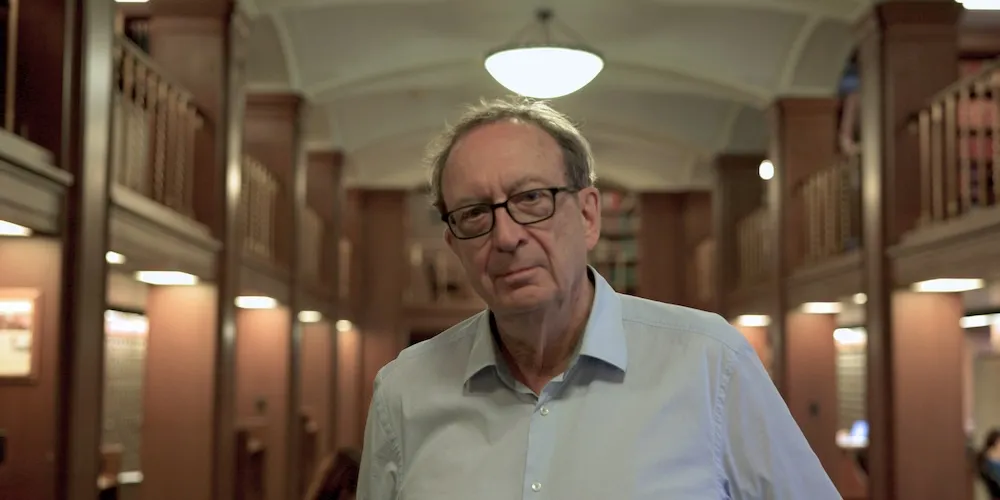
Frank Rose witnessed five decades of change in the West Village and rode that wave of change himself. He came to the city in the 70s and got his start in journalism on the music beat, writing about the punk bands at the club CBGB for The Village Voice. Today he met me in his neighborhood, at a cafe in a hotel lobby—"Best perhaps to meet in a hotel restaurant for an interview? There’s lots of cafés but they tend to be very crowded," he wrote—a nod to the discretion he practices as a contemporary journalist who interviews AI luminaries like Stephanie Dinkins and iconic artists like David Byrne for The New York Times. This distinguished gentleman, with expressive blue eyes and a Valentino cashmere, might seem far away from the club kid who could've been a stand-in for Keith Haring, but Rose has never stopped looking for signs that point to the future.
Rose is now an Adjunct Senior Research Scholar at Columbia University School of the Arts' Digital Storytelling Lab, which invites collaboration between students, faculty and other creative partners to investigate and imagine new ways art collides with technology. "We’re really focused on how stories are told through emerging technologies," Rose said.
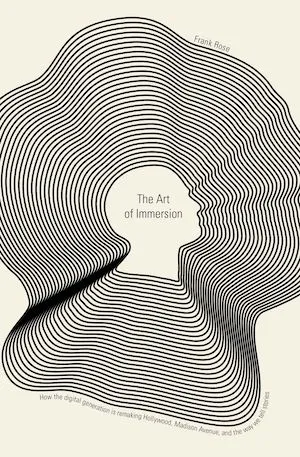
After decades reporting and editing for glossy publications like Esquire and Wired, Rose left in order to pursue his own creative project, The Art of Immersion (W. W. Norton, 2011), a deep dive into the changing digital media landscape. In his work as a journalist, Rose had noticed the emergence and popularity of new platforms like YouTube, blogs, Facebook, Twitter. Rose didn't know how, exactly, they would change the game, but he could tell change was going to come. He started talking to experts and investigating how digital media's many platforms gave rise to new, immersive narrative forms and strategies, and the research turned into a book. In The Art of Immersion, Rose made the early connection that entertainment and marketing, reality and fiction, would become increasingly intertwined through social media.
While he was working on The Art of Immersion, Rose had the opportunity to lecture at USC and NYU, and as far afield as the Naval Operations Study Group in Rhode Island, and Scuola Holden in Turin, Italy. "What could be better than teaching?" he said. "I picked up a couple things along the way and wanted to be able to share those ideas with people." He had worked with Professor Emeritus and Special Lecturer in Film Ira Deutchman and Professor of Professional Practice Lance Weiler through Columbia School of the Arts' Film Program, and they came together to found the Digital Storytelling Lab to study and develop the ways art and commerce interact with new technologies.
After his work on The Art of Immersion, Rose knew that digital media had the potential to change the way we tell stories, in the entertainment industry and everywhere else. Rose created the Strategic Storytelling course in 2014, first through Columbia Business School, then with the Digital Storytelling Lab and now, for the first time this year, through Columbia+, the university's online learning platform. Though the course is billed as executive education, it offers the broad lesson of how to use narrative and digital tools to build a real life audience. Persuasion doesn't happen in a clinical or theoretical context, it happens in the real world, between people, who are moved not by facts alone, but by their feelings. Storytelling tools empower anyone, from leaders in corporate strategy and the military to professionals in game design, education and science, to powerfully get their point across.
Ultimately, storytelling—no matter what you use it for—is about forging a connection with your audience. "You have to be clear, how you’re going to connect with people. What do they want to hear? What will capture their imagination?" Rose said.
A crucial component of the strategic storytelling course is its digital focus. What interests Rose about digital storytelling specifically, and what distinguishes it from traditional mediums like novels or movies, is its potential to cross platforms and create an immersive, multidimensional experience. "By combining whatever—television, web video, books, articles, online articles, that sort of thing, social media, obviously—you are able to reinforce a message and able to engage people on a number of different levels," he said. An author might accomplish this by packaging their latest book with ephemera like a list of everything on the writer's desk or an essay by or about the author. A TV series might release a companion podcast to each episode.
Rose, speaking in the fire- and lamp-lit lobby of a boutique hotel, speaks with the easygoing candor of an expert. He's comfortable in his knowledge and extends that comfort to you and me. His expertise comes from a great depth of case studies—from AMC's Walking Dead to the Hopscotch Opera, which took place in the backs of limousines across Los Angeles—that create and reflect new media trends.
Rose has tracked these changes and celebrated the exciting new art made with emerging technologies through the Breakthroughs in Storytelling Awards, which he created and has presented through the Digital Storytelling Lab since 2016. In their first year, the awards presaged the rise of the pejorative "Karen" and lauded the avant-garde efforts of a future MacArthur Genius Fellow. The awards highlighted an Absolut ad campaign that used an app to gather people in real life (if Pokemon Go! sold vodka).
In the following years, the award would recognize an early application of artificial intelligence to make literature. To create 1 The Road, Ross Goodwin programmed early AI to use a sample of literature, Foursquare reviews, and geolocation data and put the computer in his trunk. While Goodwin drove between New York and New Orleans, the AI spat out a novel on receipt paper, which was published unedited.
"Most of it was gibberish, but some of it was nonetheless, surprisingly, kind of fascinating. And that was before, obviously, the current iteration of large language models, that sort of thing," Rose said. "It showed where generative AI was going to go. It really pointed in that direction."
Rose believes the importance of the Breakthroughs in Digital Storytelling Awards serve not just as a recognition of excellence, but will become an archive for future generations. "Some of these projects that we recognize, they get a lot of attention—[the TV series] Westworld, for example—but others do not. Some of them barely cause a ripple. But they could be very important as a first step," Rose said. "Twenty, thirty, forty, fifty years in the future, people will be able to look back, scan these things. See what worked and what didn’t. Get ideas from something long forgotten."
While researching for The Art of Immersion, Rose found that it takes people 40 years to create a form of narrative that's native to a new medium. When it comes to AI, he said, "I think it might take us even longer because the technology is moving ahead at such a rate. Ten years ago, if you weren’t a computer scientist, AI wasn’t on anyone’s radar." Like in the early days of social media, no one could predict the specific value or consequences of an emerging technology. When artists use emerging mediums, they bring us into the future. They take risks and move us in directions no one else could have imagined.
"The more enmeshed we got into the digital world, the more valuable real life interactions become. Now, more and more people are realizing it."
As we stand on the precipice of unknown change with AI, Rose wants his students to be able to command the emerging technology as a tool and appreciate its influence on how we operate. "It’s really hard to say where it’s going. What does intrigue me about it is—and this has only become clear in the last six to eight months—it’s putting an increased value and focus on what it means to be human," Rose said. AI can write programs and code, but even its best works of literature are missing the essential component of human expression. "A new appreciation [is emerging] for originality," Rose said. "It’s critically important."
Ten years ago, Rose did a study with the ad agency J. Walter Thompson that surveyed millennials about their attitudes towards digital versus physical artifacts. What he found was that, although millennials were more engaged with the digital world than earlier generations, they also appreciated physical artifacts more. "The more enmeshed we got into the digital world, the more valuable real life interactions become," Rose said. "Now, more and more people are realizing it."
Each month the Digital Storytelling Lab hosts gatherings that feature conversations with artists going in new directions and the larger community here in New York. Frank Rose is leading his Strategic Storytelling course on Columbia+ from January 26 to February 19, 2026.