Visual Arts Student Francisco Javier Ramírez Exhibits 'Streets Taken' at Butler Library
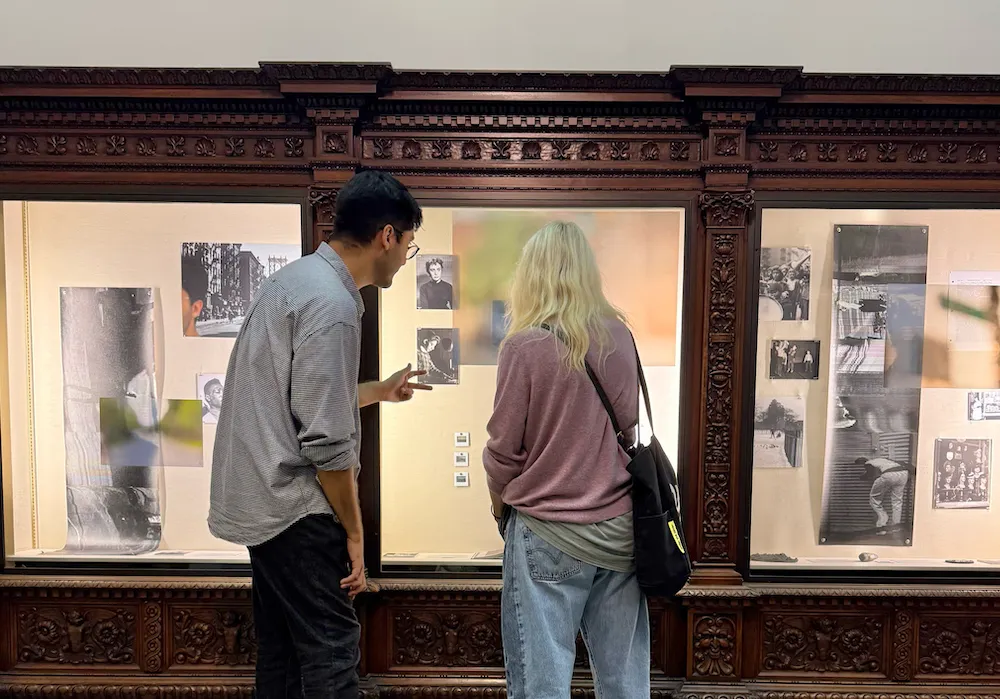
The latest exhibition on view in Columbia University Butler Library's third-floor display cases, Streets Taken, features photographs by prominent New York photojournalist Edward Schwartz from the Butler Rare Book and Manuscript Library (RBML) alongside new works by MFA Visual Arts student Francisco Javier Ramírez.
Curated by Melina Moe, Curator of Literature at the RBML, the exhibition is a special collaboration between the RBML and the Visual Arts Program. With the support of a Graduate Assistant Fellowship from the RBML, Ramírez—who is concentration in Photography at the School of the Arts—spent the summer working with Edward Schwartz's photographs and other materials from the library's archives, developing his new works in response. Now in its second year, the partnership provides funding for Visual Arts students to produce new works that engage with Columbia’s archives.
Last year the fellowship went to MFA students Sharon Lee '25 and Javier Griffey '25, and Undergraduate Visual Arts student Vivien Ko Sweet (CC '25), to produce works in response to the Coney Island archives. This year, Ramírez was selected to create work engaging with the Edward Schwartz Archive, which includes photographs, negatives, home snapshots, and transcripts of oral histories from the Russian-Jewish American photographer best known for his earnest portraits of New Yorkers and documentation of civil rights protests.
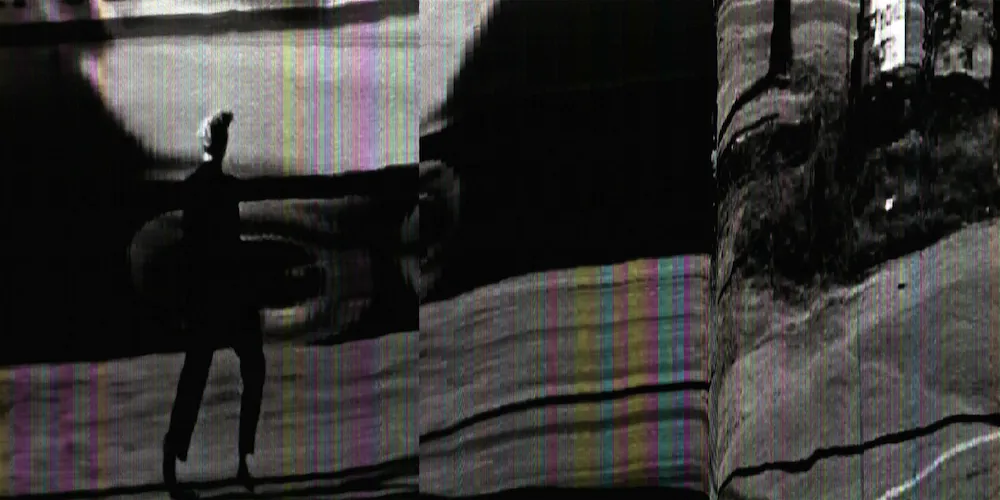
Ramírez, whose work in the Visual Arts Program has involved interventions into archives, wanted not only to trace the parallels between himself and Schwartz, but to create works that actively collapse past and present. Through displaying his own iphone photographs of the archival material as 35mm slide facsimiles and producing new images in formats popular in Schwartz's time, Ramírez emphasizes the non-linear nature of working with archival material. Revisiting the sites Schwartz photographed, Ramírez documented them with a disposable lens, creating a grainy, blurred effect. Printed as transparencies and taped to the glass of the display cases, the viewer can look through Ramírez's photographs to Schwartz's, forming a palimpsest of images. A similar effect is achieved in the accompanying publication, Ed at age 34 (printed at Ramírez’s own press), which pairs the two photographers' works in intimate conversation on the page.
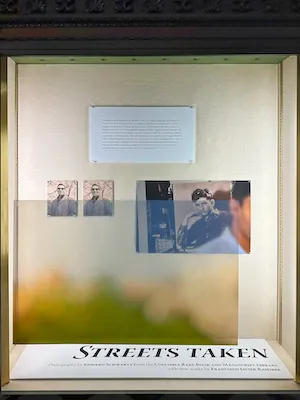
"This format became a way of playing with time, allowing the past and present to coexist," Ramírez said of the ambiguity he cultivates in his work. "I emphasize this expansiveness and interconnectedness through softness and blurriness."
Within the collapsing of past and present, Ramírez explores a parallel intersection: that of the personal and political. Schwartz's life was punctuated by ruptures: the Great Depression, World War II, and McCarthyism, to name a few. A passage from Disc #29 in his oral histories stuck out to Ramírez:
"After all my attempts to become a freelance photographer, I came to the conclusion that at 48, it wasn’t going to work out. I had to find a job in structural engineering, swallow my resistance to working in an office again, and accept the facts of life."
As the child of an immigrant and someone who has migrated himself, Ramírez found himself resonating with the push and pull of ambition and reality that Schwartz expressed. Though Schwartz gave up a career in photography, he continued to work at his craft, exhibit his work, and as one of the postcards in his personal papers said, "to be amongst the artists of [his] times." And here enters Ramírez, a student with the same ambitions, merging Schwartz's legacy with his own.
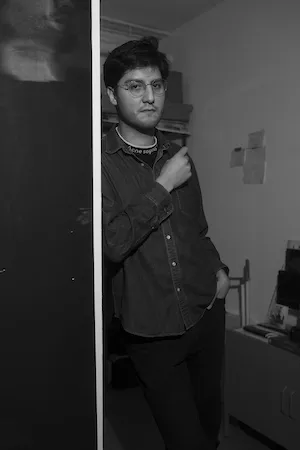
"At this intersection of life, trying to pursue an artistic career, [reading] that felt like both hope and comfort," said Ramírez. Working with the Schwartz archives spurred meaning on both an emotional and conceptual level: "Since I started the MFA, the archive has taken on a deeper significance in my practice. I have been increasingly interested in how we construct meaning and how ideas take shape through the images we choose to preserve, and in the aesthetics of the archive itself."
Francisco Javier Ramírez is an interdisciplinary visual artist born in Mexico City and based in New York. His work draws from personal experience to embrace complexity and chaos, using myth, memory, and history to explore the intersections of reality, artifice, and nonlinear time. He has exhibited internationally, including at the Print Center New York and Museo de la Ciudad de Querétaro. His artist book Ojos que no ven was a finalist for the Best Latin American Publication award at the FELIFA Festival 2023 and his zines and photobooks have been featured at LA Printed Matter Art Book Fair, Brooklyn Art Book Fair, and ZONA MACO, among others.
Streets Taken is currently on view in the third-floor display cases at Butler Library, and will run through November, 2025.