The Visual Arts + Sound Art Class of 2027 Takes the First Year Exhibition Beyond the Gallery
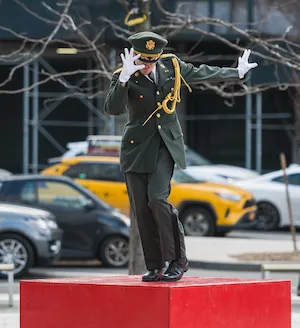
Milo, a City College student, was at McDonald’s on Saturday, March 28, 2026, getting a one-dollar coffee when he heard music coming from across the street.
Following the music, Milo happened upon the 2026 First Year MFA Exhibition: "They were doing a sort of military march—but make it c-nty," he said of Gianfranco Reyes's performance piece, Reporting for Duty (2026). "Then they got on a big red box in the middle of the courtyard and started dancing so well it made me want to dance."
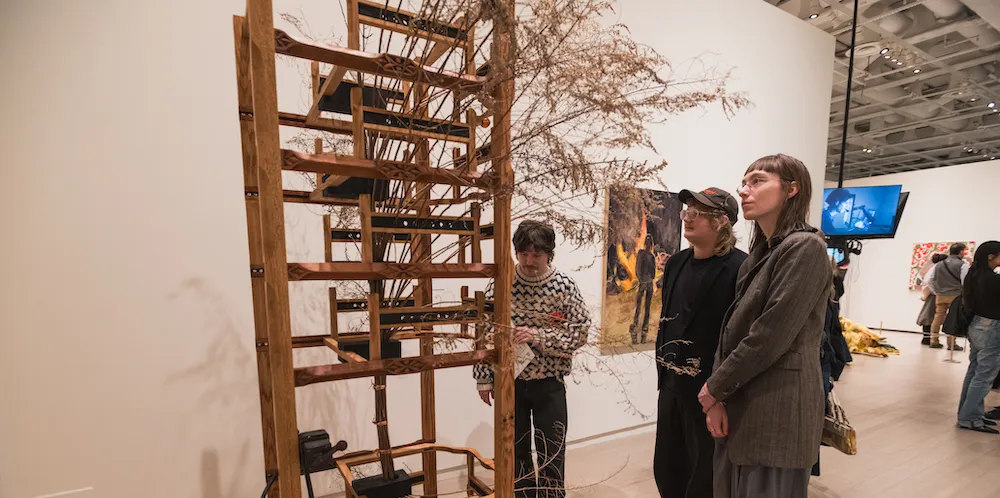
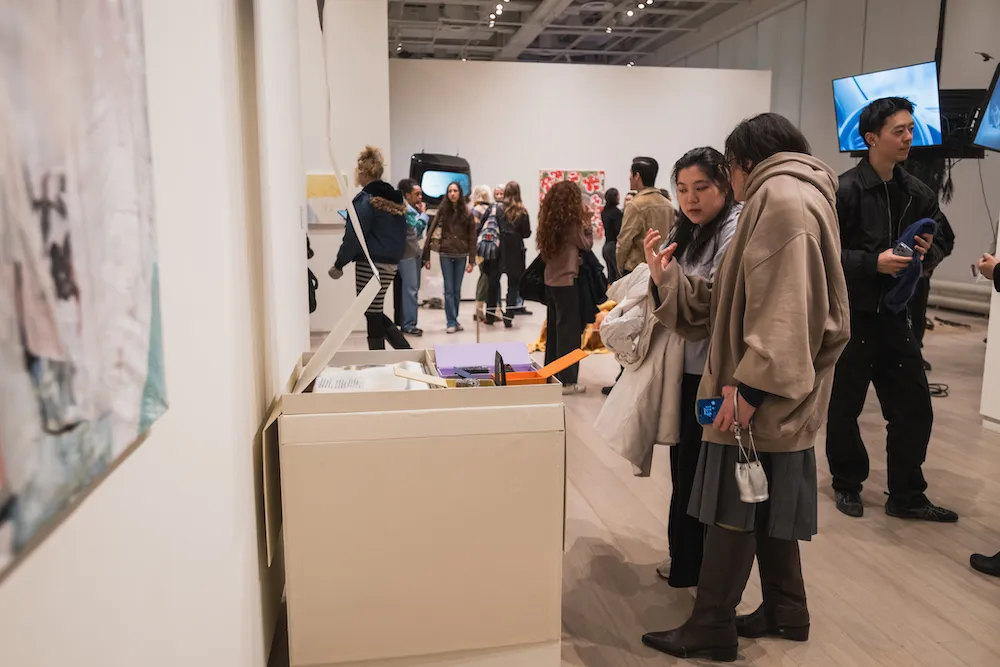
Instead of dancing, he entered the Lenfest Center for Arts and took the elevator to the Miriam and Ira D. Wallach Art Gallery. Across the walls, floor, and beyond the gallery, the Class of 2027 expressed themselves through image, text, sound, and performance.
Artists, friends, family, and neighborhood art appreciators chatted excitedly or immersed themselves in audio- and video-based works, entering a bathtub or someone's computer screen through headphones.
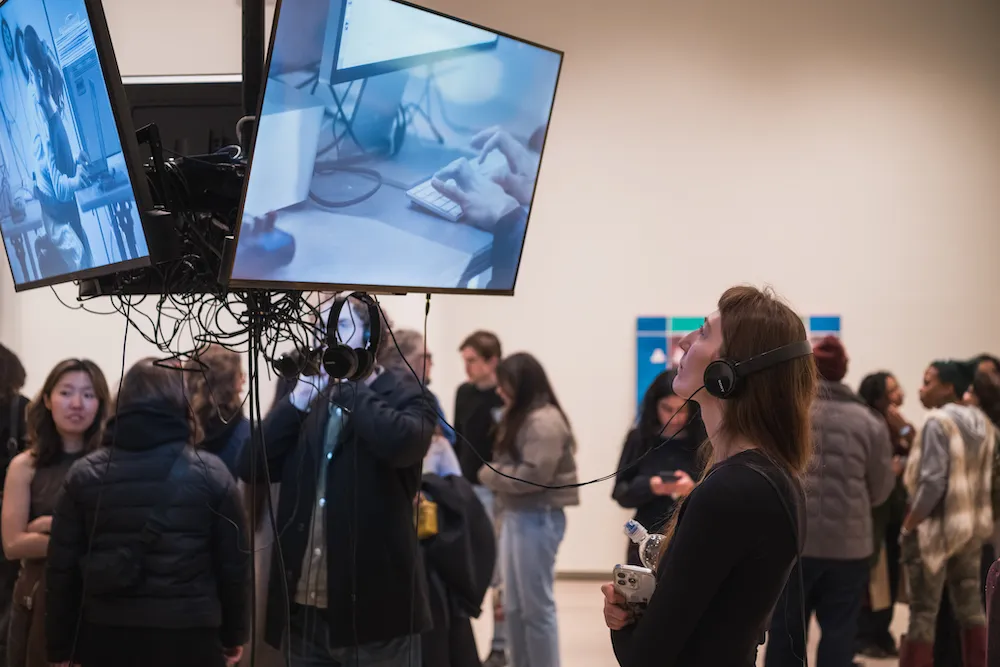
In Dayana Matasheva's Autofiction II (three-channel digital video installation, 2026), the perspective shifted from the player's point-of-view of a first-person shooter game to footage of their face in a calm, almost Buddha-like state of concentration—a rare memorialization of unnoticed hours passed online. "they scrolled into each other," flashed a white screen with black text at the bottom, "their algorithms clashed and shuttered."
Also dealing with autobiography was Self-Portrait of Queer Latina Licking ICE (machine-woven synthetic chemille rug and red cotton thread, 2026) by Natalia Neuhaus. Red thread spilled from the tapestry, pooling on the ground beside her video self-portrait, Blood Bath (single-channel HD video documentation of performance with color and sound, analog CRT television, handmade goat's milk soap, and Depression-era glass dish, 2026).
"In December, when I started thinking about what to do, ICE activity was starting to escalate, and I thought, I have to do something about this," Neuhaus said. "So I took some self-portraits of me licking ice because I’m Latin, and I’m a queer—so I was like, I’m going to melt ICE with my queerness."
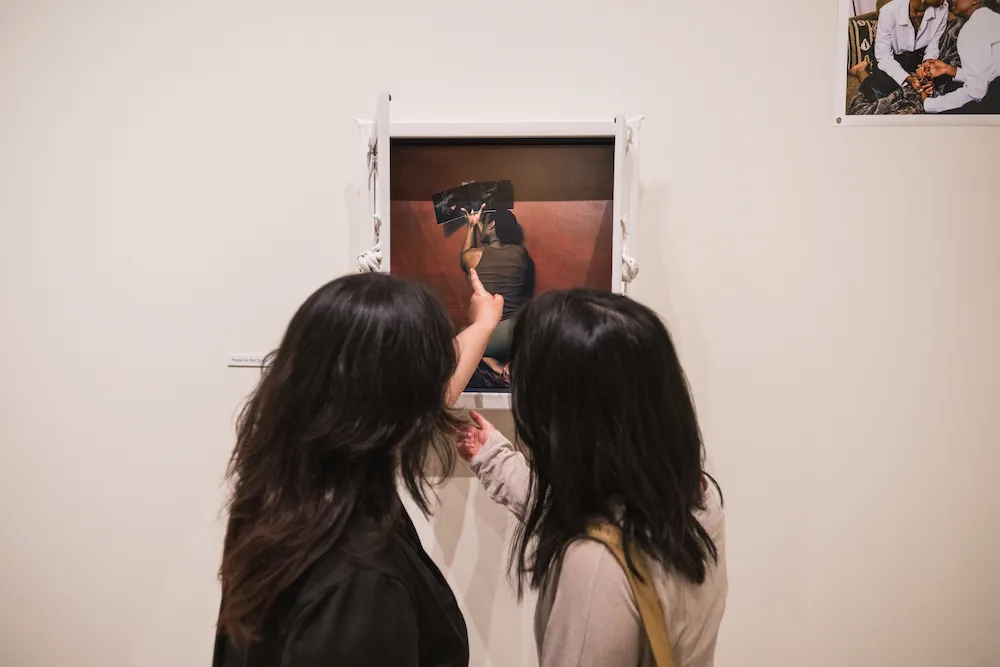
Mary Osunlana's Decoy (archival pigment print, reclaimed wood, and mixed media, 2026) questioned what we're seeing when we look at portraits. Framed by shutters made of mirrors, a print of someone holding a mirror to their face was first obstructed by my own reflection. Bodies reflected one another in elegant compositions.
Sparse, intentional color rubbed shoulders with abstracted, disproportionate figures in A'ssia (Ashu) Rai's brown paper painting (henna, gouache, gesso, tracing paper, brown paper, glue, found photography, and found painting on canvas, 2026) and Minji Choi's The Man, The Suit, and The Prince (each oil and ink on canvas, 2026). Alternatively, Becky Moon's Dream of the Wood (acrylic on canvas, 2026) was so detailed it became abstract. A cross-section of a log revealed colorful molecular compositions mirrored by equally intricate shapes on the outer edges of the canvas. A spiral shell glowed like a moon in the dark corner of the canvas; I was convinced the painting held an alchemical spell, if only I could decipher the lexicon.
Sculpture brought three-dimensional scenes of violence and regeneration into the gallery in the form of Sarah-Mecca Abdourahman's Meet Me in a Red Sea (fabric dye and bleach on fleece, oil and acrylic on aqua resin with plaster gauze, and fibreglass, 2026) and Jasem Alsanea's A Desert Blossoms from Rivers of Tears and Blood (wood, plaster, palm leaves, latex, pigments, polylactic acid, resin, sand and amaranthus, 2026).
Down the hallway, I followed Neta Moses's WindowTV (4K single-channel video installation with stereo sound, sound by Guy Moses, 2026) to the window, where the piece concluded as a banner on the overpass over Riverside Drive, a site-specific installation. "IN DARK TIMES BE THE SUN," it read in a bold black typeface. This year's exhibition began and concluded outside, in the space around the gallery—a reminder of the power of public art.
Another artist asked how long Moses planned to leave the piece up. "Until someone takes it down," she said. Low in the sky, the sun shone golden through the banner, on full view to the rush-hour traffic below.
The Class of 2027 First Year MFA Exhibition was on view March 28 through April 12, 2026.