Professor Adama Delphine Fawundu '18 Exhibits Globally in Three Kindred Exhibitions
Assistant Professor of Visual Arts Adama Delphine Fawundu '18 is currently exhibiting three interrelated works exploring the interconnectedness of geographies and our shared humanity—fittingly, these exhibitions take her work across the globe.
This creative outpouring includes solo exhibitions salt 17: Adama Delphine Fawundu at the Utah Museum of Fine Arts (UMFA), Praise House, up at the Harvey B. Gantt Center for African-American Arts & Culture in Charlotte, North Carolina, and a major installation in the 36th Bienal São Paulo in Brazil.
Praise House, curated by Dexter Wimberly, pushes geographic and disciplinary boundaries as it maps physical and metaphysical movements across Africa and its diaspora through photographic installation. Fawundu’s connections to the earth—and to the sacred materials it produces—grounds her connections across nations, to global kin.
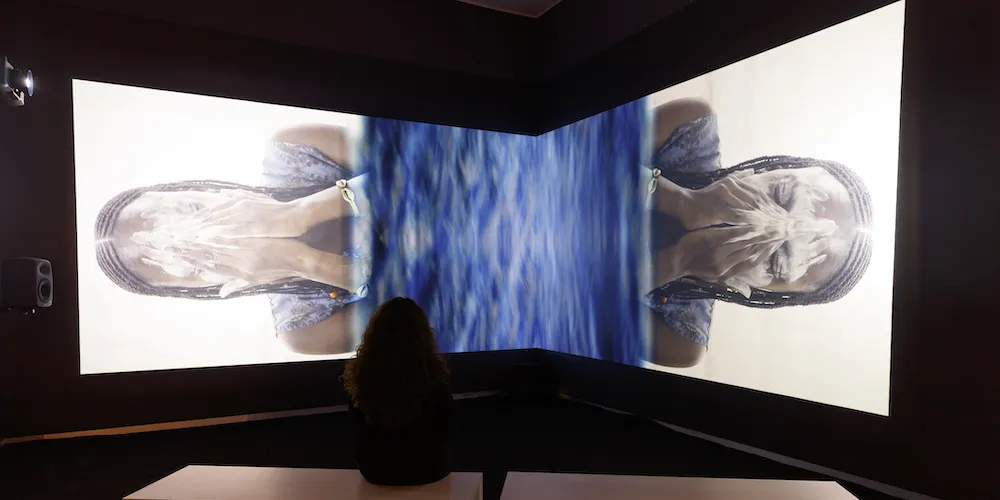
In salt 17, these connections are realized tangibly through the inclusion of objects from UMFA’s African art collection alongside Fawundu's "kpoto patchwok" pieces, a process named for the Mende word for gathering fruits and nuts (kpoto) and the Krio word for piecing together textiles (patchwok). Mirroring this work is her two-channel video, Vibrations from the deep, shot in Nigeria, Congo, Sierra Leone, Ghana, Cuba, Brazil and the United States.
Vibrations from the deep shares its sound composition with Fawundu's 36th Bienal São Paulo installation, Vibrations from the deep, May the hands of the miners roar, let’s chant, vamos canter, tiki toyemba: Florest e vida, O gigantic acordou, May the yams in the farm grow well. Olokun has no rival. Aṣẹ. Axé O!
"This installation begins with its title—an intentional weaving of voices, chants, and incantations," Fawundu said. "It references the labor of Congolese miners in Goma, the mass protests for policy reform in Brazil, and the deep wisdom carried through Ifá cosmology, which continues to resonate across the Diaspora and beyond." The installation gathers fragments, just as the title does, combining material ephemera from Fawundu's travels, textiles inspired by her grandmother, historical documents on Zumbi and Quilombo resistance, and everyday photographs from the streets of Kinshasa, among others.
"I thought about what it meant to have these videos transmitting into the atmosphere at the same time on two different continents," said Fawundu. "My research extends within and beyond the written archive—it is experiential."
For these three exhibitions, Fawundu immersed herself in the lands and waters along the Congo River, the Great Salt Lake, All Saints Bay in Bahia, and the Atlantic Ocean at the shores of Badagry, Nigeria. In her research, she connected the slow evaporation of the Great Salt Lake and the over-mining in both Salt Lake City and Goma, Congo.
"I think of the earth as many places yet essentially one body; disruption in one place reverberates across the others," Fawundu said. "How do we each do our part where our feet are grounded? Across the three exhibitions, each work carries traces of the others."
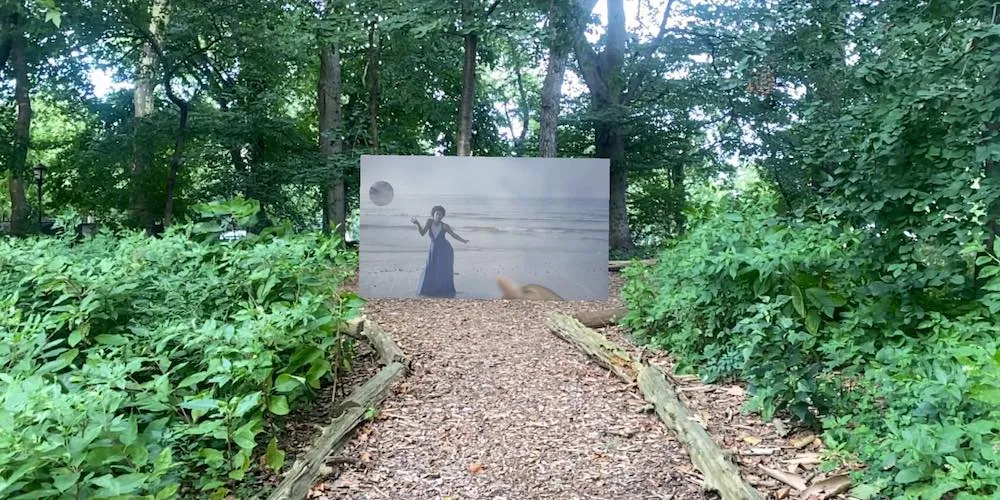
To push this idea further, she collaborated with a project of the São Paulo Bienal, supported by the company WAVA, titled Apparitions, to create site-specific virtual excerpts of these videos in Congo, Nigeria, Brooklyn, and Salt Lake City using augmented reality. In Brooklyn, echoes of Fawundu’s installation are viewable in Prospect Park via the free WAVA app.
If you visit the site, prepare to enter a reflective, meditative state of being. "I believe the works I am called to make are not just visual; they are vessels for ancestral energy, carriers of stories, and tools for transformation," said Fawundu. "Through intuitive making, I aim to create works that invite stillness, presence, and a return to the rhythms of the earth and spirit."
Adama Delphine Fawundu is a Brooklyn-born and based visual artist of Mende, Bubi, and Krim ancestry. She has exhibited works engaging with themes of ancestral technology and radical imagination internationally, including at the Congo Biennial (2025) and the inaugural Malta Biennial (2024). The co-author of MFON: Women Photographers of the African Diaspora, Fawundu is the recipient of numerous awards, including the Guggenheim Fellowship, New York Foundation for the Arts Fellowship, and the Rema Hort Mann Artist Grant. Her work is held in the permanent collections of the Brooklyn Museum, Princeton University Art Museum, Norton Museum of Art, and more.
Praise House is on view at the Harvey B. Gantt Center October 3, 2025–March 8, 2026. Fawundu's installation at the 36th Bienal São Paulo is viewable September 6, 2025–January 11, 2026, and salt 17 is up at the UMFA September 13, 2025–June 14, 2026.
For those in the New York area, there is another exciting opportunity to view Fawundu's work—and it might be on your way home. Sponsored by MTA Arts & Design, Ancestral Awakenings features work Fawundu created at Lefferts Historic House as Prospect Park Alliance’s inaugural artist-in-residence in 2024. Ancestral Awakenings is currently on view at the Atlantic Av-Barclays Ctr. subway stop (B/D/N/Q/R/2/3/4/5).
Adama Delphine Fawundu’s work at the 36th Bienal de São Paulo, 2025 © Levi Fanan / Fundação Bienal de São Paulo
Adama Delphine Fawundu '18, Apparitions, courtesy WAVA.
Adama Delphine Fawundu '18, Praise House, installation view. Photography by Christina Hussey
Adama Delphine Fawundu '18, Praise House, installation view. Photography by Christina Hussey
Adama Delphine Fawundu '18, Sîmba #1: feet grounded in the earth’s deep core, head crowned by a galaxy of stars—she sees: you are me, I am you, we are countless, yet one, 2025. Image courtesy of the artist.