The Class of 2026 MFA Thesis Exhibition Resonates Widely
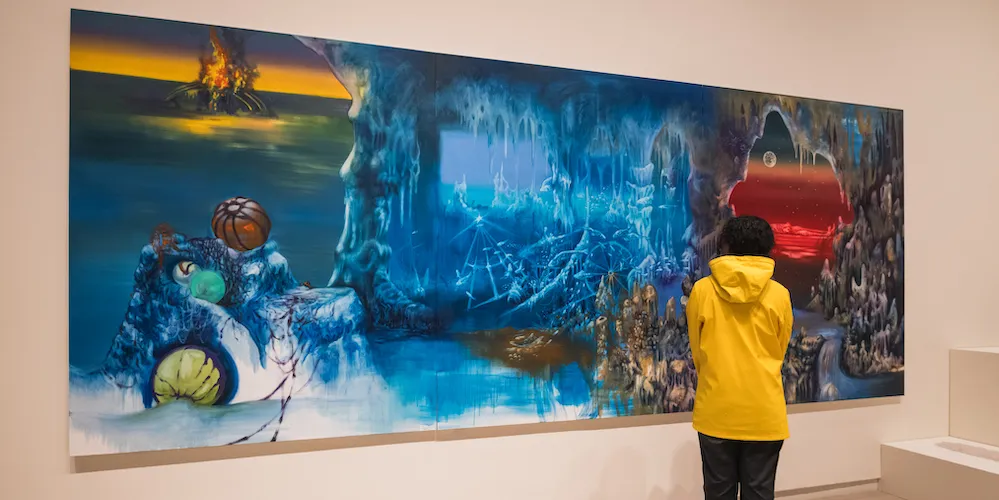
This past month, two floors of the Lenfest Center for the Arts have been bustling with artists, visitors, and performers. Curated by Amal Issa, the Sound Art + Visual Arts Class of 2026 MFA Thesis Exhibition comes to a close on Saturday, May 24, 2026. Before their work is dispersed in exhibitions across the international art scene, catch these 29 emerging talents in one of New York's favorite group shows.
"Insofar as," begins Issa in her introduction to the exhibition catalogue, immediately qualifying the artists within the bounds of their setting. "Insofar as all institutions are institutions of empire—and insofar as we are all its subjects—I invite you to consider the works in this exhibition." Throughout the exhibition, the graduating artists trace the emotional residue of diaspora, celebrate queer Black rave culture, and subvert the functions of everyday objects through sculpture, painting, drawing, video, sound, photography, performance, and installation.
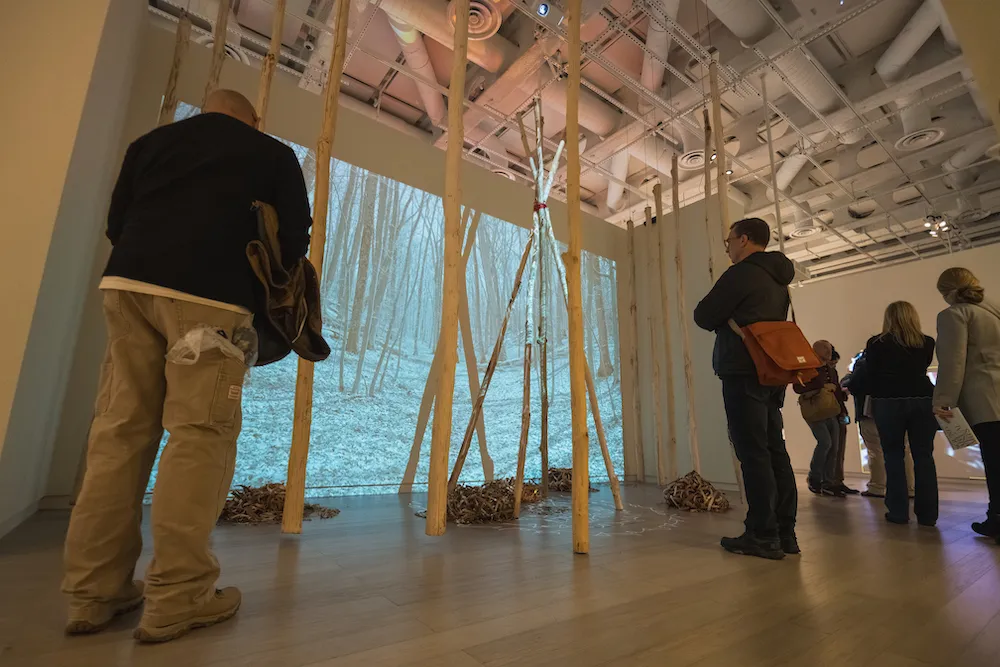
The show opens with darylina powderface, whose twelve components (amber and ash wooden poles, wood shaving bundles, satin ribbon, and my ancestor's stories, 2026) redefines the "materials" of the work as beings. An interdisciplinary artist and storyteller from the Iyarhe Nakoda Nation and Siksika Nation, she enlivens her sculpture with a projected video, also titled twelve components (multi-channel video installation with directional audio and digital video, and my ancestors stories; music by Sound Art student Ásalaus, 11 min. looped). In it, a dancer dressed in red—rhyming with the red ribbon that ties the wooden poles together—moves fluidly among a forest. A patterning of symbolic shapes, or maybe a sentence in a pictographic language, is projected onto the floor, dappling the wood shaving bundles like light through a canopy.
Ashley McLean utilizes a nook in a far corner of the gallery, painted deep blue, to immerse the viewer in the fragmented physical and emotional landscapes where memory resides. Between Reverie and Memory (single-channel video with four-channel sound; 6 min. 51 sec., 2026) is a photographic and video-based project chronicling the artist's return to Guyana after twenty-two years. Cicadas trill over her grandfather's voice; two small boys attempt to pick up a humungous coconut; cows trot down the road, followed by headlights. On the walls surrounding the video installation, archival pigment prints that work exclusively with natural light celebrate the deep, bright colors of clothing and infrastructure, as well as the dimness that seeps into the edges.
Opposite the gallery from McLean is Youkyoung Cho's video installation, 19450815 (single-channel video with color and sound, custom-built platform with ramp and seating, mirror, postcards from North Korea, pin spotlight, and cast shadows, 15 min., 2026), an ambitious film which stares down the barrel of history and dares to reconstruct it. Campy, yet not without genuine emotion and intimacy, 19450815 restages an "independence" festival that creates an opportunity for defection from North to South Korea, collapsing the aesthetics of celebration and violence. "But handcuffs can only lock two hands," says the narrator, as the arms of many dancers spread like rays of sun, or a Hindu goddess, behind a woman clutching her baby.
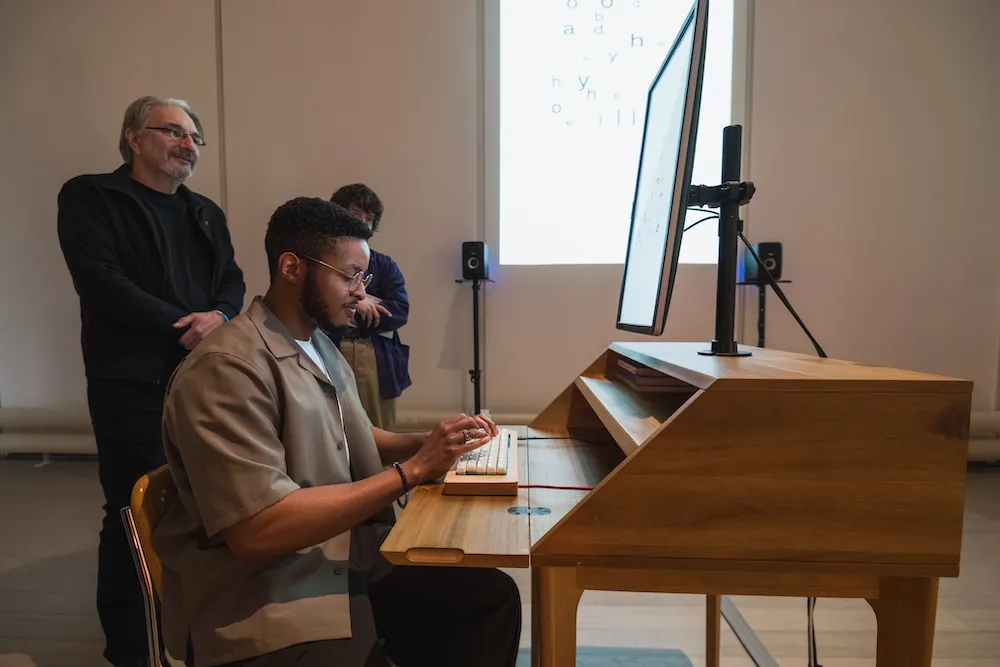
Miguel Gallego, a Sound Art student, immerses the viewer in an encounter, as well; in this case, it is an encounter with language, and the sounds it produces. "Visitors are invited to interact with this artwork," reads the placard for Compositions for a new writing machine (printed circuit boards, microcontroller, mechanical and tactile switches, found furniture, monitor, and software). Above the placard is a small desk and chair, outfitted with a clicky-clacky keyboard and a monitor. On the wall to the left is a projection of the monitor, accompanied by two large speakers. Typing is considered as a set of gestures: the keys appear as typographic symbols as well as musical notes; the force with which a key is pressed and time it is held down alter both the timbre of the note and the size and shape of the symbol. While visual artists have considered handwriting as an expressive gesture, Gallego's apparatus was inspired by his early struggles with penmanship, and therefore, lengthy relationship with the keyboard. For Gallego, sound creates an opportunity for (in the artist's words) the "intrinsic expressivity" of typing—the hesitant pauses, frustrated backspaces, and fervent clattering that reflect the thought process of the typist—to be represented.
Fellow Sound Art student Ásalaus's work earth fragments (wild clay, stoneware clay, copper wire, magnets, and electronics) considers the expressivity of earth through homemade speakers fashioned from clay. Seismic activity occurs in overlapping chimes, clangs, and quavers. Meanwhile, Jasphy Zheng interrogates how bodies interact with art in a performance piece titled 70 stools and 11 performers (installation with intermittent performance, 2026). When I visited, one performer sprawled facedown in front of Alejandro Valencia's Interregnum (2026), a laser-cut piece of drywall that read "THE OLD WORLD IS DYING." Another dragged a stool over to study Christine Miller's collection of 19th and 20th century racialized ephemera in Whiteness and Blackness 36 (wood, mirror, acrylic paint, ephemera, and books, 2026). Somebody else arranged themself in a high plank, feet propped on the wooden surface of Yeji Cho's Homeland in Another's Skin (wood, steel, motor, sensor, and sound, 2026).
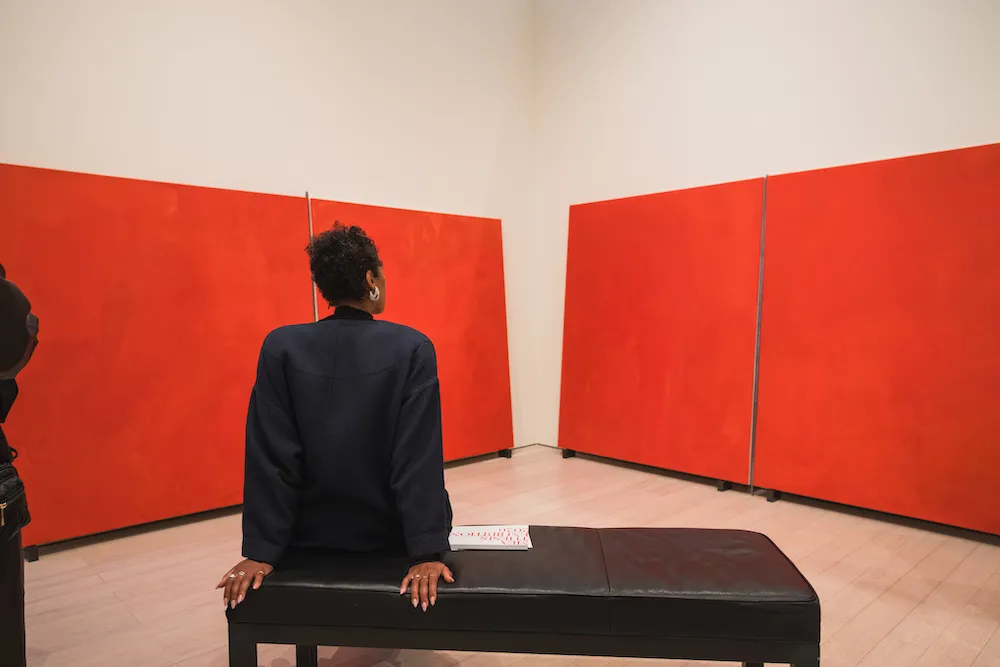
Ghostly images reward close looking in the paintings of Sarah Huffard and Michael Igwe. At certain angles, the shadows and highlights in Igwe's massive red paintings reveal themselves to be figures in various states of embrace. While Igwe's work illustrates the oral folklore passed down to him by the Annang tribe in Akwa Ibom, Nigeria, the subject of Huffard's three untitled oil paintings seems to be attention itself. Appearing at first as blank white canvases, pale blue and yellow marks emerge like patterns of light and shadow lacing a wall in the late day. Adjacently, Iris Wu activates the blank wall of the gallery in cross-outs (archival pigment prints, gelatin silver print, nails, tape, staples, wire, rope, and salvaged objects, 2026). Square-inch prints and porcelain miniatures are strung up and hung with wire and twine, making a delicate map that traces the viewer's engagement. Traces time—our willingness to test the distance.
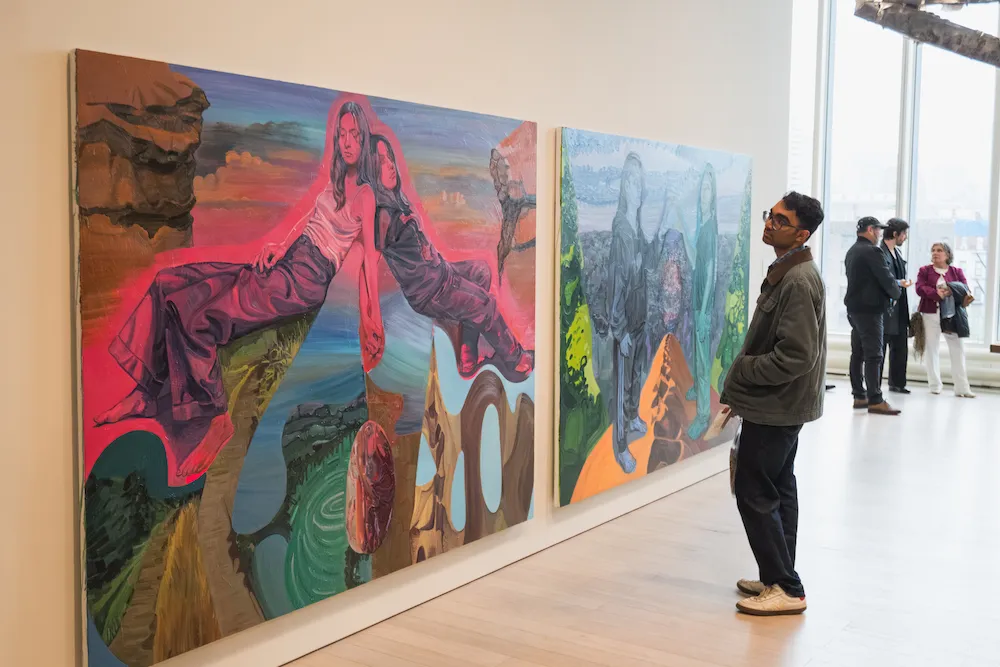
The two floors jam-packed with artwork test the limits of human attention. Yehwan Song's sculptural imagining of internet-driven mass psychosis sprawls maze-like; the institutional tiles of Soomin Kang's surreal playground invite a misplaced nostalgia; Sound Art's Alek Green breaks language into its elemental parts—in huge, colorful sculptures that could accompany Kang's work in a jungle gym for artists interested in the aesthetic qualities of functional objects. Each artist has brought their particular confluences of identities and aesthetic sensibilities to the work. An empire, university, or gallery, is made up of individuals, and the blank spaces—the resonances—between them.
You are invited to bring yourself and your potential resonances to the Class of 2026 MFA Thesis Exhibition at the Lenfest Center for the Arts through Saturday, May 24, 2026 at 6 PM.