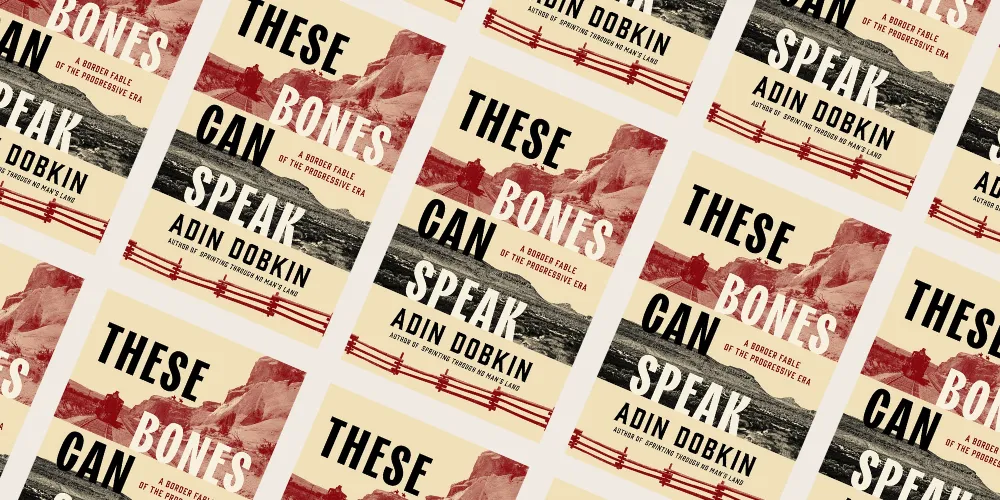
In 1919, Tejano legislator José Tomás Canales had gathered evidence of the Texas Rangers’ violence against Mexican workers and small landowners. Yet when the moment came to confront two leaders who had allowed that violence to flourish, he failed to call them to the stand. In These Bones Can Speak, forthcoming from Little A on January 26, 2027, Writing alum Adin Dobkin ’20 investigates the forces behind that decision, as well as the political system that constrained Canales’s pursuit of accountability.
Drawing on investigation transcripts, newly uncovered archival documents, and the material record of the border itself, Dobkin situates Canales’s struggle within a multigenerational history of the Texas-Mexico borderlands. A descendant of a New Spanish ranching family, Canales was shaped by a changing world of land dispossession, labor conflict, radicalism, and reaction that also gave rise to the Rangers’ power.
The book follows a family’s claims to land, its losses, and the violence its members witnessed while examining competing ideas of property, labor, and freedom. Through J.T. Canales’s story, Dobkin presents the Rangers as a political instrument sustained by a system of racial capitalism, tracing how that system enabled state-sanctioned terror and limited the possibilities for reform.
Aziz Rana, author of The Constitutional Bind: How Americans Came to Idolize a Document That Fails Them, called the book “a remarkable achievement,” praising Dobkin’s ability to weave Canales’s biography together with centuries of border history and an account of the Texas Rangers’ lawlessness and violence.
“Beautifully told and deeply humane, the book is a gripping reminder of how cycles of state violence have shaped the lives of the border’s most vulnerable, and the consequences of failing to account for past injustice,” Rana said.
Although Dobkin began researching the book after graduating, he credits his Columbia education with helping shape its form.
“Though I started research after my time at Columbia, the book's formal considerations were influenced by the teaching and learning I completed as an MFA student,” Dobkin said.
Adin Dobkin is a writer and journalist born in Santa Barbara, California. His work has appeared in The New York Times Magazine, The Atlantic, The Paris Review, and Los Angeles Review of Books, among other publications.
These Bones Can Speak is available for preorder through Bookshop.org, Barnes & Noble, and local bookstores.