This Is Who We Are: Professor Bette Gordon
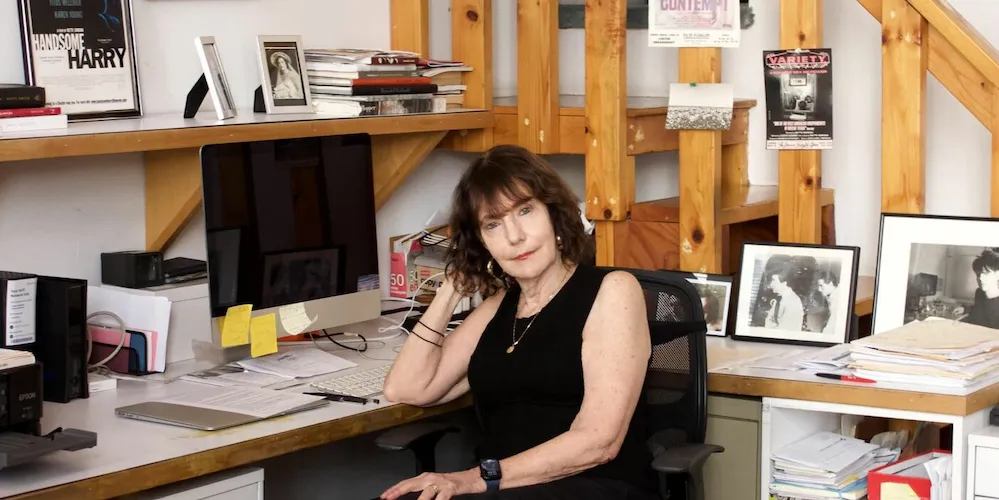
As I sit down to interview my first Directing professor at Columbia University, Bette Gordon locates me in the mind map of her classroom instantly. "You always sat at the back, to the right," she says. Three years have passed since that moment, yet she never forgets where a student sits—just like a scene she never stopped watching. "Well, we both know I am a very visual person," she says with a small laugh.
Perhaps this is simply how Bette Gordon lives—everything is footage.
Gordon traces her relationship to images back to the first time her father placed a tiny camera in her hands. He guided her as she looked through the viewfinder and told her to find a frame. When she had, he said, "Now hold your breath," right before she pressed the shutter. For a young Gordon, that singular moment must have been (literally) breathtaking.
Gordon was attending high school in Boston, Massachusetts when her French teacher gave her a surprising assignment—to see a movie in Harvard Square at the Brattle Street Cinema, a beautiful cinema that showed arthouse films, classical works, and everything in between. The film was a repertory screening of Jean-Luc Godard's Breathless (1960).
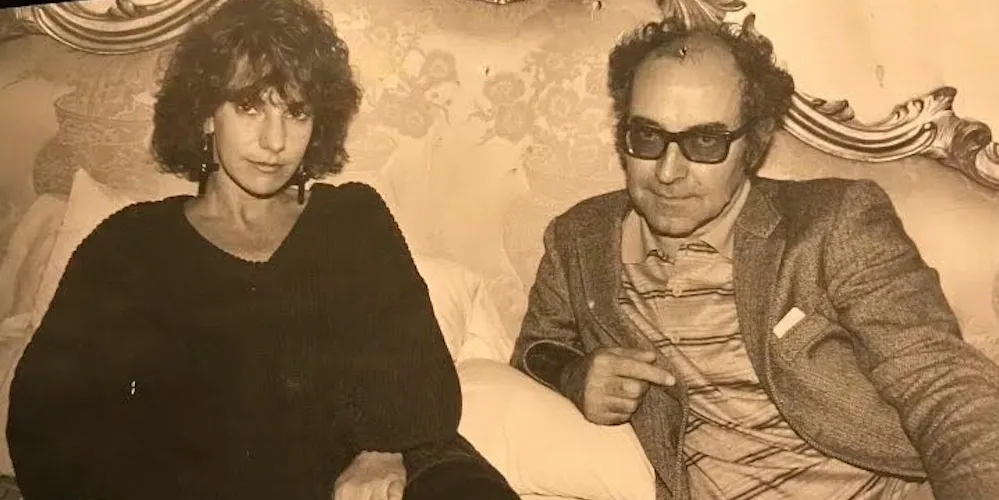
"I think forever is a moment," she says, and that was one of them. A young Gordon walked out of that theater, completely mesmerized. "The camera gliding through the streets of Paris in a way I had never seen before, it was full of life," she recalls—the loose camera, the upending of convention, the way it integrated both filmmaking and literature, Hitchcock and Hegel. When she stepped outside, the sun was setting over Harvard Square and Gordon remembers thinking, "I am going to live in Paris, inside that movie."
As fate would have it, Gordon ended up in Paris to study art history, language, and literature soon after. But she found herself in Paris at a moment of rupture. The Vietnam War was at its height, the repercussions of the great student uprising of May '68 were in the air, and an entire generation was refusing to be controlled. "It was a life and a challenge, and we stood up to authority. Perhaps that is why I’ve always encouraged my students to push back and ask questions," she says.
Far from home and away from the comfort of friends, Gordon found herself going to the cinema often. "I loved going to the cinematheque where something I had never seen would be showing," she says, films by Fritz Lang, Jean Renoir, Rosellini, Orson Welles, Alfred Hitchcock, Howard Hawks, Agnes Varda, Truffaut and Godard, Jacques Tati, and so many more. "So in a way that was my education," she says. Later, a friend suggested they take a formal class in cinema.
Taught by a writer from the well known Cahiers du Cinéma, the class was, of course, in French. Mise en scène was not yet the familiar term she would later carry into her own classroom. What she was learning, really, was a new grammar—the idea that beyond the script, the actor's performance, it was really the composition, the visual elements within a frame that convey meaning, a kind of visual subtext, creating an emotional response in the viewer.
In class, Bette made it clear to us that "it is not only the story that is being told, but the manner of telling. The job of a director is to control the viewer’s attention, to induce the viewer to look at certain parts of the frame at certain moments. By controlling the composition, the Mise en scène, the director is able to provide information about the world of the story and the characters." As a teacher, she asked us "How do we look? How do we see?"
When Gordon returned from Paris to The University of Wisconsin-Madison, she began making her own films. Around this time, she discovered experimental cinema. More related to painting and poetry, it offered a way to re-evaluate cinematic conventions. She asked herself, what are the unique aspects of the film medium? Time and space. So as a filmmaker, she made films that explored the way we perceive an image and how the camera alters that perception. Working on an optical printer, she would shoot a roll of film, and then copy and slow it down, frame by frame. "I would copy one frame sixty times," she says, "and then the next frame, sixty times"—slowing motion down to its very bones, then overlapping those groups of frames to create her own pulsation and movement. "I thought if I could understand the technology then it would become a force of its own." It was painstaking, obsessive, and entirely hers.
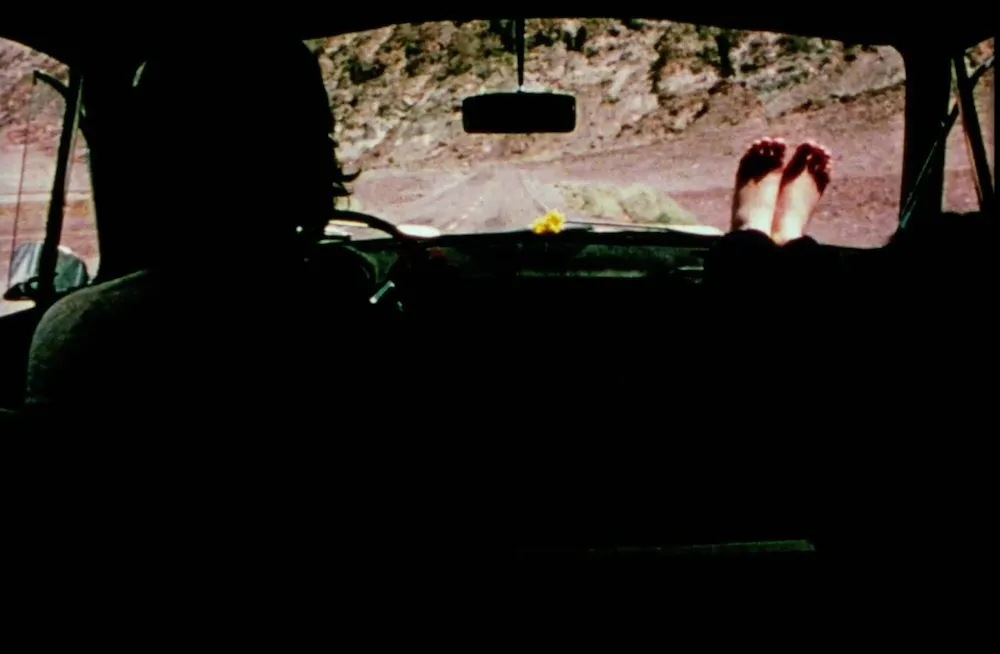
Back then, Gordon was collaborating with her then-boyfriend, James Benning—now a professor of film at CalArts. Together they made three films, one of which was called United States of America. Gordon had just bought her first car, a $300 Volkswagen squareback. They bolted a piece of wood in the back of the car, attached a Bolex camera with a motor to it, and spent fourteen days driving from New York to California. The camera never moved. What changed was everything outside the windshield—the landscape shifting coast to coast, the back of two young filmmakers' heads, a red shirt swapped for a blue one. All the small details of color, space, time, and movement telling a story of their own.
When I ask what propelled her to experiment in these ways, she leans forward in her seat. "I just wanted to know," she says. "What would happen? What would happen if." I see in her the same aliveness I remember from her classroom—the kind that was so contagious it made you lean forward in your seat too. She takes a moment, then settles into an answer. "Curiosity. It's the premise by which I live—that the questions are often more important than the answers. But exploring what those answers could be is a life in and of itself."
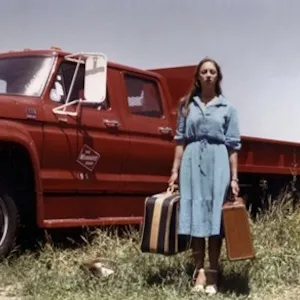
When Gordon was leaving the Midwest and coming to New York, she made Empty Suitcases—a fragmented story about a woman who cannot make up her mind about where to stay, moving back and forth between New York and Chicago. "Making Empty Suitcases," she said, "felt like a film in the process of making itself. I conceived the film one scene at a time. It is an episodic mediation on the idea of displacement for women, not being able to find one’s place." Gordon was really excited to put the pieces together like a puzzle and she didn't worry about a script. "Because I shot the film over a long period of time, I never had one single actress play the main character. With each new scene, I would ask a different friend to step into the role. I would just ask—will you carry a suitcase out of a train station? Will you lip sync the words to All of Me by Billie Holiday in my bedroom?" she says. So, in a way, the character in the story was a woman, or many women at the same time.
It is the kind of film that could only be made with a complete disregard for convention—something Gordon has continued to embrace in different ways. It bleeds into how she teaches. Why do you need that? Says who? Who cares? Gordon slips seamlessly between speaking as a filmmaker and speaking as a teacher, as though the two have never been separate. "I've never done anything else other than make films and teach filmmaking, and they go together. I mean, they're the same," she says. "Each time a student brings a creative problem to me and we’re discovering it together, that moment is so gratifying for me because I continue to learn. And I always say the day you stop learning is the day you are not alive anymore."
When Gordon describes the New York she arrived in, she describes an energy that was electrifying. New York in the late seventies and early eighties was a different city entirely. "What drew people like me to downtown NYC was the spontaneity and drive, as well as the clubs, with punk underground bands, places full of artists, filmmakers, poets, and writers. There was a common urban sensibility, a raw grittiness." When Gordon moved to Tribeca—where she still lives today—there were very few people living in these huge lofts that at one time were used for manufacturing. There were no shops, no restaurants, just warehouses, some of them squatted by young artists, hooking up electricity between buildings, inhabiting the spaces until the city had no choice but to recognize them. "You didn't need to be professional," Gordon says. "You only needed to have the drive. People borrowed equipment from each other, showing the films they were making by creating their own viewing spaces. We were our own audience, there were no rules, just a sense of exploration, fun, and empowerment."
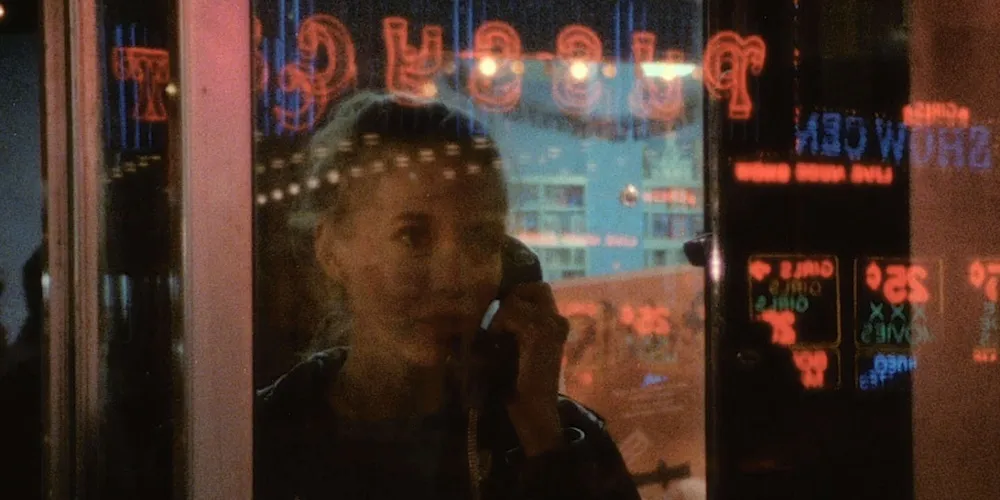
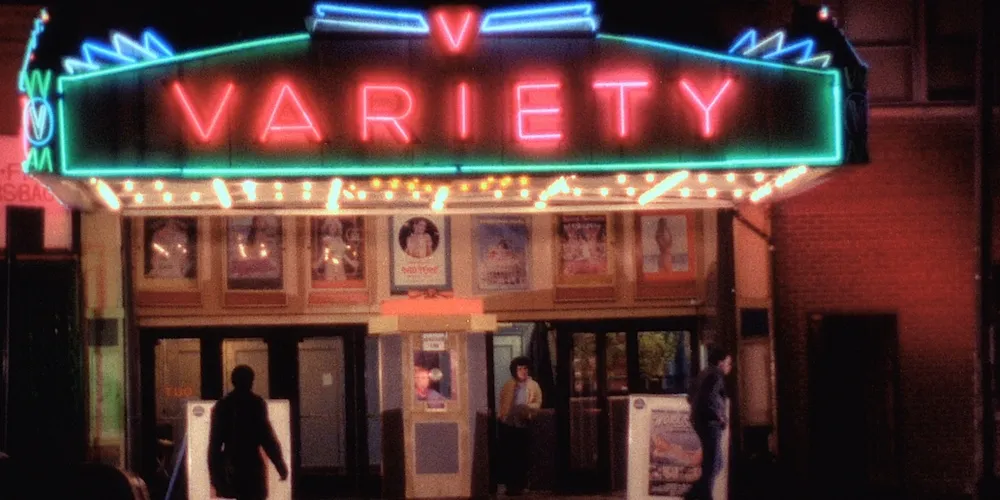
One night, as Gordon walked home at two in the morning, something stopped her. In the distance, she saw a cinema she had never seen before, lit up in dazzling blue and red and green neon. It said: Variety. There was a freestanding booth out front, and as Gordon got closer, she realized that it was a porn theater. "I just couldn’t stop looking," she says. "And I became fascinated by the questions that arose. Who is looking at whom? Who has the power in this situation?" For Gordon, it was the perfect location to invite the viewer to turn voyeur, in both watching the woman in the booth and watching with her. She had always been interested in film noir, and she thought about reversing the conventions by empowering the female in the booth to become the investigator, transgressing the limits of her situation, and turning the male into the enigmatic figure and object of her gaze.
Those questions became the driving force of Gordon’s indie film Variety (1983). Variety is a film about looking. Gordon used frames within frames, windows, and reflections to visually capture the idea of looking and being looked at. Pornography offered her a way to explore this and to see what it had to say about desire, and what kind of fantasies it mobilized. Variety was invited to the Cannes Film Festival and was nominated for the Camera d’Or, and the film paved the way for her to continue to make feature films, including Luminous Motion, Handsome Harry, and her most recent film, which was bought by Netflix, The Drowning.
When I ask Gordon whether she knew that Variety would cement her place as one of the defining voices of American independent cinema, she says "I didn't know. I didn't know at the time. I didn't think about any of that. That's also what I want my students to learn—is to not think about anything other than the joy and the fun of exploration. Make your film because you want to make it, not because you have to make it."
For me as a young filmmaker, there is something both inspiring and humbling to know that what Gordon carries with her from that period isn’t the recognition, but the spirit in which the film was made—that untethered, unbothered freedom that comes from making something entirely for yourself. "If I succeed, I want to succeed on something I wanted to explore," she says. "Even if it doesn't work—at least I know it's authentic and I followed my instincts." She still tells her students the same thing. "Block out the voices. You have your own voice, right or wrong. What matters is that you made the film you dreamed of making." She wants them to remember to bring themselves to the table and trust that it will be enough.
I ask Gordon how she deals with doubt. "There's not a day that I don't have it," she says. "Like anybody. But you have to put one foot ahead of the other and have your blinders on, not looking too far to the right or the left. Because everyone has their own path. You can't let the 'no's' stop you," she says, "because there's always a way. It might not be exactly the film you wrote, but you'll take something from that and make it into something else. That's being an artist."
Gordon tells me that, at heart, she believes she is a teacher because she loves being able to share what she knows to inspire others. She says that no matter what else is happening in her life, when she enters the classroom, "I come alive. Maybe the latest film project I've been working on has just fallen through and I am devastated, but I know I still have something to give my students." For the next three hours, nothing else matters to her but the filmmakers sitting in the classroom.
It is perhaps the most quietly radical thing about Bette Gordon—that in a world increasingly driven by markets, careers, algorithms, ‘proof of concept’ shorts, and the noise of other people's lives, she has always simply followed the joy of playing, experimenting, asking questions, and daring to embark on a journey that might answer them. "Creativity is a gift," she says. "And we all have it."