This is Who We Are: Minhal Baig
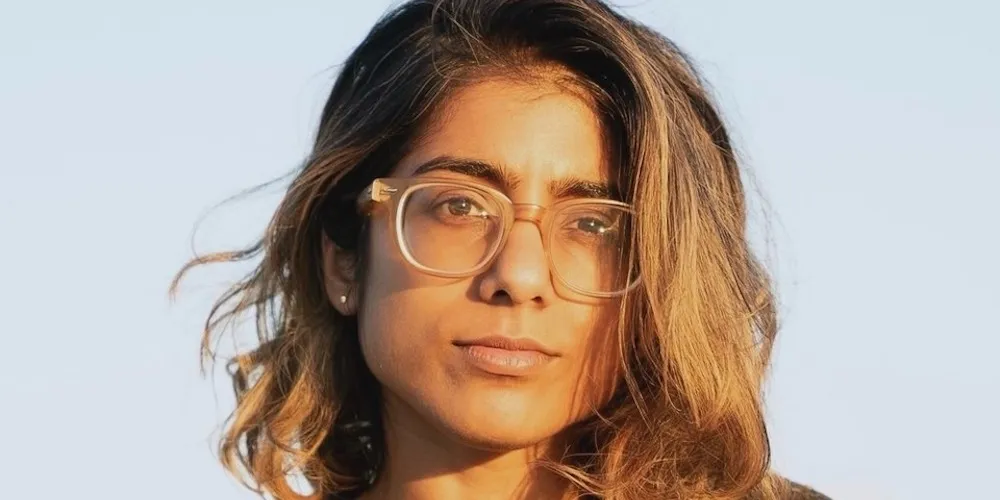
This Is Who We Are is a series featuring Columbia University School of the Arts’ professors, covering careers, pedagogy, and art-making. Here, we talk with Assistant Professor of Film Minhal Baig about the persistent miraculousness of filmmaking, finding process through practice, and blowing it all up.
Minhal Baig, who joined the Film Program as Assistant Professor this Fall, didn't study filmmaking in a graduate program.
"I grew up wanting to tell stories, I just didn't realize what medium it would take until much later in my life," Baig told me. In undergrad, she focused on painting and playwriting. It wasn't until she was out of school that she saw how these two interests—storytelling and visual arts—could come together through film.
"I was always writing, all the time, but filmmaking—directing, producing movies—didn't seem like a thing that was attainable because I didn't really understand how movies were made," she said. This seems to have been only a minor roadblock for Baig. Her first feature, Hala, which she began writing in undergrad, premiered at Sundance in 2019 and was subsequently released by Apple.
Baig came to filmmaking because she had a story to tell, and film seemed like the most accessible medium to share that story. "Hala came from a sincere desire to explore coming of age through a particular lens—to explore what it was like to grow up with my immigrant parents while wrestling with my own identity."
Though Baig now has three careers in film—independent filmmaking, TV writing, and teaching—she still marvels at what she gets to do for a living.
Making a film is a long process. Each time, she told me, "is like going up to bat and having one chance to really share something personal, something that makes me feel vulnerable, and something that also justifies the time and energy of all the people involved for years and years."
But all that pressure results in something profound. "When you step outside the bubble for a moment—and it truly is a bubble that gets to make movies—it truly is exceptional and rare to be able to convince hundreds of people to make this thing that you wrote in your parents' house, in your bedroom. And they spent millions of dollars on it. And then you got to go to Sundance—that's a crazy thing to be able to do!" she said with a laugh.
Baig doesn't take the process for granted. While painting may seem more immediately gratifying, Baig credits her experience studying visual arts for her appreciation of the more methodical, time-consuming stages of filmmaking.
"We'd make our own canvases: stretching it over the bars, sanding it, priming it, doing the underpainting, doing the studies," she explained. "I actually found that all that time leading up to the painting was very necessary. All that preparation led me to something that was better than my original idea. And in filmmaking, it's very much the same, though that process is so much longer."
For Baig, the longest—and often most arduous—phase of the process is screenwriting, which she has been teaching at Columbia. Though it can get overlooked for the more fun, social phases of filmmaking like directing and producing, Baig has a special place in her heart for the writing process.
"It's difficult because you have to sit with yourself, and sit with discomfort, and sit with boredom. You have to sit with an idea, which sixty percent of the way through, you hate—and then you have to find your way out of it—through it—to the end."
Yet, on the other side of discomfort is transformation. "Writing has actually become my favorite part of the process," Baig told me. This was not hard to believe, as she hopped on our zoom a couple minutes late, apologizing, "when I'm writing, I experience time blindness."
As a teacher, Baig emphasizes process over product. The classroom is a space of experimentation and exploration—"the goal is to write something that you are excited about and feel transformed by; the goal isn't to make something that everyone in your class likes"—Baig reminded me. And having a regular, committed practice is what makes that process possible.
A committed writing practice doesn't have to mean isolating yourself at a desk for hours every day. Writing can be social, too—Baig expressed that writing for shows like Criminal, Bojack Horseman, and Ramy functioned as a sort of informal screenwriting education for her. Sharing work, receiving feedback, and rewriting is the basis of the "well-oiled machine" of writing for television. If this sounds a lot like a graduate school workshop, it's because it is—on steroids. In the end, the script is rewritten by the showrunner. "Then you can learn from what they changed—it can be a very humbling experience," Baig said with a grin. "I highly recommend it."
When I asked Baig what she learned between her first feature, Hala, and her latest, We Grown Now—which premiered at the 2023 Toronto International Film Festival and was released by Sony Pictures Classics—she turned her attention back to her unofficial graduate program: "TV writing is pretty essential to the writer that I am today."
Her experience in writers' rooms led Baig to have a heightened awareness of the audience when she wrote We Grown Now, a story about two boys growing up in a Cabrini-Green high rise whose lives are irrevocably changed when a tragedy shakes their community. "Prior to my last film, I worked in this very internal way…And it's not about how close I am to the material—this last one was so personal to me," said Baig, who grew up in Chicago in the 1990s.
On the contrary, Baig wants the audience to feel as close to the material as she does—sharpening her skills as a writer doesn't mean compromising her creative vision, but clarifying her ideas. "Everyone, at a certain point in the process, has to come onboard and believe in the vision," Baig said. "Before, I was really writing for myself, and I still write for myself, but I am so much more aware that I am, at the end of the day, turning this in to someone who really needs to understand what I'm trying to get across."
Balancing your creative vision and the imagined audience's opinion is no easy feat. Baig's advice for her students? "You're not a studio filmmaker yet. You're here to explore your own voice. Make the work that matters to you."
Do we need to go through "the gymnastics of landing that one piece of dialogue?" Baig asked a theoretical student. "Let's review this whole scene—even its placement, its existence—is that where you need to be spending your time and energy, or do you need to blow this up?"
A glint in her eye when she asked this led me to believe she thinks you should blow it all up.
"No one's rushing out to the bookstore to buy your script," Baig cautions her students. By this, she means don't be precious—a script is only a blueprint for the film.
Baig knows this from personal experience. "It happened on both of my last two films," she said matter-of-factly. We Grown Now lost a plot line that was entirely embedded in the script: "You're making two different movies," an executive told her. "You have to pick." The executive was right, Baig said—she was trying to combine the movie she wanted to make with the movie she thought would appeal to a wider audience. "I realized, I don't want to do that. I want to make the movie I'm genuinely excited about." So she started over, from page one.
A similar situation occurred when she made Hala: at first, the plot centered around a romantic relationship, but after receiving feedback on the script, Baig realized it was the relationship between the protagonist and her parents that she was really interested in—which made for a significant rewrite going into production.
"That always happens to be the case," Baig said. "The part that resonates with other people is also the part that I'm most excited by—the part that drove me to make the film in the first place—and there's some block, some reason that I'm not fully exploring it."
Blowing it all up isn't just about letting the work transform itself, but letting yourself be transformed by the work, Baig told me. "This last feature I made was so transformative. I don't think I could ever go back to the person I was before I made that movie, and that's kind of a crazy thing to say about your own work."
This is the reason why Baig makes films, writes for TV, and teaches screenwriting. "It's the thing that we're constantly chasing—for the work itself to be the fulfilling piece, not the validation or getting into film festivals or the critical reception—for the work to do that."
If that's the result of blowing it all up, I think it's well worth it to toss out the first draft—whether that be a script, a painting, or an article—and start again. And again, and again.
Minhal Baig's latest feature, We Grown Now, was awarded the TIFF Changemaker Award and Audience Award at Chicago International Film Festival and received Best Picture, Best Cinematography, and Best Editing nominations for the 2024 Independent Spirit Awards as well as NAACP Image Award nominations for Outstanding Independent Motion Picture and Outstanding Youth Performance. Sony Pictures Classic released the film in 2024.
Baig had a two-year overall writing-producing deal in television with Amazon, was a 2022 Sundance Momentum Fellow, and participated in the 2022 WGA Showrunner Training Program. She has served as co-executive producer on Criminal, story editor on Bojack Horseman, and staff writer on the Peabody-award winning half-hour comedy Ramy. Baig's work has been supported by fellowships and residencies at Yaddo and The Black List, and she is a member of the Academy of Motion Picture Arts and Sciences.