This is Who We Are: Dean Sarah Cole
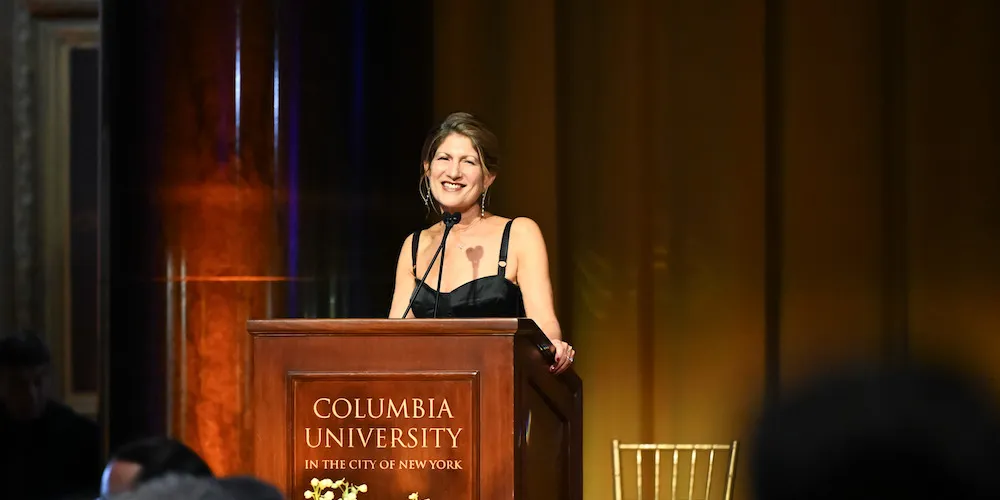
This Is Who We Are is a series featuring Columbia University School of the Arts’ professors, covering careers, pedagogy, and art-making. Here, we talk with Dean of the School of the Arts and Parr Professor of English and Comparative Literature Sarah Cole about the importance of an office coffee machine, free speech in the arts, and H.G. Wells.
When Dean Sarah Cole first came to the School of the Arts as an interim dean, one of her first decisions was to bring a coffee maker into the office so she could offer some small hospitality to anyone visiting. Soon after, she established open office hours, so any member of the School of the Arts community could find a time to sit down with her and share their thoughts and experiences. Once she transitioned from interim to our official dean, she spearheaded the first school-wide alumni reunion in a decade, not just to gather old friends and celebrate the School of the Arts' 60th Anniversary, but also to offer some strength.
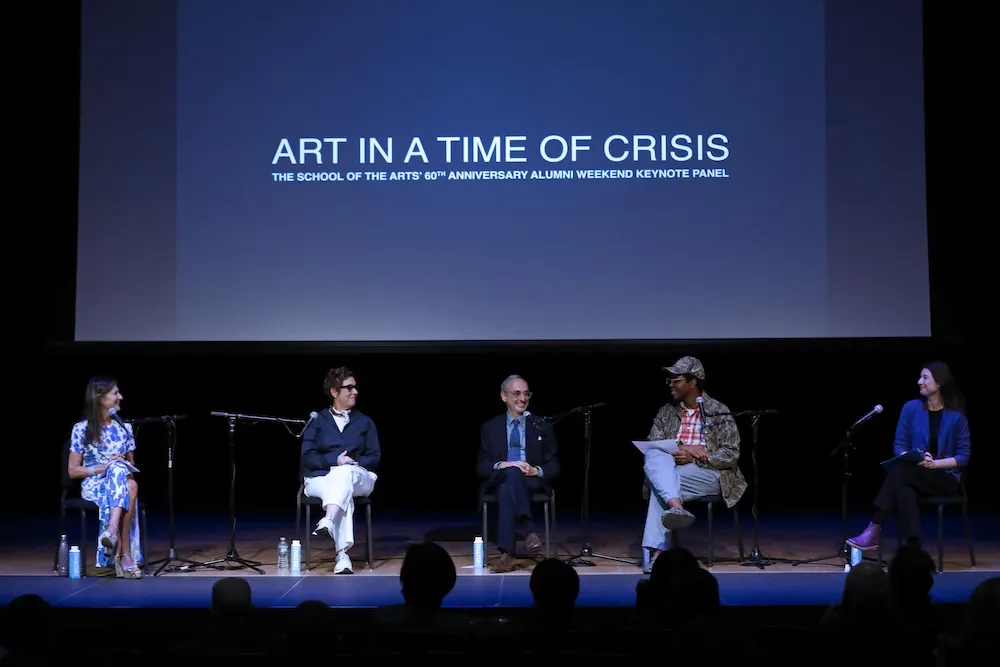
"We're in a very tough moment for arts and artists, and we have been for a few years in a tough moment at Columbia," Dean Cole told me in her office on a dark winter afternoon. "I—and not just me, but all the wonderful collaborators [and alumni] who planned this weekend—we all agreed that, in addition to celebrating the achievements of our graduates and having a fun weekend together, we should offer some programming to meet this moment." The opening panel, moderated by Cole, gathered Professors Gary Shteyngart and María José Contreras Lorenzini alongside celebrated alums Lisa Cholodenko '97 and Hugh Hayden '18, to discuss the momentous challenges, responsibilities, and opportunities of artmaking in a time of crisis. A lunchtime conversation centering free speech in the arts featured prominent graduates and affiliates of Columbia Law, including Fabio Bertoni (JRN '95, LAW '97), who acts as general counsel for The New Yorker.
"We are very devoted to the essential principle that creative artists need to be able to create freely. They need to be able to speak their truths, to be able to buck the trend, whatever that is. It's our job to provide the encouragement, the atmosphere, the teaching, the community, to allow that," Cole said.
"We are very devoted to the essential principle that creative artists need to be able to create freely. They need to be able to speak their truths, to be able to buck the trend, whatever that is. It's our job to provide the encouragement, the atmosphere, the teaching, the community, to allow that," Cole said.
Cole has a reverence for ambitious art, ambitious kindness. She is motivated by her "deep conviction that art matters," she said. "When I've said a few times in these last few years, 'it matters more than ever,' that may sound like a cliche, but that doesn't mean it's not true."
Cole does difficult things voluntarily, and with a good attitude, like running every day in the park and taking the helm of a major arts school in a moment of great tension and scrutiny. In her role as the steward of the School of the Arts, Cole must balance her vision of what the school could be with the pressing, daily needs of the institution.
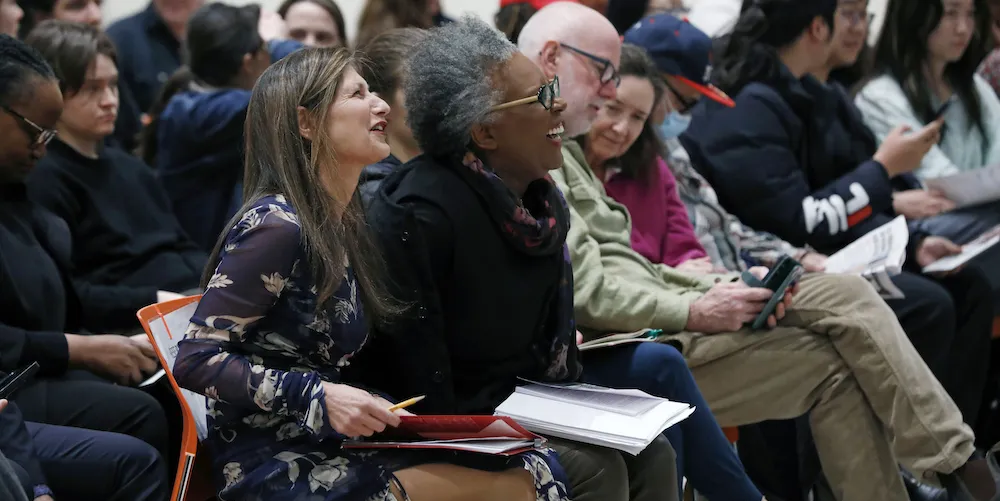
"Trust is the most important thing in academic leadership; and we see what happens when it's eroded, " Cole said. "That's not taken for granted. I believe very strongly that our faculty will be thoughtful, and generous, and gracious, and trusting, as they have been; and I owe them—along with the students and the staff—to try to make good on these goals that we share. The School of the Arts is such a strange, heady mix of unbelievable, dazzling excellence with incredible need. And it's really that mix that is the motivator for me."
Cole faces the capital needs of the school head-on: the upkeep of centuries-old buildings and offices, improving spaces for students and faculty, and particularly providing for student financial aid. "My dream is to make this school affordable for every single student who would want to come," she said. "I feel the responsibility to try to ensure a better financial future for the school. I feel that every single day."
As with carving a path in becoming an artist, achieving this goal is not linear. Cole must draw from every resource she has, as well as imagine new opportunities for support. At her core is a sense of duty to her community, the faculty and students. "Sometimes it's stressful. It's also extremely motivating," she said. "There are lots and lots of things that go into fundraising. Sitting down with a potential donor is a tiny part of that. A lot of it is about building up the visibility of the school and trying to reach new communities and trying to work with all of our different offices on different kinds of outreach and communications. And, frankly, enhancing the excellence of the school with hiring and with supporting our great faculty, that's really where it's all going to come from."
Cole, who is also the Parr Professor of English and Comparative Literature, joined Columbia's faculty in 1999. Before she came on to helm the School of the Arts, she chaired the Department of English and Comparative Literature and helped to lead the Faculty of Arts and Sciences as the Dean of the Humanities. As the Dean of Humanities, she founded Columbia's Humanities War and Peace Initiative and partnered with the Climate School to develop a new pedagogical initiative in Climate Humanities. Now, Cole continues to use her decades of experience reaching across institutional lines to find solutions and opportunities. "I'm collaborating with the faculty and with other staff leaders in trying to develop a spate of new programs, curricular programs, degree programs," she said. "These new programs are very exciting, and allow us to continue bringing new kinds of students doing all kinds of creative work into our School in the future."
"I'm collaborating with the faculty and with other staff leaders in trying to develop a spate of new programs, curricular programs, degree programs," Cole said. "These new programs are very exciting, and allow us to continue bringing new kinds of students doing all kinds of creative work into our School in the future."
As the Dean of the School of the Arts, Cole is working with the School of Engineering on bringing an art stream into their Masters in AI. She's in dialogue with her partners at the Climate School, and working within the School of the Arts' Writing Program to incorporate opportunities to study science writing, medical humanities and narrative medicine. Cole is also developing connections with institutes and centers that host visiting artists to bring the arts together across Columbia's campus. And, of course, there's the task of fundraising, recruiting new donors who believe in the importance of the arts, while working with many generous people who have supported the School in the past.
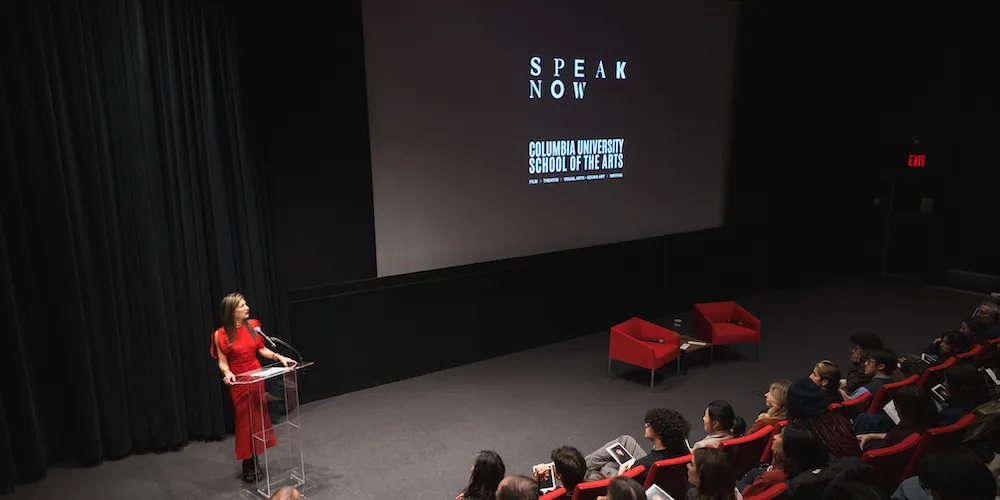
To bolster these initiatives, Cole believes in raising the profile of the School of the Arts, making sure that our powerhouse alumni and the acclaimed professors that mentor students get the spotlights they deserve. One way she's done this is through helping establish public arts events that bring prominent alumni back to campus and into conversation with the local community. In 2024, Cole launched Speak Now, a series of talks featuring artistic luminaries—alums like Celine Song '14, Claudia Rankine '93 and faculty like Theatre Professor Emeritus David Henry Hwang and his collaborator, director Leigh Silverman—that consistently pack the Lantern at the Lenfest Center for the Arts with Columbians and community members. Speak Now brings us all together to consider not just the legacy of the School of the Arts, but to celebrate the art our community has created. Sometimes, that art is even on display for the community to appreciate. To celebrate the 60th Anniversary of the School, Cole and the Office of Public Programs and Engagement worked with prominent founder of performance and video art Joan Jonas '65 to hang large-scale reproductions of her drawings from the ceiling of the Lenfest Center for the Arts lobby. The special exhibition, titled Joan Jonas: Moving Off the Land II (Excerpts) was extended due to popular demand and welcomed guests to the building for over seven months in total. "[The exhibit] allowed us to achieve this set of broader goals for the school, including having beautiful art visible to the public, and to Columbia, to every single person who walks in and out of that building," Cole said, "and to elevate our alums in our community, to introduce them to new generations of people who might not know their work."
To meet the current moment, Cole might suggest H.G. Wells as a guide. In addition to her considerable responsibilities as an administrator and teaching professor, Cole is still a committed educator. Last semester she taught a seminar on the visionary author, who she was awarded a Guggenheim Fellowship to study in 2014, and on whom she wrote a book, Inventing Tomorrow. Now she is working on a book to define a new genre of novel, the "protest novel," which grew out of her work on many 20th century writers, including Wells. "He was one of the great imaginers from the twentieth century," Cole said. "He believed that literature is there to make changes in the world now—that the novel could be an activist, interventionist genre or form." Wells could imagine how the world should be, and dedicated his life and talents as a writer to helping others see and enact that potential. "Even if Wells was very flawed in some ways as a person, what I learned from Wells is to see the many artists out there who want to make change now," she said.
Cole's day to day is filled with listening—to faculty, to students, to alumni. In addition to her office hours, which she holds as often as her schedule allows, Cole regularly hosts concentration meetings with each of the School of the Arts' 17 different fields of study, from film directing to painting to poetry. She asks them questions: What exactly is going on in their concentration right now? What do they need? What are the problem issues? What's something exciting and new that's happening? How can she help? Their answers shape priorities and strategy. "You really see the diversity and specificity of each of these units," she said, "and then you also see where there are certain kinds of things that cross over." Many artists are interdisciplinary, and Cole works with them to build connections across concentration lines. "That's the sort of special magic of the school," she said, "the breadth of the kind of work that we do here."
In Cole's research abstract for her 2014 Guggenheim Fellowship, she opened with a quote from Wells that inspired her study: “In diverse forms and spirits we are making over the world,” Wells wrote in 1933, “so that the primary desires and emotions, the drama of individual life will be subordinate more and more, generation by generation, to beauty and truth, to universal interests and mightier aims. This is our common role.”
While Cole wouldn't so narrowly prescribe the role of art in society, more than ten years later she is still interested in artmaking as a force and harbinger for change. "It's a very generous project to be an artist," she said. "I find [the School of the Arts] an inspiring place in every way. I find the students inspiring."
"It's a very generous project to be an artist," Cole said.
"When we as a society get stuck in certain mindsets, configurations, ways of thinking, and ruts, the arts help us to see differently, think differently, reorganize how we understand the world. They're there to offer a different perspective and a different way to experience the world, experience your own humanity, experience the humanity of others. So it's essential, though not always easy or comforting.
"We [at the School of the Arts] have to stand for that, and we want to stand for that, and that's why people come here to study."