This Is Who We Are: Blair Singer
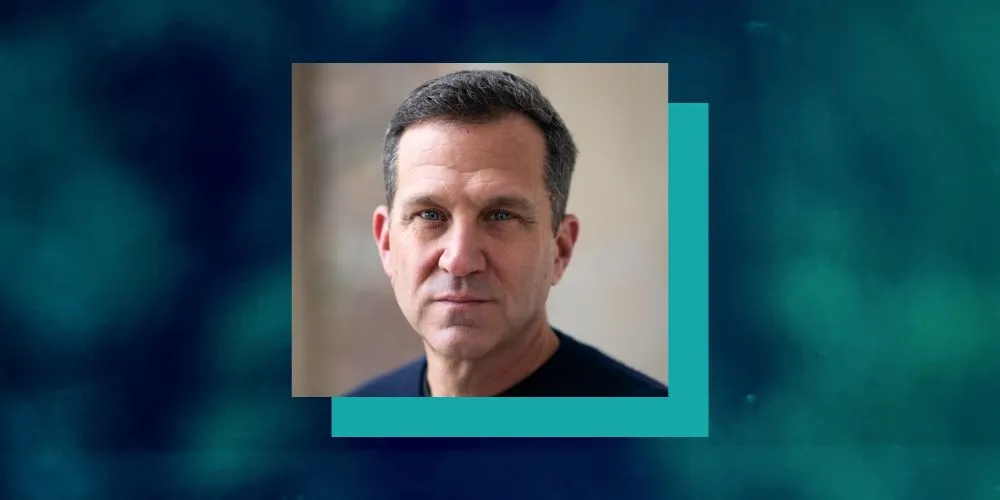
This Is Who We Are is a series featuring Columbia University School of the Arts' professors, covering careers, pedagogy, and art-making. Here, we talk with Associate Professor of Professional Practice in Film and Theatre Blair Singer about his transition from acting to writing, the necessity of preparing students for the industry, and the relationship between teaching and practice.
“I was born in Long Island, but I grew up in Los Angeles, in the valley, before it became Kardashian,” Associate Professor of Professional Practice Blair Singer tells me. It’s two weeks away from the end of the Spring semester and we’re sitting in his office on the sixth floor of Dodge Hall. While I’ve never studied with Singer—he teaches screenwriting across the Theatre and Film Programs, including in the Film Program's Writing for Film and Television Concentration launched in 2022—I’ve had the pleasure of chatting with him in passing. He’s the type of professor who can’t help but take interest in the people around him.
Singer’s foray into the arts started with acting. After his parents divorced, he found community in his school's theatre program. He enjoyed it enough that he went on to study it in college at UCLA. Arriving there, he hung out with people who would later be associated with The Actors’ Gang, an experimental theater group based in Culver City, whose members have included people like Jack Black, John C. Riley, and Helen Hunt. His friends often discussed a talented young actor named Michael Stuhlbarg who had left UCLA for a school called Juilliard. Singer had never heard of it. It seemed mysterious. “Hearing these guys talk about him, guys who I really respected, talking about this guy that they really respected, I was like: well, if that's the best place, then I have to go there.” He dropped out of school and spent a year preparing to audition. He got in at the age of 20.
While a student at Juilliard, Singer “learned in opposition,” pushing back against his professors. “I was really immature, but surrounded by people who were really focused on being actors and teachers that were very serious about the craft. Now that I'm a teacher, I realize how frustrating that can be…I'd rather somebody take it in, try it on, and then put it back up on the rack if you don't like it. I didn't know it at the time, but [my teachers] were really drilling a discipline into me that I wasn't taking."
After graduating, Singer acted professionally with gigs in LA, with the Shakespeare Theater Company in DC, a summer at HUMANA Festival of American Plays in Louisville, Kentucky, and a role on Law and Order where he had to track down a body (“somebody had to do it”); but acting was not Singer’s sole ambition. Though he wouldn’t have called himself a writer, he wrote plays as a student at Juilliard, the first of which was directed by his classmate Carrie Preston, now known for her work on shows like The Good Wife and Elsbeth. One day, while acting in a play, he showed his director a script he’d been working on. The director took interest and decided it was a project worth pursuing. After working closely on the script for a few months, the play got selected for a reading series at Manhattan Theater Club, organized by Professor of Professional Practice and head of the Dramaturgy Concentration Christian Parker, who at the time was MTC’s Literary Manager. “That was [what] I needed to say to myself, that I could be a writer, because I didn't grow up with writers…it wasn't in my worldview that that was something I could do,” says Singer.
While Singer’s involvement in the reading series landed him an agent, it altered more than just his professional life. A play by the writer Courtney Baron—currently an Adjunct Assistant Professor in Columbia’s Film Program—was also selected for the series. It was a piece about hunting preserves in Texas. Singer read the script and was amazed. “I didn't know people my age could write like that. And so I reached out to her, and we had coffee, and, you know…” Singer paused before saying, nonchalantly, “we’ve been married for 20 odd years.”
Around the time of the reading is also when Singer started to teach, which he did at summer camps and a summer program at Stanford. He was figuring out if this was a viable and meaningful way to make a living. He fell in love with teaching when he started working with DreamYard Project in the Bronx. As part of the project, they’d put artists in public schools for year-long residencies. There he taught slam poetry and theater and acquired mentors who taught him that teaching wasn’t about power, but service. “That really clicked for me, that those who can must teach. It was something that really allowed me to get over my ego.”
At the same time, Singer started to become interested in television. “Six Feet Under was popular and [creator and producer] Alan Ball had hired a lot of playwrights. I was getting married and I knew I needed to make money.” Singer was hired to write on a show called The Book of Daniel, starring Aiden Quinn and Ellen Burstyn. “I don't know how many aired. I think we shot eight [episodes], maybe four aired. They dumped the other four. It was actually a very realistic start to my TV career.”
Singer’s early years in television were complicated. Unaware of implicit hierarchy, Singer often spoke over his more seasoned colleagues. He hadn’t had anyone to teach him how to act in those rooms. “I had to learn by making a lot of mistakes. One of the reasons why I wanted to teach at the graduate level was to save people some time and to not make mistakes that I made.”
Now, Singer teaches pilot writing to playwrights, screenwriters, and directors. When I ask Singer what it’s like to teach across departments, he responds by telling me about his overall approach to teaching. “My friend [producer and television writer] Michael [Sardo] says [artists are] small business owners; we're entrepreneurs. In the morning you make your table, but in the afternoon, you have to bring that table to market and find customers.” While Singer is quick to tell me he believes, firmly, in the art of his work and the importance of an individual voice, he sees an arts education as a vocational one. “Sometimes film schools and theatre schools do a really great job with the making of the table, but not such a great job with taking it to market. Professional prep is a craft, just like how to write a good scene, how to write a good act, how to write a good play.” Singer focuses heavily on this professional prep in his teaching, because ultimately, Singer wants his graduate students to see themselves as professional people at the start of their careers. “My bark is really loud. I run a professional room, so you got to be on time. I lock the door if you're not there… but, if you talk to my thesis students, [they'll tell you] I cry all the time. I'm really soft. I'm really invested.”
While teaching has become a large part of Singer’s career, he’s still a working writer in the field. As he teaches his students how to conduct themselves, he too is working and reworking his approach to his profession. An exercise he swears by is having his students sit down and write a twenty-, ten-, five-, and then one-year plan. While explaining the idea, he pointed to a large piece of poster paper sitting in the corner of his office designated for this precise task. The idea occurred to him when a former student of his got engaged and started to discuss her wedding plans. “We backward-plan our weddings, but we don't backward plan our careers…if you're waiting for the outside world, you're not going to know what you're looking for.” In the exercise, Singer tells his student to be as ambitious as possible: lay out all your hopes, wants, and goals and slowly work to break down these goals into manageable, pursuable steps and thereby make the overwhelming haziness of ambition into tasks of daily living. “I think marching into the world without a plan is a surefire way, at least in this business, to go kaput. I don't want anybody to graduate without having their own target.”
There are few times in my life where I suddenly feel the need to race out of a room and start scribbling. Hearing Singer discuss this approach with such assurance and simplicity, I felt as if every moment of confusion I’ve ever experienced could be avoided. It’s not that he provides this suggestion to his students as a surefire way in which to achieve capital-S success, but to show that intimidation can be met with organization, pacing, and focus. It’s an idea both steeped in the whimsy of hope while also entirely practical. Taking every fleeting, passing idea, and putting it to paper makes the possibility of the hope that much more possible.
Towards the end of our conversation, Singer asks if I want to teach. I tell him I’m not sure. Probably not immediately. I need a few years away from school to feel I’ve acquired enough experience to share. Singer nods before plainly stating, “Your worth is more than your achievement in the arts.” I know this comes from a well-earned place—wisdom acquired from a career existing between doing and teaching. While still a writer filled with ideas, Singer sees his work with students as valuable as any professional or artistic achievement. Based on the sudden burst of clarity I feel from my conversation with Singer, I can understand why. By the end of our conversation, we've made plans to follow up after I complete the multi-year plan exercise. If I learned that much from an hour long conversation, I can’t really fathom what a semester’s worth of wisdom might produce.