This Is Who We Are: BK Fischer
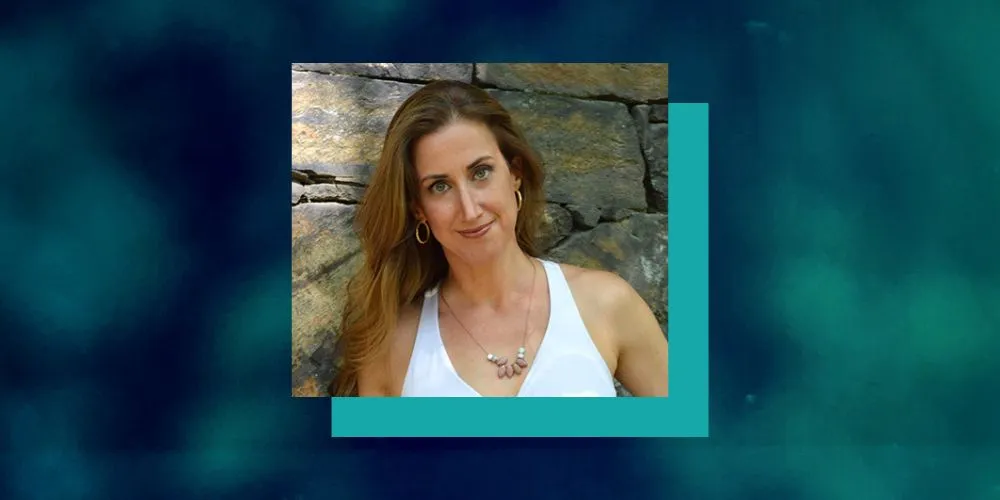
This Is Who We Are is a series featuring Columbia University School of the Arts' professors, covering careers, pedagogy, and art-making. Here, we talk with Adjunct Associate Professor of Writing BK Fischer '97 about cranberry morphemes, plasticity, and tap dancing.
Columbia Writing students don't have many mandatory courses. Before we graduate, we are expected to take a certain number of credits and a single lecture. If you're a Nonfiction concentrate, you take a research class. But, if you listen to gossip on the street, there is a consensus forming among students that one class should be required to graduate: Comma Sutra, led by Adjunct Associate Professor of Writing BK Fischer '97. The title might be a nod to Fischer's ability to make grammar sexy, but the course is more than a flashy Grammar 101. It's a workshop on the sentence level. Its students learn the terms that allow them to point out and name what elements are or aren't working in a sentence, a clause, a punctuation mark.
"I say it on the first day of class that, you know, I can drive a car. I can drive my Volvo. And I can, maybe, under the hood, identify three parts. Right? If I'm lucky. I know where the battery is, and the radiator thing or whatever. But I can still drive a car fairly safely," Fischer said. "But maybe there is something to be said, if I wanted to be a race car driver, with knowing a little something of what [auto] mechanics know about how an internal combustion engine works. Because then I'm trying to take the machine to its limits. If I'm trying to really push language to its edge and find its potential to create some work of art that does something new with the language that's never been done before, then maybe I do need to know how it's put together."
When Fischer first designed the course, her highest priority was to create a class teaching grammar that was low pressure, exploratory, come-as-you-are. "I try to establish right away that we're not talking about bad grammar versus good grammar," she said. "It's not even that you need to know [or adhere to] the rules as much as you need to be able to describe what you're doing."
The class draws from abundant materials—from cartoons to poetry—and Fischer's multimodal teaching style to cram in as much variety as possible. "I knew right away that I had a challenge because a grammar class could be boring as death. So I had to really make it interesting. There had to be a lot of tap dancing on the table," she said.
Sometimes, Fischer worries she has overshot, that the reputation of the class has become more entertaining than even possible. There are still discomforts, she insists, like sentence diagrams. If grammar is like the anatomy of language, Fischer, whose husband is a surgeon, compares sentence diagramming to medical school cadaver dissection.
"You know, [sentence diagramming is also] unpleasant and kind of torturous. You take apart things and look at the ligaments and the muscles and the different systems of language in a similar way," she said.
Fischer, who graduated from the MFA Writing Program in Poetry, has been teaching the class for over a decade. She was originally recruited by Writing Professor Timothy Donnelly '98, a former classmate of hers.
"The faculty had been wanting a grammar class. And the faculty had raised concerns that students didn't have sentence structure and [other] basic usage conventions under their belt. They didn't want to have to spend time in workshop doing that, understandably.
"It's not that people had bad grammar. They just didn't have language or vocabulary for talking about it," Fischer said. "So the whole class is just about applying a lexicon to an intuition. Just labeling grammar."
As an example, Fischer dug into parataxis and hypotaxis. "We all know what that is, and we all know the difference when we're reading anything instinctively, whether it's more paratactic or hypotactic, but almost none of us would have language for it.
"Sometimes hypotaxis gets called the periodic style versus the periodic style. Periodic is hypotactic. It lets you think about how Cormac McCarthy's style is very different from Henry James's," Fischer said. "And then you're like, well, wait, is Virginia Woolf using parataxis? Yes, but then she's kind of dipping hypotactic here when she goes into memory. James Baldwin is super hypotactic. These long, elaborate, dependent clauses, this incredible rhetorical restraint."
Students can then decide to lean into the drama of hypotaxis or the suspenseful, staccato rhythm of a paratactic sentence.
"You can't try a new experiment with a new variable if you can't name what the variable is," Fischer said. "You can't dig into that if you don't know the category exists. So it breeds curiosity.
"Is syntax style? Is that what we mean when we say style?" Fischer asked.
It's necessary to mention that part of the appeal of the class, for all its wonkiness, comes from Fischer's tremendous charisma as an educator. She is consummately generous: when scheduling our interview, she invited me to her home on the Hudson, on a quiet street in Sleepy Hollow (she was Westchester County's inaugural Poet Laureate). Fresh, washed blueberries and an assortment of cookies and crackers awaited on her kitchen island. She asked if she could get me something to drink, and brewed me fresh coffee with beans she picked up at the farmer's market. Her Goldendoodle is named Oakley. When she talks about the things she cares about—her students, her poetry, cranberry morphemes—she's animated with a contagious enthusiasm.
"The word cat is a morpheme. The suffix -ing is a morpheme," she said, describing the smallest units of language. "But there's a thing called a cranberry morpheme, which is a morpheme that only makes sense if it's joined to something else. So in 'blueberry,' you have two morphemes, and they both work independently. Black-berry, blue-berry, but what's a cran-? We don't have a cran anymore. Maybe there was a cran in the language—I'd have to go to the OED [BK's nickname for the Oxford English Dictionary]. Or, in 'twilight,' what's a twi?"
Her book of poetry Ceive (BOA Editions, 2021), which was a finalist for the National Book Critics Circle Award, emerged from her favorite cranberry morpheme. "You can receive or deceive or perceive or conceive," she said. "But you can't ceive. It's sort of a weird word."
Fischer's inspiration for the book came directly from Comma Sutra. "We were just geeking out on this weird linguistic thing, and then it turned out to kind of spark: what if I kind of brainstorm all the -ceive words? It's so interesting how things can cross pollinate.
"That's what we want to happen, all of us, around the table on Tuesdays. We want things to just start zinging and buzzing and coming out with these ideas of what we can generate from the sparks of language. What can we flint?"
It's not a coincidence that Fischer is a poet. She uses a lot of poetry in her syllabus because "poetry has a lot of exposed reaction surface," she said. "You see a lot of the breaks and the rips and the parts are easier to get close to." Her singular, honed point of view is, above all, what makes the course so friendly, so beautiful.
"I talk about languages having both instrumentality and plasticity," she said. "So instrumentality is how we use language to get messages across. We communicate ideas. We get things done with language. We make promises. We do all kinds of things with words. Language is instrumental.
"And then there's the plasticity, which is the way language is made of sounds and ink on the page or sticks or syllables or sound waves between here and there, or a shout from across the room or the prosody or the rhythmic element. So the material aspects of language, its plasticity. Its stuffness. We can be concerned with language the way an abstract painter is concerned with paint. Not just for its ability to represent a tree."
In her own education at Columbia, Fischer is stunned at her good fortune to have been taught by and to have learned alongside such luminaries as the former Head of Poetry and Professor of Writing Lucie Brock-Broido '82, U.S. Poet Laureate Tracy K. Smith '97, Professor of Writing Timothy Donnelly '98 and Mary Jo Bang '98. Comma Sutra's focus on close reading, considering how exactly a sentence is put together, is influenced by a class Fischer took as an undergraduate at Johns Hopkins with Judith Butler. "How is this put together? Is this dash right here creating an abyss of sense or something? How is language fracturing at this semicolon, to create this rupture or balance or whatever it is?" Fischer asked, remembering Butler's line of questioning. But when offering her own students advice, Fischer defers to the art nun, Sister Corita Kent, relaying the teachings of John Cage: "There is no win and no fail. There is only make."
Our interview wound down when her husband came home from his shift at the hospital. Their goldendoodle, brimming with enthusiasm, could no longer be contained in the backyard. We gathered the plate of cookies and coffee mugs off the table in Fischer's bookshelf-lined office where we had been talking and brought them into the kitchen. On the short drive to the train station (Fischer took me in her family Volvo) the eastern shore of the Hudson River passed on our right.
During Fischer's tenure as the Poet Laureate of Westchester, she led ecopoetics classes for young people, called the Floodwaters Workshops. They visited sites of flooding and flood risk in the county, which included great portions of the riverbanks near Fischer's home. Fischer's latest book, Disaster Porn, forthcoming with BOA Editions, emerged from the direct studies in the Floodwaters Workshops and in Comma Sutra, the contradictions and multiple signifiers within language and the world we inhabit. "Words don't always point in one direction," Fischer said.
When Fischer dropped me off at the train station, she asked me to let her know when I got home safe. Old wooden poles poked out of the river near the train tracks. In the late afternoon sun, their reflections in the water stretched long, both a mirror image and a shadow. I imagined Fischer and her Floodwaters students looking at the same beautiful view, in some earlier season, wondering how long until the river entered their homes, or if it would again, looking at the river, asking themselves how to solve this problem, and not finding an answer, but in art, perhaps, a way forward.