Professor Elizabeth Ramírez-Soto Co-Edits Special Journal Publication on Guerrilla Archives
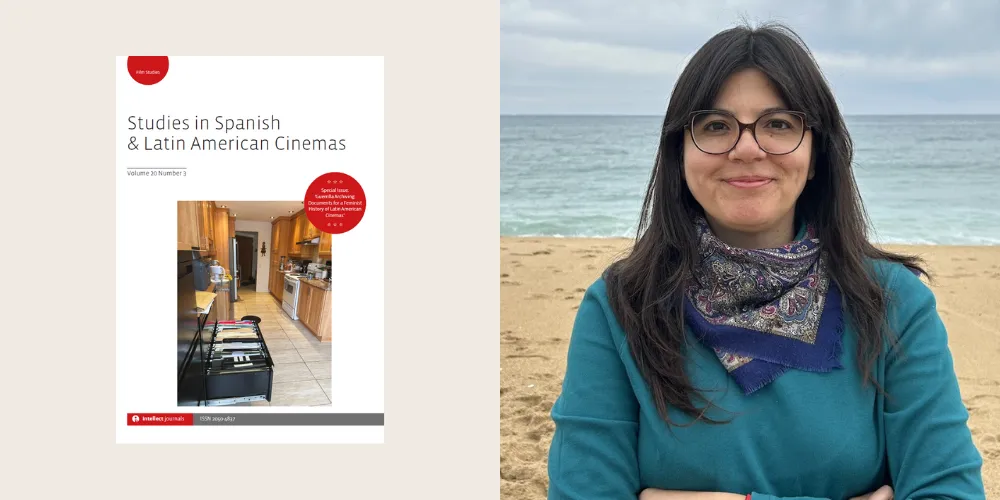
Associate Professor of Film and Media Studies Elizabeth Ramírez-Soto recently helped co-edit and co-publish a special edition of the Studies in Spanish & Latin American Cinemas journal: Guerrilla Archiving: Documents for a Feminist History of Latin American Cinemas.
Ramírez-Soto and her colleagues at Red de investigación del Audiovisual hecho por Mujeres en América Latina (RAMA)—a network co-founded by Ramírez-Soto of those who research women in Latin American cinema—recognized the need to expand the traditional concept of "the archive" in order to gain a better understanding of women's contributions to film history, which is often obscured or overlooked.
“Our goal as editors was to shift the discussion from film archives to paper records outside the official archives, i.e., the documents that accompany a film’s life and which tend to occupy a secondary place in discussions about the state of global film archives today. These often-neglected sources are what allow us, as feminist film historians, to really understand the scope of women’s contributions and the many challenges they faced to make their films.”
Along with her co-editors, Isabel Segui of University of St Andrews and Marina Cavalacanti Tedesco of Universidade Federal Fluminese, Ramírez-Soto sought to bring together research that vindicates "the importance of preserving women filmmakers’ collections of documents." The essays included in the special edition "map, systematize and render visible these ‘imperfect archives’ or counter archives," with the goal of rewriting the history of Latin American cinema, bringing to light the critical contributions of women filmmakers.
“This special issue is very close to my heart,” Ramírez-Soto shared. “When we first came together, we were startled as researchers working on women filmmakers from Latin America by the fact that we barely knew about the exciting work each of us was doing! Thus, we decided to create this network, and this special issue on Guerrilla Archiving is a direct result of our collaborative efforts.”
Ramírez-Soto's own research is closely tied to the archive and what tends to get left out of it. "I have been tracing and recuperating these kinds of ancillary materials in my own research on Chilean exile filmmakers for some time now," she shared. "In fact, I took the picture that illustrates the cover of our special issue during one of my field trips to Canada. I took it in the apartment of the wonderful filmmaker Marilú Mallet, who literally stores her personal documents in her kitchen. She has lived in Montreal since fleeing Chile in 1973, after the military coup. I suggested the photo to the co-editors because it seemed to me that it powerfully captures some of the urgent questions we raise in our special issue: Where are these precious documents to be found? What can we do to preserve them? What secrets do they hold and how can these documents help us rewrite dominant histories that are overwhelmingly centered on men directors?"
Ramírez-Soto’s research has appeared in journals like Historical Journal of Film, Radio and Television, Feminist Media Histories and [in]Transition, as well as in numerous edited collections in the United States, Chile, Argentina, Mexico, and Cuba. She is the author of (Un)veiling Bodies: A Trajectory of Chilean Post-Dictatorship Documentary (Legenda, 2019). Her areas of research include transnational cinema and television, feminist film histories, and documentary. She is interested in looking at the interconnections of political violence, forced migration, and transnational modes of production, focusing on Latin America.