Over 30 Years of Anne Bogart
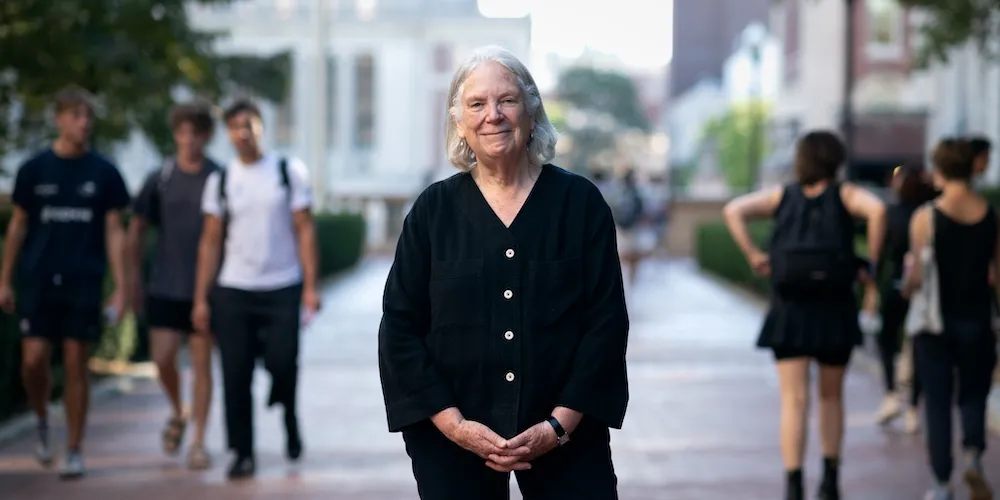
Theatre Professor Anne Bogart has led the Directing concentration in the School of the Arts Theatre program for over 30 years—almost as long as the concentration has existed. While her reputation off-campus precedes her as the co-founder of the renowned SITI Theatre Company and the revolutionary Viewpoints acting method, on campus she is known for her extraordinary dedication to her students and their success. Bogart will retire in 2026—but her legacy lives on not just in the future of the Directing concentration, but in the countless Theatre alums she has mentored over the years.
"There is this incredible piece of wisdom I got from my directing professor, Anne Bogart," Oscar-nominated director, screenwriter and playwright Celine Song '14 recently told NPR, "show up, pay attention, speak from the heart, and of course, the hardest of all, have no expectations." Song, who took Directing courses with Bogart while in the Playwriting concentration and then went on to make the hit films, Past Lives (2023), and Materialists (2025), comes back to this advice from Bogart as a guide not just in artmaking–but in life

In the 30 years since Bogart joined Columbia's MFA in Theatre full time faculty, she's touched many students like Song, and she's fundamentally changed how we teach Directing here.
"The only way you learn how to be a director is to have people come in and see your work, who don't care about your work, and you get embarrassed and then you see your problems and then you go back and rehearse," Bogart said. "So I tried to create a situation where they're making as much work as they possibly could, right away from the first week they get to Columbia."
When Bogart came to Columbia to lead the Directing concentration in the 90s, classes were held in one small basement area—a space with zero windows and a single studio. In 1993, nine directors arrived at the School of the Arts to work with the newly recruited Bogart. In their first semester each Directing student researched, rehearsed, and staged dozens of productions in a space Bogart repeatedly described as "tiny."
"I decided not to let the restrictions keep us from making great things," Bogart said. "I didn't tailor the program to the fact that we had very little, I made it actually more ambitious…I wanted them to make as much work as they possibly could and put it up in front of an audience as often as they could." Directors worked out of the bathrooms and led rehearsals in makeshift conference rooms. The breakneck pace and close quarters forced students to prioritize the pillars of directing: preparation, collaboration, and improvisation. Pillars that Bogart first witnessed as a teenager.
"The only way you learn how to be a director is to have people come in and see your work, who don't care about your work, and you get embarrassed and then you see your problems and then you go back and rehearse."
The first play Bogart ever saw was a production of Shakespeare's Macbeth. The late, great Adrian Hall directed the show after earning a million dollar grant from the NEA to bring theatre to high school students in Rhode Island. Bussed in from her village, Middletown, to Providence, Bogart was ushered to one of over two thousand seats. Everyone breathed together. The house lights dimmed, and her life was changed forever.
"I didn't understand a word," she said. "I'd never heard Shakespeare before, and the words were coming out of the ceiling, and it was happening 360 degrees around me. This incredible company, which Adrian Hall had started, was doing work that was really complicated. But at the end of it, I sat there and I said, that's what I want to do for the rest of my life.
"He taught me my first lesson in directing, which is never talk down to your audience," she said. "I realized that the theater is not about understanding because I didn't understand a thing. It's about bringing yourself—my 15 years of everything I've experienced up to that experience of this—and meeting it somehow."
In her 30 years at Columbia, Bogart has overseen seismic change in the MFA Theatre program. For one, students no longer share a single basement studio. With the support of Bogart, Dean Emeritus Carol Becker, and Dean of Academic Administration and Planning Jana Wright, the Lenfest Center for the Arts was built in 2017, and several new performance spaces and practice spaces for Theatre students were established in the Nash Building too. Directors now command four equipped studios and two theaters to rehearse and stage their work, but the pillars? Those remain the same.

Bogart created a curriculum that involves each student directing two fully staged half-hour productions a week for 14 weeks in their first semester, 28 productions in total, all of them open to an audience. "The innovation was all about making a lot of work and then giving rigorous critique and then going in and doing it again, again, again. It's a very serious, very demanding training," she said. The ideas that the students bring to Columbia with them are typically burned through in the first few weeks. Whatever their process was before, directors are forced to dig deep and adapt. Only after they have learned to trust their intuition do they get to work on longer-term projects, before a final year ends with more time in paid internships than in the classroom.
"So I always thought that's how directors should learn how to work," Bogart said. "First, do impossible things really fast. And little by little you can stretch it out.
"I can't tell you the number of times I've gotten emails or talked to directors who've gone through the program who go out into the world, and often because they're just going out into the world, they get hired to do difficult things, and they would say, 'I got hired to do this thing. I had to put this show up in five days, piece of cake. I'm well trained.'"
Bogart's legacy at Columbia goes much deeper than her impact on the curriculum. Every single Theatre graduate I talked to expressed deep and sincere gratitude for her vision and support, but she refuses the credit, downplaying her role as a mentor.
"We know a lot of people. We're old and ancient," she said. "What we can do in terms of mentorship is just connect them with directors and people they want to work with. That's really what we can offer: the fact that we know pretty much everybody in the theater scene. So we can write to any director who the directors want to work with and say, this is somebody you should pay attention to, and usually they do. So it's a Rolodex, except that we don't use Rolodexes anymore. That's what we can offer."

Despite Bogart's modesty, her contributions to the School and the lives of her students are obvious. “Anne Bogart is a treasure," said Dean Sarah Cole. "It is hard to overstate what an impact she has had on generations of students in our Theatre program. And yet, she is not interested in her own influence; instead she is all about the students, helping them to unleash their creative potential, all the while providing them with useful tools and real-world competencies. No one better embodies the ideal of a faculty member of great creative and intellectual power who also offers care, empathy, and practical advice to her many students.”
In Bogart's 58 years as a director, her favorite show is still the one she's currently working on. Her legacy is one of presence, of mutual attention. It's no coincidence that her landmark achievements—founding SITI and the Viewpoints acting method—emerged from collaboration, as well as her unique approach to training the next generations of directors.
"How people get along is the subject unique to theater. It's not true of dance, of architecture, of writing. That's the DNA of theater," Bogart said. "Collaboration becomes the heart of it. How are you getting along? And then it's not only how are people in the play getting along, but it's how are the actors getting along? How is the audience getting along? How are the actors and the audience getting along? That's the question that is most resonant in the air."
For Bogart, this focus on collaboration is paramount. Aside from the technical training—exercising directors' preparation and intuition—the most important thing students leave Columbia with is working relationships with their peers.
"When you're in school, you always think, I have to get to know people who are successful," Bogart said. "It's really the people around you who are going to be your team. You need to know the people who you're sitting next to. This is your generation."
"How people get along is the subject unique to theater. It's not true of dance, of architecture, of writing. That's the DNA of theater. Collaboration becomes the heart of it."
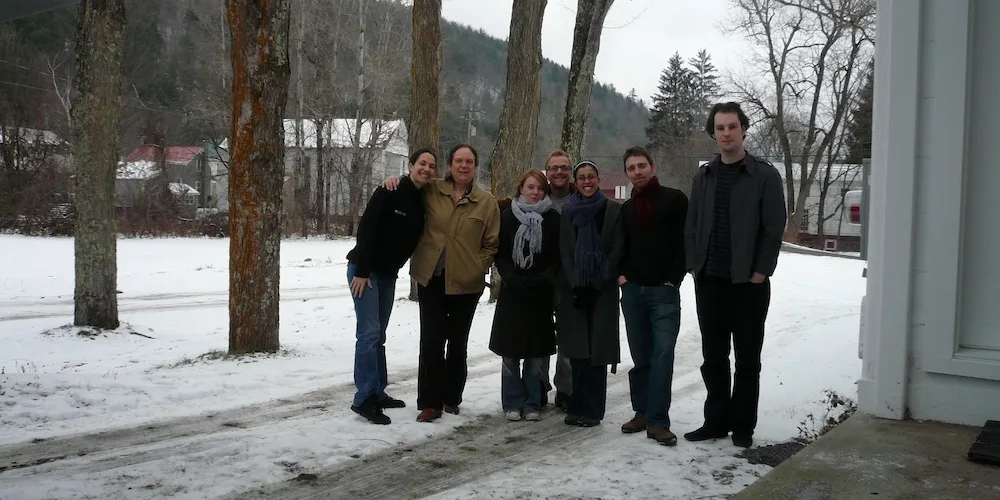
This emphasis on collaboration has led more than one Directing cohort to form artistic collectives or partnerships—including this year's. Well before graduation, Directing students Delia Dumont, Talia Feldberg, Emilio Maxwell Cerci, Dennis Oliveira, Brennan Urbi, and Brittany Vi-King have established an artistic collective called Pick Six, with the goal of "investigating the role of the Director and creating an abundance of opportunity and collaboration in an otherwise scarce profession." They credit their closeness and collaborative work partly to Anne's influence.
"We’ve all, at one time or another, remarked on Anne’s ability to foster an environment of collaboration and support—even at the intense Directing program auditions," said Dumont, speaking for the collective. For that reason, those values are core to the way the program is built, and key to getting the most out of it. Pick Six, a collective born from our care for each other and our shared commitment to mutual collaboration and support between directors, comes directly out of that culture."
When asked about what she's doing next, Bogart, ever grounded in the present, said, "We'll see." What she leaves behind is a fine-tuned structure, one that has been finessed over thirty years.
"I think the best thing I can pass on to whoever takes my job is the structure," said Bogart. "First of all, Columbia has the largest Directing program either in the country or the world. We take six directors a year. That is, most places take one or two, or they'll take two every two years. We take six every year, which means there's 18 directors at any time. So we've come up with a structure that I think really works. It's my hope that whoever comes in will do their own thing, but also take that structure that I think is very powerful, that has developed over many years. That's how I hope that the resonance will happen—through the structure that I leave."
Just as on the stage, running the Directing concentration is all about meeting the moment. Preparation can only take you to the precipice of action. Then, you're in the flow. It's the flow on which Bogart has staged her entire career and pedagogy.
"That's the balance. You have to prepare a lot. But then at the same time, once the door closes [on] the rehearsal, that preparation is giving you the right to walk in the room. That's all. So you have to have things to fall back on. I can't go into a rehearsal without having done a great deal of research, but once I'm in there, I can be present," Bogart said. "You prepare, but once you start…it's like following the Ouija board. You ask a question and it starts to move."