Learning (and Breaking) Form in Adaptations Course with Professor Galt Niederhoffer
Wicked. Bridget Jones: Mad About the Boy. Frankenstein. What do all of these 2025 films have in common? All three are adaptations of earlier work. Some have many branches on their adaptation trees. Wicked, for example, has gone from book to musical to two-part, silver-screen masterpiece. Bridget Jones: Mad About The Boy stemmed from Jane Austen’s classic Pride and Prejudice to a 2013 book series to a decades-spanning movie franchise. Frankenstein seems always to be Frankenstein, but Mary Shelley has given each creative team who takes on her terrifying idea more than enough to run with in different directions.
The golden age of adaptation is now. In a lecture hall at Columbia School of the Arts, Adjunct Assistant Professor of Film Galt Niederhoffer is priming her students to launch headfirst into this creative intersection. In her interdisciplinary course, "Adaptation," Niederhoffer teaches students how to take a creative work—be it a short story, novel, music album, or anything in between—and transform it into a film with legs, heart, structure, and, most importantly, a deep respect for the source material.
This respect for the source material is particularly emphasized by Niederhoffer because she has often generated the source material herself. A filmmaker, novelist, and producer in her own right, Niederhoffer designed this class out of passion and personal experience. "I taught this class first in my younger years, in my early 30s at Columbia, and I think it was born out of my love of books and my own experience in two careers because I've been both a novelist and a film producer since my early 20s. As a person working in two different media, books and film, this has always seemed the natural intersection of the two forms that I love and study and create."
In 2010, Niederhoffer's novel The Romantics was adapted into a film starring Katie Holmes, Anna Paquin, Adam Brody, and Elijah Wood. "I think that what I learned most from adapting it is that a novel is always better when it embodies the concision of a script, and a script is really benefited by the emotion, interiority, and metaphorical power of a novel," said Niederhoffer.
Her next experience with adaptation was particularly unique: her novel, Poison, was adapted for TV prior to the work being published. She was, therefore, able to let the two mediums exist in conversation with each other. "After working on the pilot, I went back and revised the first act of the novel," said Niederhoffer, "because it was so much better for this economy and concision" which had come out of the adaptation process.
In her "Adaptations" class, Niederhoffer uses a storytelling-first approach that is relevant to more than just Film students. Indeed, this class is one of the few that MFA Film students are able to take with students outside of their program. With many of the adaptations studied in class coming from popular literary works like The Virgin Suicides and Ice Storm, several students flock to this Film class from the MFA Writing Program in particular. Film student Phoebe Zimmerer shared, "It’s really nice to have a space where we can interact academically with people who are thinking about this class through a different lens. It brings the class to life and encourages you to think about things from all different angels."
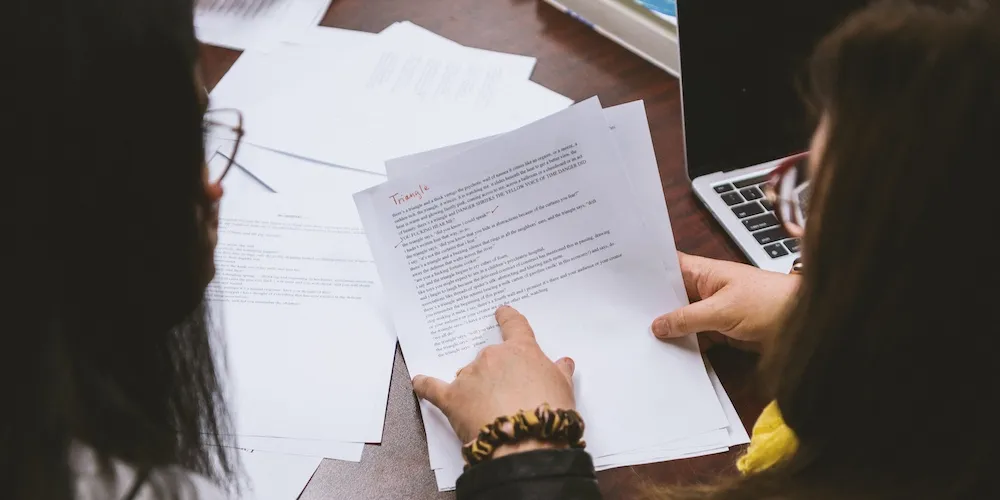
Zooming in closely on the intersection between literature and film, students in Niederhoffer’s class spend the majority of the year looking at short stories and converting them to a graph that maps out the necessary components of a screenplay. "It allows me to talk about the importance of theme and metaphor and the interaction of character and plot or consequence. I think it's really interesting when great art can be understood through the lens of form," Niederhoffer says.
For Niederhoffer, this approach to form is all about understanding the core of a story—a critical step in changing one form of media into another. Before that transformation can occur, argues Niederhoffer, artists must learn to boil a story down to its core elements and consider how those elements will be uniquely expressed through the transformation.
"The framework is so fascinating because it’s a clinical approach to structure, but I don’t feel limited by it," Film student Sophie Schnell expressed. Despite the almost mathematical approach to dissecting a story, there is never one correct answer for each point on the graph. Often, for example, students will disagree on what the inciting incident of a film is. Different opinions are thrown into the room and discussed at length. Through this open discussion, unexplored themes emerge. Seldom is unanimous consensus found. Instead, through the discussions ignited by the framework, students come to understand the unlimited artistic avenues an adaptation can take.
"I think I teach now with this sort of hyper-emphasis and interest on form as though film has a platonic ideal, like a sonnet or a symphony or a still life," Niederhoffer shared, "and trying to understand what are the specific formal attributes of a screenplay that make it beautiful and effective and emotional and perfect. There are a million ways to skin a cat, if you will, but I think that in order to preserve the integrity of and understand the impact of this particular form of screenplay, it's important to understand what those formal attributes and ideals are.
"I think it might be a necessary way to teach it because you can't just say, 'hey, you know, tell your story! What's your message? What's your truth?'" Niederhoffer expressed. "That's all well and good. But if I'm going to stand up there and teach students, I like to be able to prove what I'm saying, to make a solid argument that can then be either defended or rebutted. I don't think one can do that and teach a form without understanding at least the ideals to which we're all aspiring." While the framework is key, Niederhoffer emphasized, "It's a framework. It's a map. It's not a mandate."
For Niederhoffer, understanding the 'rules' of form is the first step to breaking them. "When Beethoven was breaking form with the fifth symphony, there was a reason that he was doing that which was both creative and political. I would argue that the impact of that—of those innovations and those breaks with form—is based in our understanding as audiences and as artists of the form at its most pure."
Come the second half of the semester, students are plunged into the deep end. Each student chooses a work—be it a music album, children’s story, novella, or slice of history—to turn into an adaptation themselves. They take a turn leading the class, discussing the best way to take their project from one form to the other. The graph is used as the backbone for this discussion, helping to demystify a process that can at times feel opaque or overwhelming. With a solid foundation in place, students can anchor themselves in the core elements of the works they've selected to adapt, while they explore creative ways to break the rules and make those adaptations uniquely their own.
The technique seems to be working. "I have always held strong opinions about different adaptations that I see, but I had yet to make my own," said Film student Zoë Woehrmann. "Honestly, whenever I approached the process, I didn’t know where to start. Now, I feel incredibly confident to make my own."
Galt Niederhoffer has produced over twenty indy films, twelve of which premiered at the Sundance Film Festival. Her films have won the Audience Award and the Sundance Awards for Screenwriting, Directing, and Cinematography. Niederhoffer’s films include The Kids are Alright, Robot and Frank, Infinitely Polar Bear, Grace is Gone, The Romantics, and Lonesome Jim, among others. Niederhoffer is the author of four novels published by St Martin's Press, including A Taxonomy of Barnacles, The Romantics, and Poison. She has published essays in The New York Times, The Wall Street Journal, New York Magazine, and Vogue.