Columbia Artists Think with Buffalo in 'buffalounit for bison bison (dance_hum for dirtbath)' at Dia Chelsea
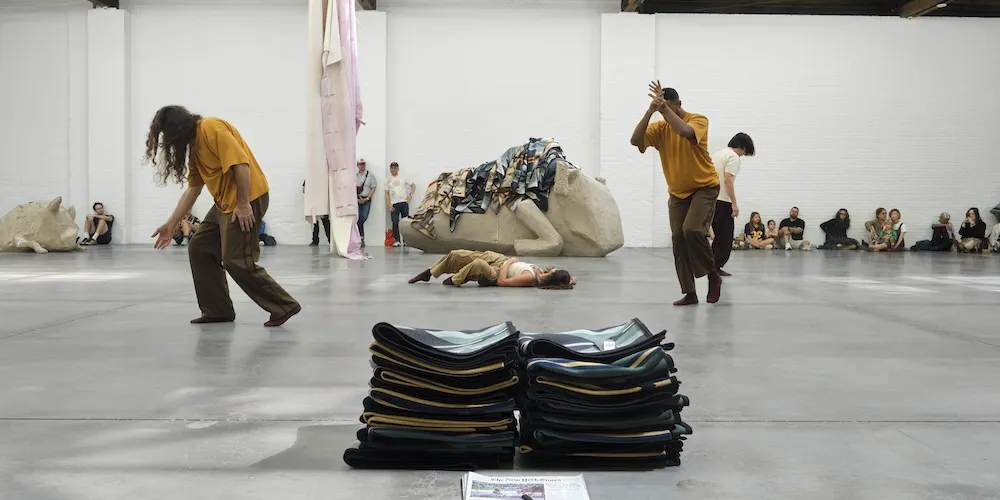
A buffalo kicks its plaster hooves in the air, fully immersed in its dirtbath, while another kneels on its front legs, entering the wallow headfirst. A calf playfully nuzzles the earth while a nearby adolescent stands awkwardly, its legs too long for the growing bulk of its body.
This does not take place on a prairie, but on a polished concrete floor in Dia Chelsea, where I have come to witness the major new Dia Art Foundation commission by Duane Linklater, Duane Linklater: 12 + 2, and its accompanying performance series, buffalounit for bison bison (dance_hum for dirtbath).
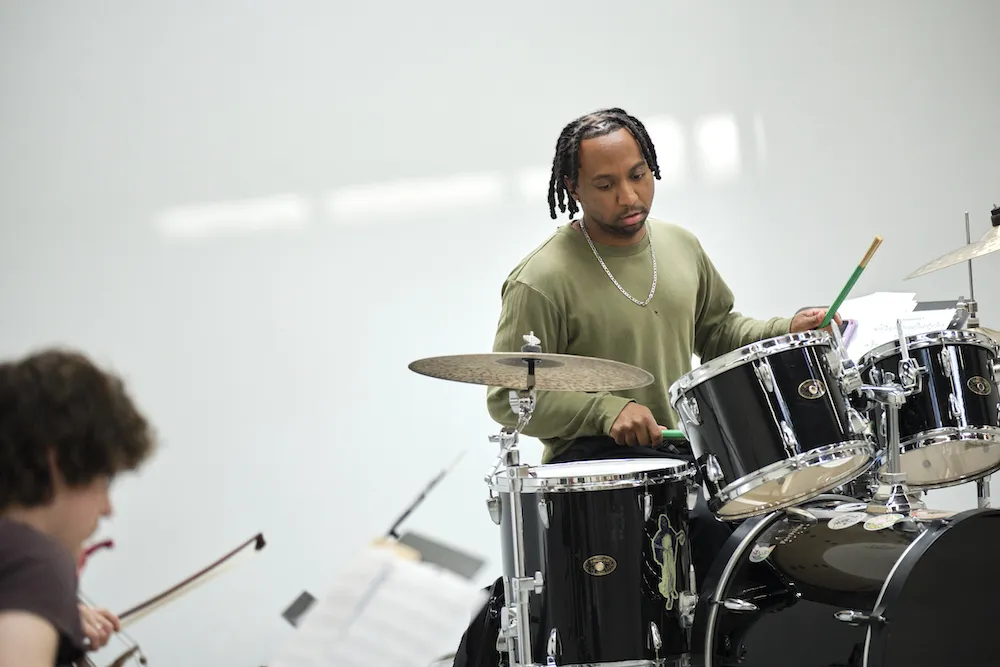
The performance begins at 2:04 PM, a time of cosmological significance for the Omaskêko Cree artist. Sock-footed, Johnathan González, dancer and Adjunct Assistant Professor at Columbia's Graduate School of Architecture, Planning and Preservation (GSAPP), glides among the plaster buffalo. From the back corner of the gallery, music from Sound Art student Miguel Gallego and recent alum Gladstone Butler '23 reverberates with increasing fervor.
"Wallowing," or rolling on their backs in the dirt, is a pleasurable activity that buffalo—a keystone species in North American grasslands—engage in when they feel safe and comfortable. "Wallows," the resulting shallow depressions, serve as habitats for new plant species and water reservoirs for prairie life.
In the exhibition, "12 + 2" refers to an Omaskêko Cree cosmological structure, as well as literal instructions for building a teepee, or a home. In a conversation with curator Matilde Guidelli-Guidi, cited in the exhibition pamphlet, Linklater asks, "is the wallow a buffalo home?" If so, how can Dia be transformed into a home for buffalo—a space that centers Indigenous presences—while contending with the institution of the gallery?
These questions are activated by wallowposition (plaster on foam, 2025), a series of seven buffalo sculptures that spans two galleries. Reaching 15 feet in length, the figures vary in wallowing positions, size, shape, and undeniably, personality; Linklater uses sculpture to bring viewers into intimate contact with individual buffalo movements. The performance series takes up this intention and expands it to confront broader movements: how buffalo weather changes in their environments (both natural and those enacted by settler violence), and how musicians and dancers can express those resonances.
To this end, eagleswitheyesclosed (a musical collaboration between Linklater and his son, Tobias) composed music within durational parameters set by choreographer Tanya Lukin Linklater (the artist's wife and frequent collaborator), who then used the score to structure the dance. Exploring themes of distillation and transmission, the ensemble whittles over the course of seven performances from three musicians and four dancers to a duet between the percussionist and a dancer.
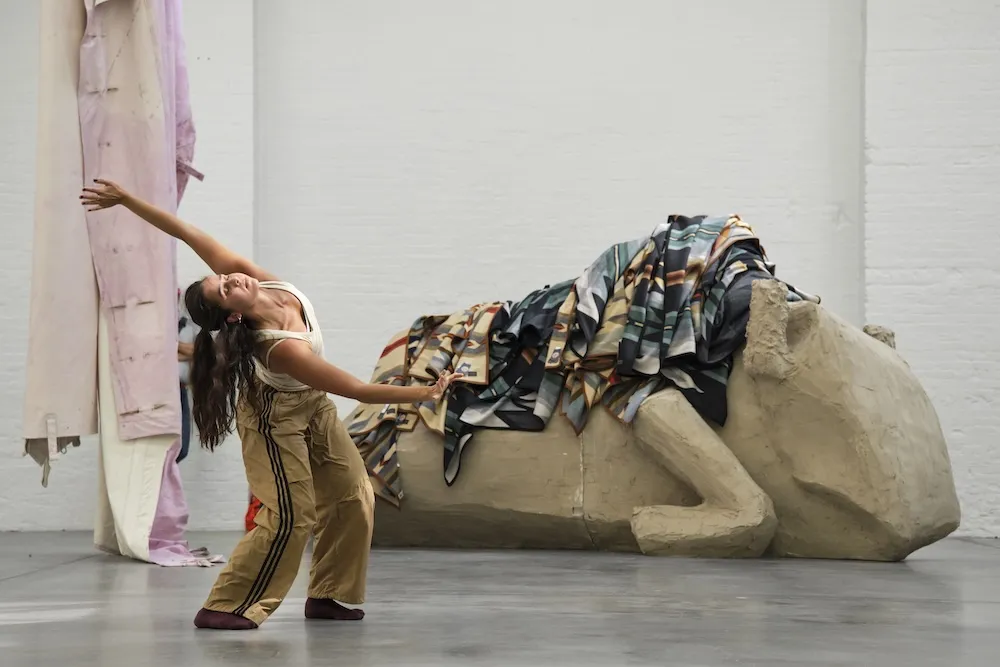
The performance I caught on October 11 featured dancers Talia Dixon and González with musicians Butler and Gallego, and I had the chance to chat with a few of them after the performance.
Butler, the percussionist, told me he and Gallego became involved when Assistant Director of the Sound Art Program, Seth Cluett, put the two of them in touch with Linklater, who has a history of inviting student-artists into his work. Fjóla Evans, the cellist (who had already departed the performance at that point), is pursuing her doctorate in composition at Columbia's Graduate School of Arts and Sciences (GSAS).
Butler described the performance score as a "launching point for improvisation" between the dancers and musicians. By the time the performers receive the score, it has been interpreted and transformed several times; their job is to do so again, each time they perform it. For Gallego, the guitarist, entering the performance "obliquely" aids in the process of transmission, as the musicians are not trying to soundtrack the dancers, but to "respond [to them] on an affective level." Gallego, whose background in guitar consists mostly of playing in rock outfits, finds that the ever-changing nature of the performance introduces a productive "element of peril." This rings true in the haunting, bellowing sounds he produces during the performance.
For González, transmission involves taking up the movements of the other dancers as they depart, but also embodying the quiet atmosphere of the Linklaters' home in North Bay, Robinson Huron Treaty territory (Ontario, Canada), where the dancers traveled to help create the choreography. As buffalo encounters are quite rare, the dancers absorbed buffalo movements the same way we all seek out experiences with our favorite wild animals: "We spent so much time with buffalo on Youtube," said González.
Near the end of the performance, González swings their arms vigorously toward the musicians and the audience in a gesture that can be translated to 'bring it on!' They told me Lukin Linklater calls it 'the dirtbath': "It's about creating images of the dust storm…to get everyone in the dirt together. I'm trying to make the cloud big: cover the musicians, cover the audience, cover myself."
When I ask González if they have a buffalo sculpture they feel most connected to, González walks me to an elder buffalo, whose back is draped in Pendleton blankets printed with stolen Indigenous patterns, which Linklater uses as a symbol of colonial violence. "I come here a lot to ground myself in the performance," they say. "There's something very beautiful and full of grief at the same time. It anchors me."
Poet Layli Longsoldier (Oglala Sioux Tribe) expands the notion of "wallowing" in her contribution to the exhibition pamphlet, "I Want to See My Relatives Close-Up." For her, wallowing represents a form of kinship between buffalo and the land, or between humans and buffalo. She revels in a sort of "writerly wallowing": "And here I am, reflecting, meditating on, and enjoying my time with thoughts about the buffalo," she explains. "This is my own form of wallowing."
Viewing the performance, I wallowed in the unbridled emotion released through music and dance. I wallowed in the gentle, yet forceful motions of the dancers. I wallowed in the performers' generous answers to my questions, in my own curiosity, and in the writing of this article.
For those interested in further wallowing, Duane Linklater: 12 + 2 is on view September 12, 2025–January 24, 2026 at Dia Chelsea, 537 West 22nd Street, New York. The final performance, a duet between percussionist Gladstone Butler and dancer Talia Dixon, will take place on October 25 at 2:04 PM.