Celine Song '14 Reminds Us of An Artist’s Bravery
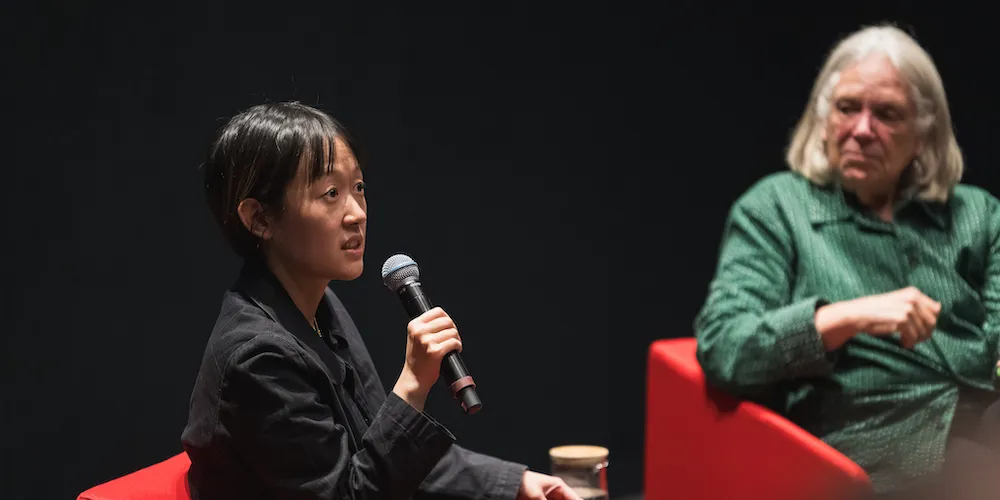
I ran from an afternoon class in Dodge Hall to the Lenfest Center for The Arts to make it to Speak Now: Celine Song; a conversation between playwright, filmmaker, and Theatre alum Celine Song '14, and Professor Anne Bogart, the legendary theatre director, founder of SITI Theater Company, and Concentration Head of the Theatre Directing program. The evening was sold out within hours of tickets going live, with a long list of names on the waitlist—hopeful students and community members wanting to see these two in conversation.
Speak Now, a speaker series at Columbia University School of the Arts organized by the office of Public Programs and Engagement, features artists whose work has reached a broad public and embodies the adventurous creativity that is the hallmark of the School of the Arts. Dean and Parr Professor of English and Comparative Literature Sarah Cole opened the event by reading abridged biographies of each speaker. When Cole got to Bogart’s biography, she stopped short of listing every production Bogart has worked on (Bogart is being honored as a 2025 inductee into The Theater Hall of Fame), encouraging us to look them up online. Cole then spoke about how Song’s career epitomizes the gift of a degree in the arts, what with her crossover to film after training in theatre.
Song is so well known for her films—Past Lives (2023) and The Materialists (2025)—that few people know of her MFA in playwriting and her early career in theater. Song’s most well known plays are Family, which had a production this past September at La Mama, and Endlings, which premiered at ART in Boston in 2019. But before discussing Song’s transition into the world of film, Bogart asked the other pressing question all MFA candidates want to know. How did Song survive the transition from student to professional? Bogart encouraged Song to not avoid the hard truths, to which she replied “Oh I couldn’t avoid the hard stuff… I don’t think that’s possible,” before laying out the difficulty of the early stages of an artistic career in New York City.
Song is very upfront about the material realities of both art-making and daily life in New York City. Economics, and the role it plays in our lives, is foundational to the plot of Materialists—Song’s second film from 2025 which follows a matchmaker, played by Dakota Johnson, and the way her romantic choices are complicated by money. The film is inspired in many ways by Song's own biography, and her early experiences with economic hardship as a young theatre-maker. After toiling away in New York City Theatre, Song was approaching her 30th birthday and still struggling with financial instability. “I was looking at turning 30, and then I was like, I don't think it's going to be very cute for me to not be able to pay rent,” she said. Unable to find a steady day job in New York—Materialists is inspired by her six-month gig as a matchmaker, which she said was so much fun she couldn’t get any writing done—she decided to move to LA to pursue a TV-writing gig. In LA, Song was hired as a staff writer on the show Wheel of Time, a television adaptation of the fantasy series by Robert Jordan on Amazon. While in LA, a trip that was only meant to last two weeks, Song started working on the script for Past Lives, a document she says changed her life.
Inspired by her work in television, Song purposefully put clear descriptions into her script—laying out exactly what each scene should look like—which made clear she had a directorial eye and displayed an awareness of her project beyond narrative and into the visual. “Once I shared the script, it was clear those who understood the script were the ones who wanted to make it into a movie. [I thought], 'they'll let me direct it if I figure out a way to express it.' So my script was a bit like a pitch for myself as a director, on top of it being a script. This document allowed me to go from being a playwright to being considered as a potential director.”
It's clear that Song has thought at length about visual narrative, particularly the ways in which it can differ between theatre and film. In response to a question from Bogart about the difference between writing movies and plays, Song responded by categorizing them as different languages before delving into a discussion of the figurative nature of theatre and the literality of film. Song pointed to her experience working with Bogart on her second-year collaboration project. That year, one play was set in a cathedral. While in the basement of Schapiro Hall—home to Columbia’s graduate Theatre courses—the students on the project couldn’t figure out how to create the illusion of a cathedral until Bogart told the students to sit in a line and look up. “Suddenly you can see it," Song said. "You suddenly see the cathedral… you create all that space. Just by the way the audience is looking, the actors are looking, and therefore we're going to see what the actors see.” Whereas for film, Song said, time and space are quite literal. The impetus isn’t on the audience to follow along and imagine, but instead to observe the changes happening in front of them. “What's amazing about theater is you're asking the audience to come with you through so much time and space and jump through it and move through it and live through it just by the power of language and the actor who believes it all.”
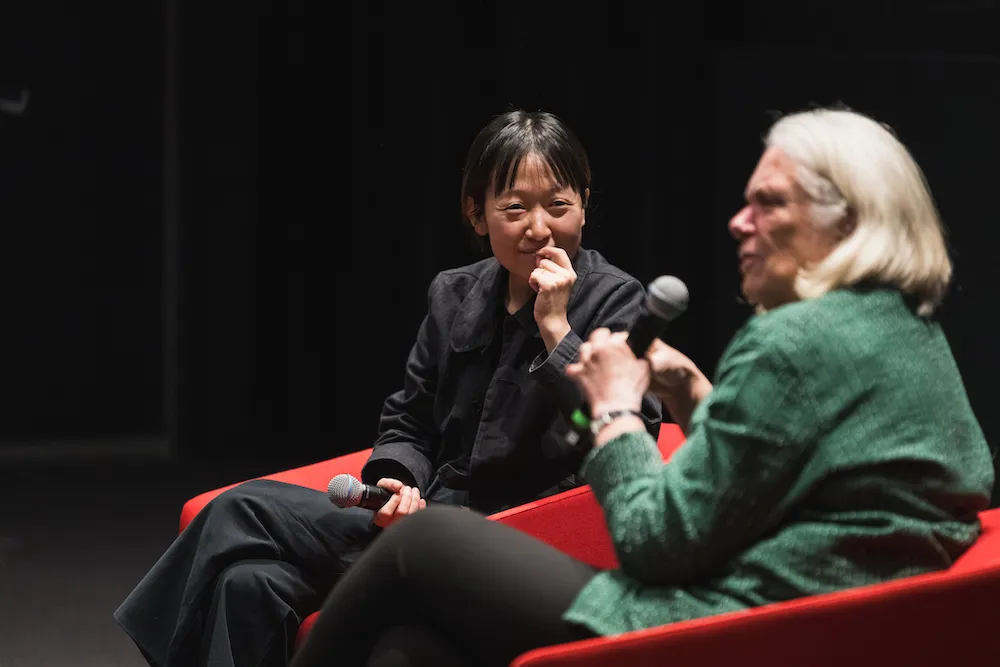
While Song's flexibility and attention to visual narrative helped to open doors for her, she ultimately credits her success to her willingness to put her work out there in what she referred to as “higher stakes environments”—environments dedicated to figuring out if a draft works, with readers willing to go beyond mere praise for the completion of an attempt. Song emphasized that in showing up to this context, an artist must not apologize for the state of the piece: “You have to show up and not apologize at the beginning of sharing… You're always going to improve [by] presenting in front of other people… this is the difference between a professional artist and an amateur. A professional artist is somebody who is showing up to communicate something about their own lives and their own world to a room full of people.”
Bogart was touched by this point: “It's so brilliant, the notion of putting [the work] in a high stakes environment," Bogart replied. "We tend to want to protect ourselves, right?” But for Song, showing up in this way is not just a matter of courage, it's a matter of connection—of leaving the realm of personal diary and using art to relate with others. “You have to be showing up with the courage to say, hey… this is my way of talking to you, and being here with you,” she said.
Despite her encouragement to put ourselves out there, and her acknowledgement of the stakes, Song was quick to remind us that everything is relative. “The truth is that what is the worst thing that could happen?" she said. "The worst thing that could happen is that you make something bad, and then everybody knows. So the only thing that you have to overcome is the humiliation of potentially making something bad. There is a level of courage that I think we can all muster if we intend to be artists. We're asking to do something that so many people want to do. So why do we get to do it? Well, we get to do it because we are brave enough to say we are willing to be potentially bad and be humiliated. So much about art is undressing… There are many jobs where you can hide. This is the one job where you can't hide.”
—
Celine Song is an Academy Award-nominated screenwriter and filmmaker whose signature blend of emotional depth, intelligence, and humor has established her as an essential voice in today’s entertainment landscape. Past Lives earned Academy Award® nominations for Best Original Screenplay and Best Picture, alongside numerous other honors including the Directors Guild Award for Outstanding Directorial Achievement in First-Time Feature Film, Best Feature Film at the 2023 Gotham Awards, the Film Independent Spirit Award for both Best Picture and Best Director, as well as Golden Globe®, Critics’ Choice, and BAFTA nominations. As a playwright, Song has been a finalist for the Susan Smith Blackburn Prize and a semifinalist for the American Playwriting Foundation's Relentless Award.