Associate Professor Susan Bernofsky Moderates Translation Panel between Maria Dahvana Headley and Emily Wilson
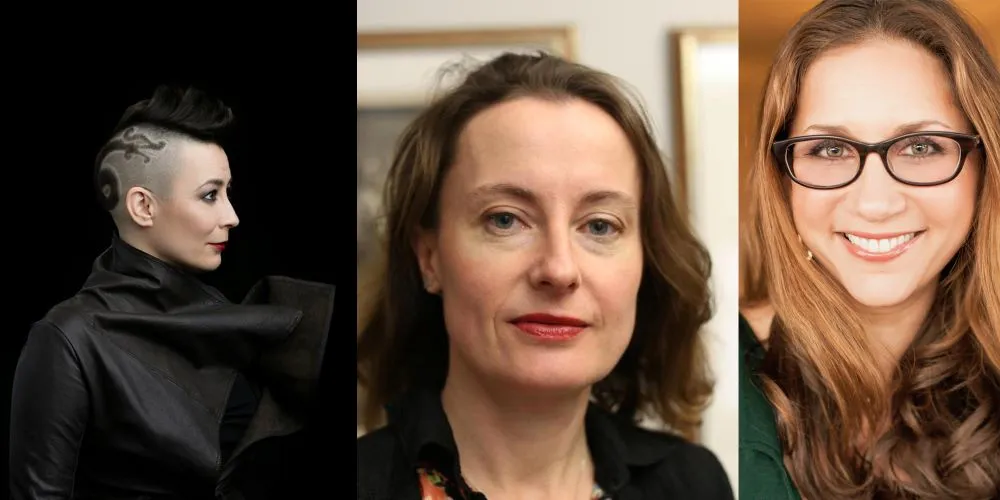
Associate Professor and Director of the Translation program Susan Bernofsky took part in the 2020 Translating the Future conference last week, which was co-sponsored by the PEN Translation Committee, the Cullman Center for Scholars and Writers, and the Center for the Humanities at the CUNY Graduate Center. Bernofsky is an award-winning literary translator, and she has translated the works of Robert Walser, Jenny Erpenbeck, Yoko Tawada, Franz Kafka, Hermann Hesse, Uljana Wolf, and others.
The evening involved a conversation between Maria Dahvana Headley and Emily Wilson. Headley is a #1 New York Times-bestselling author of the novels Magonia, Aerie, and Queen of Kings. Her latest book, The Mere Wife, is a retelling of Beowulf set in the suburbs. Wilson teaches classics and literature at the University of Pennsylvania, and has translated the works of Seneca, Euripides, and Homer. Her scholarly works include a biography of Seneca.
Before both authors read from their latest work, Bernofsky asked them to talk about how they came to the work of translation. Headley had worked as a novelist, poet, and playwright and didn’t venture into translation until she began working on her fictionalized retelling of Beowulf. She only translated the text after publishing her novelization of it. Wilson, similar to Headley, said she likely wouldn’t have worked in translation if she hadn’t been asked. Thinking about her experience teaching some of these texts-—The Odyssey specifically—she realized there wasn’t a version of the text that allowed her to teach what she wanted to. For Wilson, translating the work herself broke open the pedagogical possibilities of this ancient text.
The panelists discussed the common problems that arise in translation. Bernofsky shared how certain German compound nouns, as well as trivialization of certain English words, has given her trouble. Headley and Wilson expressed running into similar issues in their own work. For Headley, working in the world of hyperbole gave her permission to use certain words she might not have if her translation of Beowulf were more traditional. Wilson, however, pointed out that translation also gives the writer the opportunity to emphasize particular moments, shaping the reader’s experience.
Bernofsky asked the writers how their work attempts to make sense of the world right now. “I, as a classicist, and people who engage with medieval and early modern works as well, need to be much more explicit about taking on the alt-right, white supremacist narrative about the canon,” said Wilson. This way of reading Old English and ancient Greek texts, Wilson noted, is not only extremely problematic ethically and politically, but it is also historically inaccurate. Headley and Wilson also both emphasized how the field of translation itself needs to be broadened to include more diverse voices.
During the Q&A, a student asked the panelists to discuss their relationship to past translations of their source material. While Headley finds solidarity in reading others’ translations while working, Wilson tends to read them afterwards. Bernofsky works similarly: “I’m afraid that if I read them while I”m working on my own that I’ll lose my own way.” Another student asked how the writers balance their individual writerly voice with the work of translating someone else’s words. Wilson shared that she discovers new voices by inhabiting others’, and through translation, another kind of writing becomes possible. Headley also acknowledged how beginning translators may feel unworthy of taking on these canonical texts. “That person had an urge to tell the story, and you have an urge to interpret and clarify their story for people who speak your language. I think that is ultimately worthy.”
You can watch a recording of the event here and find additional coverage/recordings of the conference here.
Bernofsky’s latest work is a biography of Robert Walser entitled, Clairvoyant of the Small, (forthcoming in May 2021 from Yale University Press). She is also currently working on a new translation of Thomas Mann’s The Magic Mountain.