Widening the Frame with Professor Annette Insdorf: A Legacy of Mentorship and Community Building
The acclaimed film scholar and interviewer of the stars has widened the lens of the Columbia Film Program, serving students for over 40 years.
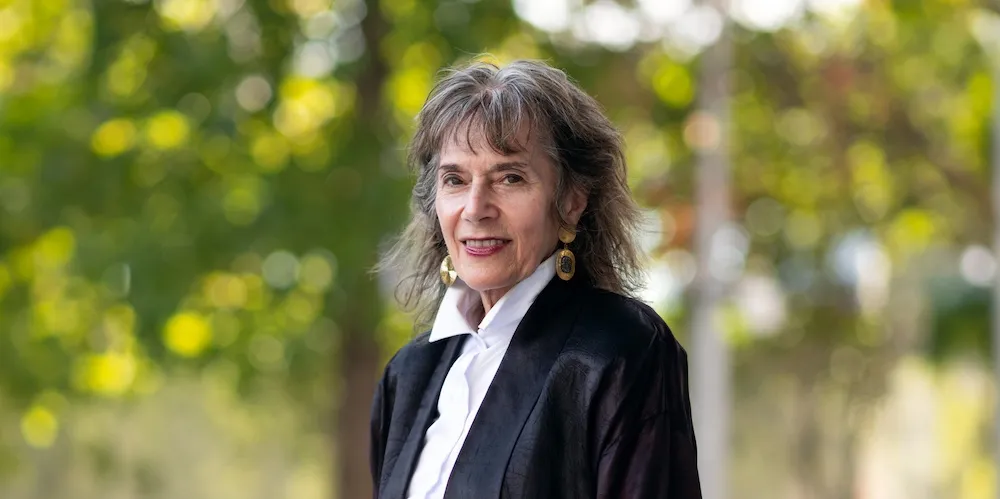
In the School of the Arts' 60 years, few faculty have enjoyed as rich and sustained a commitment to their students as Film and Media Studies Professor Annette Insdorf. Insdorf is often quoted on the importance of "widening the frame" in film studies—not just through her focus on close analysis, but by diversifying the movies shown in class. There is no doubt that Insdorf has widened the frame at Columbia, helping to shape the Film Program into the diverse, competitive program it is today—one that is just as likely to educate creative practitioners as scholars, program administrators, artistic curators, and more.
"For decades, Annette has been channeling her incredible love and encyclopedic knowledge of film to her students [at Columbia]. That’s what is most stunning about her, I think," Dean Sarah Cole said. "Just as an example, I saw her interview Martin Scorsese about Flowers of the Killer Moon at the 92nd Street Y. She said at one point that a particular shot (which they showed as a clip) of Lily Gladstone's face reminded her of a film (which I had never heard of) starring Olivia de Havilland, and she wondered if he'd that in mind. And he said yes! I don’t think anyone in the audience expected that. It was one of those amazing things, her true genius as a film watcher."
Insdorf is a titan of film studies. She has interviewed generations of luminaries—from Martin Scorsese to Alejandro G. Iñárritu, Robert Redford to Pawel Pawlikowski, Francis Ford Coppola to Greta Gerwig (BC '06), and more—as part of her long-running signature film series at the 92nd Street Y, Reel Pieces; has written seminal film books, including Francois Truffaut, Indelible Shadows: Film and Holocaust, Double Lives, Second Chances: The Cinema of Krzysztof Kieslowski; Philip Kaufman, Intimations: The Cinema of Wojciech Has, and Cinematic Overtures: How to Read Opening Scenes; and recently co-produced the documentary feature Elie Wiesel: Soul on Fire (d. Oren Rudavsky). In 2021, her illustrious career and her impact on the film industry were recognized with the Telluride Film Festival's Special Medallion—awarded to a “hero of cinema, an organization or individual, that preserves, honors and presents great movies"—followed by a Creativity Award from Moment Magazine. She has served on the juries of many major film festivals, and was even "knighted" for her educational efforts by the French Ministry of Culture, which named her an Officer in the Arts in 1999; and this is just a small glimpse of her career, studded with awards and accolades.
"I always loved going to the movies," Insdorf said, with her characteristic modesty, "initially with my parents, who frequently took me to movie palaces like Radio City Music Hall, then as a Yale doctoral student in English. I was very lucky to be in the right place at the right time—a moment when the student-run film societies showed movies of all kinds almost every night. It's not simply that my advisor Harold Bloom—and other professors—supported my commitment to writing about motion pictures. 'Film Studies' was becoming academically more respected, and I was given the opportunity to teach 'The French New Wave,' even before I received my PhD in English. That experience was so gratifying that I never stopped teaching about the movies and filmmakers I love."
When Insdorf first joined the Film faculty at Columbia in 1982 as an adjunct, the MFA Film Program was primarily a screenwriting conservatory. From those early days, Insdorf's dedication to the program and the study of film was evident. She joined the full-time faculty in 1987, and was appointed Director of Undergraduate Studies in Film, a program she helped create. While teaching cinema history to generations of Columbia undergraduates remained a calling, she was also named Chair of the Film MFA Program, a position she held from 1990 to 1995.
"'Film Studies' was becoming academically more respected, and I was given the opportunity to teach 'The French New Wave,' even before I received my PhD in English. That experience was so gratifying that I never stopped teaching about the movies and filmmakers I love."
In these pivotal roles Insdorf aspired to make the study of film more diverse and more widely available. She helped to establish the undergraduate major in Film History/Theory/Criticism; secured teaching assistantships and preceptorships for MFA students teaching undergraduates; expanded the MFA program by introducing a new track in Producing, and further strengthened the Directing track so that student-made shorts could be seen locally and even at the Cannes Film Festival. In other words, she changed everything.
"When Annette became Chair," producer, director, and Special Lecturer Ira Deutchman said, "she contacted me because there were students who she felt were not doing well in the program and that they were more geared toward producing than toward screenwriting, which is what the main part of the program was at that time. They were disgruntled because there wasn't enough in the curriculum for them, and so she asked me if I would take hold of those students and try to put together a curriculum and meet with them and talk them through what was going on—playing more of an advisory role to those students."
Insdorf and Deutchman had already developed a professional relationship in their previous work—Insdorf writing for The New York Times and Deutchman in his work at various distribution and independent film companies—and in her signature fashion, Insdorf recognized Deutchman's potential at Columbia.
In doing so, Insdorf and Deutchman laid the groundwork for what would eventually become the Creative Producing concentration of the MFA in Film, which was formally established in 2010.
A similar story played out with former Professor Richard Peña, whom Insdorf recruited to the School in the late 1990s. At that time, film criticism as a formal course of study was still rare in the United States, and the track was often billed as an offshoot of language or comparative literature studies. Insdorf changed that too.
"People don't realize how recent serious film study is in the United States," Peña said. "It was only in the 90s that—if I can be so bold—places like Columbia, Harvard, and Yale really created programs that in many ways provided a model for the academic study of film. Each of us did it in a different way, but I think all of us by that point had enough colleagues at the university who saw that film was not only something that should be studied, but should have its own proper specialization. Film study was something that not only did students want, but in fact was something they deserved."
"As a professor, Annette is simply matchless," former student Angeline Dimambro '23 said. "I took 'Analysis of Film Language' with her during my first year in the MFA Film Program [as a screenwriting student]. It's a cornerstone course of the program, and it was my first proper film studies class ever–I didn't come from a film background. She made the material not just accessible, but exciting. Every lecture felt like we were getting an inside scoop."
Insdorf's personal touch is really the outcome of her many identities—scholar, critic, mentor, educator and interviewer—and how inseparable they've become, each informing the other.
"Having interviewed filmmakers like Martin Scorsese, I'm able to quote from our exchanges in the classroom," said Insdorf. "And when I moderate seminars at the Telluride Film Festival, the panel topics and questions I create are often borne out of my Columbia classes. For instance, I recently moderated a Telluride seminar titled 'History Through the Lens of Family.' It continued a thread that I interweave in my class 'Cinema History 1960–90,' namely movies in which the personal is a microcosm for the political. The questions I posed to the Iranian director Jafar Panahi, among others, addressed how a fictional motion picture about families (whether biological or extended) can sensitize viewers to historical injustice, repression or corruption."
This passion and breadth of film knowledge is a hallmark of Insdorf's teaching. In a special tribute to Insdorf for the 2021 Telluride Film Festival brochure, award-winning filmmaker and Film Professor Ramin Bahrani wrote, "I first heard Annette's voice in 1993, in my first film class, as an undergraduate at Columbia. In that dark screening room, listening to Annette's passionate lectures and brilliant analysis, I learned how to think like a director, how to make films."
Insdorf is well known for her commitment to students, championing their work long after they've left the classroom.
"I remember she would sometimes quote from previous students' papers," Dimambro said, "which struck me—she really is in dialogue with her students and takes them, and their work, seriously. As a student, it inspires you to push yourself further and really put in the work."
"The pride I feel when I see my students and alumni succeed—whether as artists or scholars—is tremendous," Insdorf said. "And one of the most enjoyable parts of writing books is quoting from my students' incisive papers. This has been the case with my monographs on Krzysztof Kieslowski, Philip Kaufman, and Wojciech Has, as well as Cinematic Overtures: How to Read Opening Scenes."
"In that dark screening room, listening to Annette's passionate lectures and brilliant analysis, I learned how to think like a director, how to make films."
Perhaps one of Insdorf's best known qualities as a mentor, educator, and scholar though, is the way she brings people together, forging connections between former students and industry professionals with the same verve and perceptive eye she uses everywhere. As far back as 1989, she told Columbia Magazine, "Basically, I introduce talented people to other talented people. I go on instincts, contacts, a thick address book, and chutzpah."
Insdorf is credited with introducing her student, Tom Abrams '88, to actor Jerry Stiller and his son, Ben, who then went on to play the starring roles in his film, Shoeshine—also exec-produced by Insdorf—which earned a nomination for Best Live Action Short Film in the 1988 Academy Awards.
A similar story played out with a former student from her time at Yale, the late Guy Gallo, best known for his screenplay adaptation of Under the Volcano—a book considered unsuitable for film until director John Huston took a chance on Gallo's adaptation in the 1980s. How did Huston discover Gallo? Insdorf's introduction, of course.
"Her greatest influence on many people is the way she puts friends and colleagues together and lets them see what's possible," Gallo told Columbia Magazine. "She's sort of a talent alchemist."
These are just a few examples of a long and fruitful history of mentorship; but perhaps one of her most visible impacts on the Film Program as a whole is her role in the development of the Miloš Forman / Mike Hausman Columbia University Film Festival (CUFF), which started out as a sold-out showcase of student films and a panel at Symphony Space in 1987—an event pioneered and hosted by Insdorf in collaboration with then-Film Chair, Richard Brick—and later expanded to LA.
"We had no real budget for the LA event," Insdorf recalled, "so I got restaurants and sponsors there to provide food and drink for the reception."
By the mid-1990s, the festival boasted several special sponsors and events, like Screenwriting Night and an Awards Ceremony, and became the widely respected Columbia University Film Festival—in NYC & LA—helping to cement Columbia's reputation as a major filmmaking conservatory.
"If you think of all the various changes that have gone on in the Film Program over the course of these many, many years—and it is a very, very different program now than it was back in those days—" said Deutchman, "Annette is both the institutional history and the glue that really is responsible for the entire arc of its existence."