This Is Who We Are: Saheem Ali
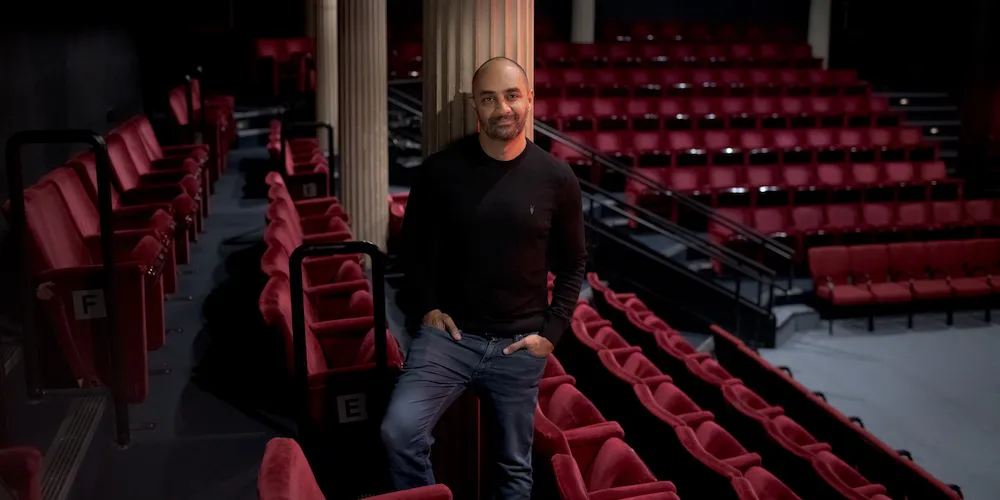
Theatre alum and Associate Artistic Director/Resident Director of the Public Theatre Saheem Ali '07 remembers the moment he became a director—though he may not have called it that at the time. Growing up in Kenya, Ali hadn't had much exposure to the world of live theatre—it wasn't part of the tradition and the culture. So when his father, an airline pilot, took a sixteen-year-old Ali to London, he had no idea that the experience would change the trajectory of his life.
"I saw this billboard for a production of a show that starred an Australian soap star that I was obsessed with," recalled Ali. "It turned out to be the musical Grease that I knew nothing about, and I went to see this performer, and I was completely mesmerized by the energy in the theater, by what the production felt like, what the music felt like—it kind of awakened something in me."
Ali returned home, and he immediately convinced his friends to mount their own homegrown production of the musical—a passion-driven project that included everything from casting, to marketing, to soliciting donations for costumes and supplies.
"I had bought the cassette tape, and I didn't know there was a movie. I wrote the script from my memory, handed it out to my friends, and I said, okay, well, this is how we do it, you're gonna be here, and you're gonna go there, and then we'll sing along to the tape."
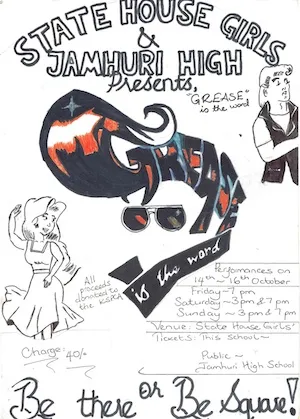
Without even realizing it, fueled purely by passion and a cassette tape, Ali was directing—though he wouldn't have called it that at the time.
"When you're 16, you're not really thinking deeply about why you do things," reflected Ali, "but there was something about the energy I felt when I watched the show that I wanted to recreate. I wanted to be inside of it, and I wanted to be outside of it, because I felt so good watching that show."
Ali's homegrown production was a massive success—and it wasn't just parents and teachers in the audience, either. A British expat who ran a small local theatre in Nairobi saw Ali's production and cast him as Mercutio in a production of Romeo and Juliet (alongside Lupita Nyong'o as Juliet—a meeting that would result in a lifelong friendship and future collaborations), and Ali was so transfixed by the process that he asked to shadow the director on his next five shows that year, spending the eight months before he left for school in the United States watching and learning so closely that he could act as the understudy for almost any role.
Once he became an undergraduate at Northeastern University, he quickly changed his major from Computer Science to Theatre—without telling his parents—and gravitated back toward directing.
"I discovered as an actor, I couldn't stay in my own lane," he said, laughing. "I was internally questioning the choices the director was making. I'd think, why are they doing it this way? Why am I doing this? Why aren't they thinking about that? I found myself unable to focus on my track as an actor. I never pushed back externally, but I internally had doubts. So I thought, you know what? I think this means that I'm more of a director than an actor, because I can't help but think about the bigger picture. I chose directing because it felt more natural to me."
It was a good choice—one that would lead Ali to Columbia University and a stellar career directing award-winning Broadway Productions Buena Vista Social Club and Fat Ham (both of which earned Ali a Tony nomination for Best Director), several shows at The Public Theater, including productions for their wildly popular Shakespeare in the Park program and his own new musical, Goddess, and many more, earning Ali a 2023 Obie Award for Sustained Achievement in Directing.
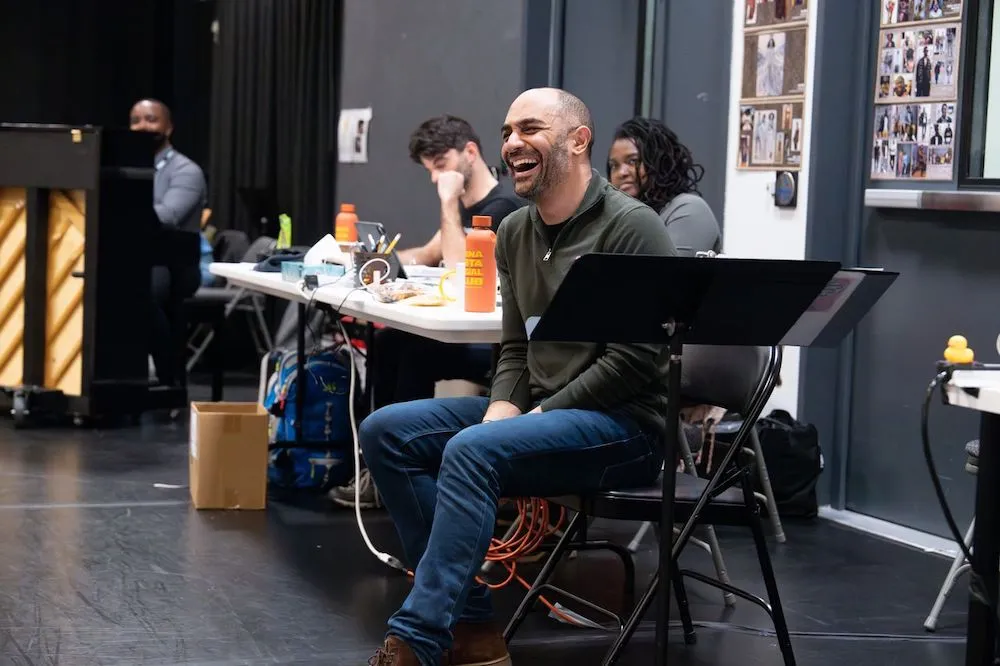
Even with all these achievements, when asked how he does it, Ali boils it down to a simple response: You have to know your "why."
"Fundamentally," Ali said, "[directing] begins with why you're doing it. It should be a story, or a subject matter, or a theme that I feel personally connected to, have a relationship to, feel drawn to in some way. You can't do something as a director unless you have a very, very specific, subjective relationship to the why. I used to think that being a director meant you should be able to do anything. Give me a script, give me a scene, give me an actor, and I should be able to direct it, but I came to discover that actually it's really important to understand for yourself what this piece means to you. Our energy on this planet is finite, so your work on a scene, your work on a play, engaging with the work, is time on this planet that you're spending."
After that, said Ali, the magic is in finding the right people to collaborate with.
"Directing is about collaboration. You're working with someone else's impetus, someone else's imaginings. You are a conduit to other people's creativity, including your own. Theatre is a hyper-collaborative event that involves bringing your best, but also inspiring and encouraging the best in others."
For Ali, this is a philosophy that carries over into the classroom—so much so that, when discussing his teaching, Ali talks more about what he's learned from his students than what he's teaching them.
"You can't do something as a director unless you have a very, very specific, subjective relationship to the why. I used to think that being a director meant you should be able to do anything. Give me a script, give me a scene, give me an actor, and I should be able to direct it, but I came to discover that actually it's really important to understand for yourself what this piece means to you. Our energy on this planet is finite, so your work on a scene, your work on a play, engaging with the work, is time on this planet that you're spending."
"Honestly, [teaching] was never something that I imagined doing. I always had a sense of adulation of the person who's teaching something. I needed to go on my own life journey and sharpen my tools and explore what it meant for me to make work in the world. I watch my students' scenes, and I'm just so inspired by their creativity, their ingenuity, and their bravery. The students are teaching me all the time. It's so beautiful, because the line between mentor and mentee, especially when it comes to directing, is very thin. The cross-pollination is tangible. I find myself feeling like a better director in my own work because of what my students teach me."
Guiding his students through the rigorous curriculum of their first year, in which each student directs two fully staged half-hour productions a week for 14 weeks, Ali remembers the values he picked up while in the Directing Program.
"It's a scrappy program," said Ali, "it's a program that philosophically says: directing is something you learn by doing. Our students, they direct two new scenes every week, and just when they've climbed that hill—they got their actors, they did their scene, they got it done—they have to do it all over again. For a moment you think, I don't know where I'm gonna pull it from, but I'm gonna pull it from somewhere. You get to discover yourself by making. I think it's the best program that there is, and I feel very fortunate to be teaching there right now."
Ali's final advice to aspiring directors comes straight from the impulse that led him to feverishly stage that homegrown production of Grease all those years ago.
"I look back at that Grease production when I was 16, and I don't know how I did it. Somehow I raised the money, somehow I convinced my friends, somehow I wrote the script from memory, and it was all fueled by a desire to create an energy that I felt was worth creating."
It's a recipe for success that Ali has carried through his life, his teaching, and much bigger productions: "Figure out who your community is, what you want to say, why you want to say it—and then figure out how it's going to make the world a better place."