This is Who We Are: Linda Marvel
This Is Who We Are is a series featuring Columbia University School of the Arts' professors, covering careers, pedagogy, and art-making. Here, we talk to Linda Marvel about the importance of committing to your craft, the value of hands-on experience, and the transformative power of theatre.
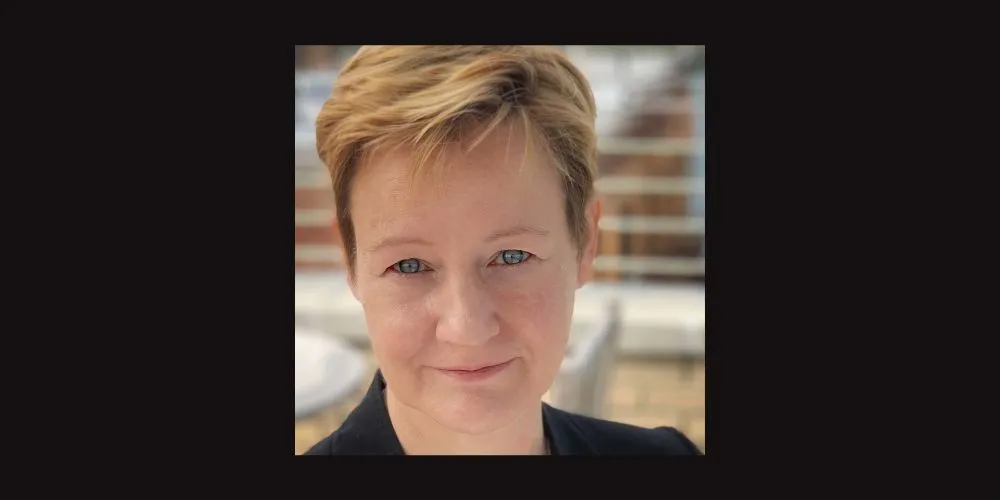
“How many people really know what stage managers do? We’re in the dark…We operate in the shadows,” Assistant Professor of Professional Practice Linda Marvel tells me on a December afternoon in the lobby of Dodge Hall. As Linda approaches the table where I’m sitting, she passes a few students she knows and checks in with them before saying she’ll see them at the Theatre Program's holiday party that evening. Linda’s interactions with these students are a clear indication of the role she’s played in this community for the decade-plus that she’s been on faculty at the School of The Arts. Marvel was brought on to teach by Associate Professor of Professional Practice and head of the Stage Management concentration Michael J. Passaro because of their familiarity with each other from the world of professional theater. At first, Marvel taught a class on the stage management of plays—a foil to Passaro’s class on musicals—but today Marvel's role as Professor of Professional Practice includes mentoring and advising students as they fulfill their hands-on production requirements for their degrees. “Doing what we are teaching them to do in classrooms and being with them in the practice of the doing,” she said.
Marvel was introduced to theater at a young age. “My parents took me to [the] theater. I always knew and appreciated the art form. My dad was a huge fan of the classic musicals, like Rogers and Hammerstein.” Growing up outside of Washington DC, Marvel also had access to vibrant regional theatre, pioneered by artists like Zelda Fichandler and theaters like Arena Stage and Shakespeare Theatre Company; but her first close encounter with a theatrical text and foray into stage management happened by circumstance. “I never wanted to act, but a friend of mine did and got involved with the high school theater," Marvel said. "She kept saying, come do something for the play.” Because of this encouragement, Marvel went to check out the theater section of her school library, “to see if this is something that speaks to me.” She picked up Master Harold and The Boys, a work by South African playwright Athol Fugard. “[Reading it] I really had one of those crystalline moments that informs your path. I felt if this genre could be this provocative, if it could make people think about themselves, their place in the world, how other people were living. I wanted to be a part of helping to create that.”
But it was exposure to the work that made Marvel understand the nature of the job. “I saw that there was this role that everyone referred to as a stage manager, and they were kind of at the center of the wheel. They spoke to everyone, they coordinated, communicating directly with the director and with the designers and with the actors and helping it all come together by being that central hub. That just felt like a niche where I [fit]. I loved communicating. I loved the interpersonal relations and the human aspect of it…so I decided that's what I want to do, and I started stage managing all of the high school plays and musicals.”
In those early days, Marvel was largely self-taught, driven by passion and attention to detail. In her spare time, she would practice what is known as blocking notation—the act of physically annotating where bodies are on stage and how they move—by studying reruns of the old sitcom Three’s Company. “[It] hasn't aged well, but was very funny at the time…I picked that show because it moved quickly. It was mostly a unit set, the apartment that they shared, and that set had four entrances, the main door, the two bedrooms and the kitchen, which was like a chef's door. It was a double-hinged door. So that was an interesting challenge because the door didn't just open one way.” While watching the show, Marvel drew up floorplans and notated where each character moved and when, pushing herself to pick up every minute detail of the scene.
This passion and commitment carried forward into her studies at The University of Maryland, where her studies in theatre called for varied coursework. “Which I actually liked," Marvel said, "because by that time, I understood that to be a stage manager, you had to know a lot about every aspect of theater, not just stage management. You could specialize either in performance or technical production…of course, technical production is what I specialized in, but that gave me classes in every form of design and in directing. I took an acting class because I felt like I needed to know what [actors] went through.”
“It is very much an artistic job. As stage manager, your focus is condensed down to the crux of what the actors and the director have found together in the scenes, the beats, the art of the story and the art of the characters. To maintain that, you have to be laser-focused."
After a few years of professional work in DC, Marvel made the move to New York. At this point, she’d learned the nature of the regional theatre ecosystem: when works came to cities like DC, it was because they’d premiered in New York. She wanted to work on the premiere. Marvel found herself drawn to theatre that felt transformative, that "can change the way people see the world, and the way they move through the world.” One of the earliest productions she worked on in New York was a Sam Sheppard play called God Of Hell—a work of satire in response to the New York City terrorist attacks of September 11, 2001—which premiered in 2004 at the Actors Studio Drama School in partnership with The New School. Marvel’s professional tendencies—a preference for plays with pol, close relationships with the creative team, and a sensitivity to the life of the play—were starting to cement and grow.
A few years later, while in La Jolla working on the first run of her close friend Doug Wright’s musical Hands on A Hard Body— Marvel worked on its Broadway transfer—a friend asked if she wanted to meet Athol Fugard. “He was looking for a stage manager. She did not know my history with Athol Fugard… she didn't know that he was my inspiration for this entire career choice. Of course, I said yes. He was living outside of San Diego and we met for ice cream and he told me about his new play and I told him about how much he meant to me. And then I did four plays with him. Two new ones that he wrote and a new production of Master Harold and The Boys, which was done in the fall of 2016.
"We were running when Trump won [the presidential election]," recalled Marvel. "That was a unique stage management challenge. My cast—which consisted of two Black men and one Jewish man—one was backstage in a fetal position and the other was climbing the walls because his girlfriend's Iranian, and he is a Black man. Almost every line of the play felt like a bomb being dropped in the theater in terms of how meaningful it was to that current moment.”
By the time Marvel started teaching at Columbia she had about five Broadway shows under her belt, including Adjunct Theatre Professor Moises Kauffman’s 33 Variations with Jane Fonda, and Fela!, a musical celebrating the life and career of the Nigerian singer Fela Kuti. Her varied professional experience equipped Marvel to not only impart the necessary logistics for stage management—dealing with contracts, familiarity with union clauses, building schedules—but also the artistic finesse needed to do the job well. “It is very much an artistic job," Marvel said. "As stage manager, your focus is condensed down to the crux of what the actors and the director have found together in the scenes, the beats, the art of the story and the art of the characters. To maintain that, you have to be laser-focused." One of the crucial skills Marvel hopes to impart to future generations of stage managers is this laser focus, this attention to the artistic core of the production. For Marvel, the work of a stage manager is impossible without this artistic understanding. "How can you understand where to place a sound if you are not taking an artistic approach to the work? How are you understanding the director, how the director is directing the actors, if you're not listening?”
Marvel notes that as a professor she is thrilled to provide her students with the pre-professional experiences and exposure she had to fight for as an undergraduate—"They're getting taught by people [working professionally in theater], so they get the opportunities to shadow Broadway shows or visit rehearsals"—but her motivation for working with students always comes back to her own enthusiasm for the field, which is infectious. I imagine her students are entirely absorbed by this energy in the classroom as I was during the interview. “For me, it's been such a fruitful career…You're in rooms eight hours a day talking about the human condition. It's fascinating, and, I think, helps make me a better person.”