This Is Who We Are: James Ijames
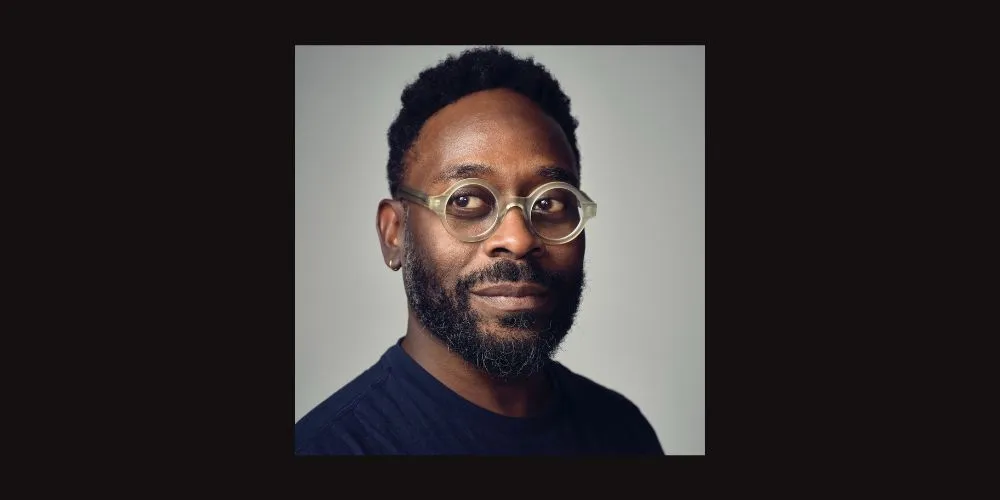
This Is Who We Are is a series featuring Columbia University School of the Arts’ professors, covering careers, pedagogy, and art-making. Here, we talk with Assistant Professor of Theatre James Ijames about plays as communal, interpretive experiences and the importance of getting people together.
We don't want to talk about the pandemic anymore, but here it's important. James Ijames believed in the power of theatre to bring people together when he first staged Fat Ham, even if gathering took an unconventional form. The play, which won a Pulitzer Prize for Drama, is an adaptation of Hamlet that takes place at a southern cookout. (Ijames teased, "What does the Hamlet narrative look like if it’s queered, and if it’s infiltrated and taken over by people of color?") Wilma Theater filmed a production of the play during the first, deepest winter of the COVID-19 pandemic on an outdoor stage, a real life porch and backyard in rural Virginia. There aren't leaves on the trees. It must have been cold.
To protect the health and safety of the crew, the number of people allowed on set was so limited that sometimes Ijames wouldn't be able to attend. He'd instead watch screening tapes at night and give notes for the actors and director to incorporate by the next morning. When Wilma released the play in spring of 2021, viewers could purchase a ticket that would allow them to watch the video-play just once, to mimic the experience of live theatre.
I like to imagine how the screening brought people together, even when gathering felt impossible. Maybe a family projected the video onto the back of their garage and invited neighbors with scarves, lawn chairs, and beer. Maybe some friends opened a group chat and texted each other furiously, silently, or then with laughter, as they watched in unison across the country. Maybe someone was recovering from the disease and all alone, and as they lay their sore body in bed and watched the cast of Fat Ham, felt for the first time in weeks the warmth of shared human grace.
"[The pandemic] taught me that we still, even when it's against our best interest to gather, we are absolutely communal beings," Ijames said. "We still needed it and we still did it. It just looked different."
Before Fat Ham, Ijames had built an illustrious career in Philadelphia, where he was the co-artistic director of Wilma Theater, a founding member of the playwright producing collective Orbital 3 and a beloved professor at Villanova. Fat Ham earned Ijames not only a Pulitzer, but a Drama Desk award and a slate of Tony nominations. In 2024, he was invited to give a commencement speech at Columbia School of the Arts. The next year he was invited to join the faculty. He's now the newest member of the Theatre department, an associate professor and the head of the Playwriting concentration.
When Ijames teaches students, he doesn't want to help them write one play, he wants to teach them how to write their plays; a body of work uniquely their own. To do so, he said, "I want them to have a mission. I think it's something that can sustain you. Even in the dark times, when it's not good and you're getting rejection letters, you have this thing inside of you that's like, but I still want to gather people. I don't think you know it when you start out. I think it's a thing you discover about yourself as you're making."
For Ijames, his mission has been to get people together, ever since he was a kid in North Carolina who dreamed of one day becoming a minister. That mission has not changed, though it has taken different forms over time. Ijames comes from a family of educators. His mom is a first grade teacher. His grandmother taught young people, too. While at Morehouse College, which offers a theatre degree but only a small selection of theatre classes, Ijames commuted to Clark Atlanta University to take his first acting class. There, one of Ijames professors, Carol Mitchell-Leon, nominated a play he wrote for a one-act festival. Her encouragement stuck. "I could really do this," Ijames realized. As he became an educator himself, he appreciated the power in his influence and support. "I hope [students] stay in touch and can always think of me as a mentor," he said. "Writing is so hard. You collect people and then you just hang onto them. I hope they know they can always reach back."
Key to his practice and pedagogy is the unique, communal dimension that performance brings to playwriting. Unlike a novel, the words in a script are written with the intention to be transformed by actors and received by audiences, live. A play is meant to be experienced by people, together. "I am always really really thinking about the audience because the thing I like the most about being a playwright is, you inherently have to gather people together." His words take on a new form when they're received by actors, then audiences. He sees a script as an active document, something that is built by each hand that touches it.
The German philosopher Walter Benjamin proposed that in order to translate well, the writer needs to reach an understanding of the original text that is essential, beneath or preceding the language itself. For playwrights like Ijames and the students he teaches, to write a play is to build a deep foundation of meaning that can sustain the layers of interpretation that will grow from the words on the page.
"[A script] has to lift off the page into the next set of dimensions," Ijames said. "And that means other people's knowledge and expertise helps bring it to truth. It's the combination that brings it to truth…I just spent years looking at a bunch of different productions of Fat Ham, and each time it's a distinct, new experience."
To Ijames, playwriting distinguishes itself from other forms of writing because of these dimensions of interpretation, performance, and time. "How do these words live in the air? Do the actors have the things they need to perform the roles? How does it work in real time and space?" he asked. "Time is as much the medium of the playwright as words are. That's what makes us similar to those who compose music…It's very present tense. Theatre has to be a thing that happens in front of people in real time."
In Ijames' classroom, students study more than craft elements like structure and rhythm, but can practice distilling the notes they receive from actors, audiences, and directors into a script that can connect with each person to build an experience that inspires a new idea. Ijames encourages his students to build relationships with each person who makes the play in order to know what they need. Actors help playwrights understand what words will give the play its best performance. Directors can give playwrights a sense of structure, insight into the dimension of time. And playwrights can share with directors and actors the purpose behind each individual beat. "We're not throwing darts at words," Ijames said. "We're intentionally choosing diction, putting the character on the line."
Ijames has firsthand experience with the ways theatre artists can work together and relate to each other, largely because he has held so many different roles in the theatre himself. Though he received his MFA in acting at Temple University, while in Philadelphia he threw himself into the experience, expanding beyond one job on the stage and pushing the expectations of what theatre could look like.
"I cut my teeth doing these strange, odd plays in very strange, odd places. I remember I did a production of Oedipus at Colonus at a skate park under a highway overpass. The audience had to tune into a radio station through headphones to hear the play. And I was devising things with friends, and all the time I was still writing. I felt like I could be a total theatre artist and I didn't need to nestle down into an acting career. Even though I got my MFA in acting, I always knew I wanted to do other things. Philadelphia was a place that gave me the chance to act on that."
Recognizing the strong influence that Philadelphia has had on his body of work, at Columbia, Ijames encourages students to see New York City as a lab. "A city offers so much of the scale of what humanity can endure," he said. "If you're really open and receptive to that, that's how you find the music of how people actually speak and behave. I'm always talking to [my students] about [the fact that] they're in a city." In New York, Ijames said, the industry is dynamic, quick to find inspiration in new corners. "Be out in it," he said.
New York City offers an unparalleled access for both Ijames and students to the American capital of the theatre industry, where theatre as a medium lives and transforms. "It's such a gift to be both practicing and teaching at the same time," Ijames said. "When you're in the industry and you're working, it's moving, it's changing, it's evolving, and I have this advantage where I can constantly bring new things back to the classroom. [The classroom becomes] not only this space for them to learn things that are tested and tried and true, but also the theory of the form as it moves forward. The best way for me to do that is for me to be in my own laboratory, thinking, 'What do these things mean to me as an artist?' so I can help them find that for themselves."
Ijames's career has been one marked by creative risk taking, an openness to the unconventional, and above all an emphasis on connection. Back in 2024, when he delivered the commencement address at the School of the Arts graduation ceremony, he drew a comparison between graduates and the Fool card in tarot, which depicts a young, hopeful person at the beginning of a journey, traveling light and accompanied by a small dog, unconcerned by the upcoming obstacles on their path.
"Whenever I encounter this card, I fall more and more in love with the idea of beginning requiring purpose, companionship, and perhaps most importantly, the ability to move without knowing what's next. Some would say that's reckless. Some would call that faith. But I believe that the beginning of creative imagination is not knowing…and the thing that has never failed me is to continue. When it's hard, when it's scary. When you feel invisible. Choosing to continue is radical, holy, and immensely powerful."
In the face of doubt or adversity, Ijames continues because of his mission, his love of bringing people together. "I've devoted my life to making an excuse to get to gather," he said. "I just keep making invitations. That is the thing that keeps me going. I love people, and theatre, you've gotta do it with people."