This Is Who We Are: Hilary Leichter '12
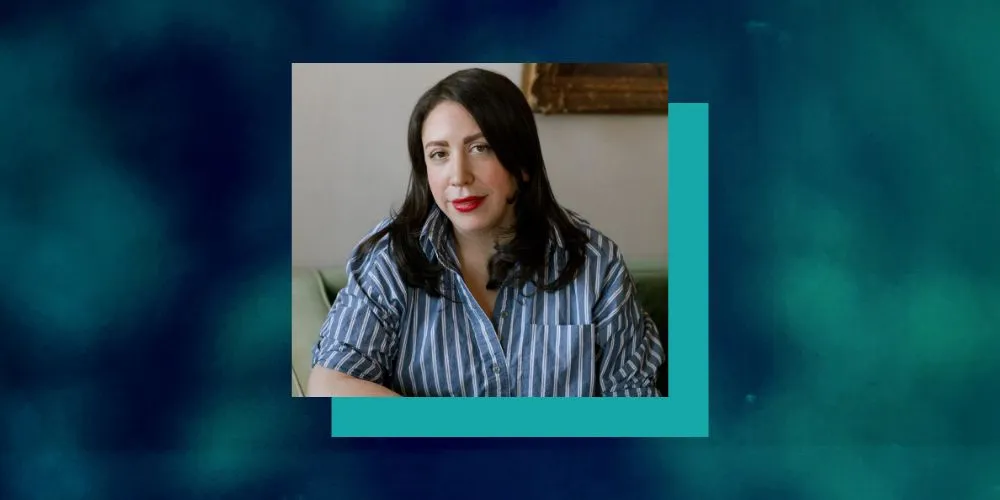
This Is Who We Are is a series featuring Columbia University School of the Arts' professors, covering careers, pedagogy, and art-making. Here, we talk with Assistant Professor Hilary Leichter '12 about creative investigation, letting go, and Bernadette Peters.
In 2017, Assistant Professor Hilary Leichter '12 wrote a short story, soon picked up by Harper’s Magazine, called "Terrace Story." In it, a housebound couple discovers a magical terrace that only appears when a friend visits. Their relationship is loving but claustrophobic, and the friend and her terrace bring spaciousness. The end contains a twist that has stuck with me for years—not least because I read the story, which eerily captures the mood of lockdown, the month it was published: May 2020.
"I creep myself out," she said, in her gemütlich office on the seventh floor of Watson Hall. At the time she was an adjunct assistant professor at Columbia. Now she is on the tenure track and the Director of Undergraduate Studies. "Terrace Story" won the 2021 National Magazine Award in Fiction, and Leichter developed it into an acclaimed novel. It’s funny how things turn out. While Leichter has been hard at work, she admits she has no control of how that work is received.
"I wasn't thinking about the pandemic at all. And then [the story] came out, and I was getting messages from friends like, oh my god, this is my life right now. But that's what happens with fiction, you know? We really don't have any control over whether it's going to be relevant, or how it's going to be relevant, just because there's so much time between imagining something and writing something and publishing something. So you just don't have any say whatsoever."
Sitting at her desk, Leichter has the open posture and large, expressive features of someone trained to be a stage actor, which she was. Growing up, her goal was to become Bernadette Peters.
"I just didn't know anyone who wrote books," Leichter said. "I didn't know it was a thing someone could do." But in college, she started writing plays. "And I decided I got a lot more joy and fulfillment out of creating my own art, not interpreting someone else's." She applied to MFA programs for fiction, and attended the School of the Arts.
Still, Leichter's curiosity as a writer might be informed by her theatre practice, her interest in examining herself and her interactions with the world for inspiration, if not material. She's learned to pay close attention to the things that spark her interest, light her up.
"I used to think, well, what will be interesting to other people?" she said. "Now, I think, if I’m not interested, then no one else is going to be interested. A short story might take a year of my life. A book might mean five years or longer. What’s going to hold my attention long enough so I can get this thing done?"
Her upcoming novel is about perspective, with its subject and form answering the question of what would happen if you could access someone else’s point of view, even just for a second. "[An idea for a book] has to be kind of this slowly unfolding mystery that reveals itself to you in new ways over time, constantly changing the more you work on it. And a lot of good ideas aren't that," she said. "I've had ideas where I thought, oh, that would make a killer book or a killer short story. And there's just not enough there to kind of trap me."
For Leichter, following her idea to its core organizes the creative decisions that follow. "For fiction, voice and story and perspective and language are all so intimately linked that, by the time I've sat down to start writing this idea that I've become obsessed and infatuated with, so many of these things have already decided themselves without my permission," she said. "It was always the voice of the story. Like it existed before I was born, and I found it floating around in the ether.
"If you realize what little control you have, I think it makes you a freer writer. I think it makes you a more humble writer," she said. That relinquishing also informs her pedagogy: she sacrifices the security of the limited circle of what she does know for the curious pursuit of an idea.
"I used to ask these questions where I knew the answer and I was fishing for someone to say the thing I was thinking. That's a terrible game to play," she said. "So [now] if I ask a question about someone's story or a line in a story, it's because I genuinely am curious or don't understand. And what a relief to not know things, you know?
"I think I have the same approach in the classroom as I do with my own writing, which is: I'm an idiot, and I'm doing this so I can learn something. And I'm hoping to be humbled and inspired and awestruck by whatever we do here [in class] today or whatever I discover by sitting down and writing."
Leichter hopes her students learn that great art is rarely made in the pursuit of a good grade. Instead, she encourages them to follow their instincts to what only they could say, and then craft the idea until it’s as good and true as it can be. "Those are two very different parts of the process: the act of creation and the act of revision and perfecting the art that you've come up with," she said.
Columbia is a research university, and Leichter contends that the kind of rigorous reflection and questioning that goes into creative writing is its own form of human research. "In fiction, we don't often think about it as an investigation of something. But I think it is," she said.
The balance to strike is between a writer’s internal, self-motivated interests and being open to the world. Leichter especially loves teaching undergraduates because they may or may not want to be writers. The creative investigation she teaches them might come back in unexpected ways.
"In undergrad, a lot of our students do become authors, but a lot of them become, you know, neurosurgeons and work in statistics or finance or become social workers. That's exciting to me. Thinking about books, thinking about writing, really asking questions about what it means to make art and what it means to be a person, right now in 2026 in America—these are questions that can be important to you no matter what you end up doing with your life."
Leichter’s relationships with former classmates, with other writers and artists, continues to ground her creative practice. "I applied for MFA programs and from there found my people."
She aims to support her students finding their people, too. "When I'm in the classroom, I'm really coming from a place of honesty and curiosity. I feel like it's not about me. It's not about my relationship with the classroom. It's about students' relationship with each other. I see myself as someone who is bringing a cohort together. When you're an artist, it's so important to find your people and your community. They're your soulmates."