Teaching Writers to Teach Writers: Professor Keri Bertino Breaks the Fourth Wall in The Writer as Teacher

In the course description for one of the Writing Program's most clamored-for classes, Lecturer in Writing Keri Bertino '09 poses two classic questions in writing pedagogy: "Can creative writing really be taught?" and "Is it possible to teach English so that people stop killing each other?"
Bertino has been teaching The Writer as Teacher for close to a decade now. Conceived in 2002 by Professor of Professional Practice Alan Ziegler—now the Director of Pedagogy for the Undergraduate Creative Writing Program—in response to students' requests for teaching opportunities, the class is geared toward students who are curious about teaching creative writing in any setting. Over the years, the class has mirrored students' interest in teaching, expanding to accommodate multiple sections offered at least once per semester.
As a student in Bertino's Spring 2026 section (and therefore a double agent), I was afforded a unique capability of reporting on the class, acting as student first, journalist second. About halfway through the semester, I met with Bertino on Zoom to discuss her teaching philosophy, The Writer as Teacher, and the intersections of teaching and creative practice.
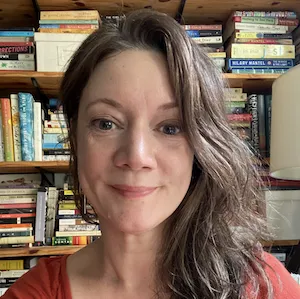
"I'd love to get into your lesson plan first, if that's okay?" she asked. I had forgotten that we booked an extra fifteen minutes so I could attend office hours, too.
The class structures itself fluidly like that. Sometimes, students act as one another's teachers; other times, Bertino performs her role as meta-teacher, narrating the reasons behind her lesson design as she teaches it, like verbal footnotes. It's strange and exciting to be let in on the tricks of the trade. Following a turn-and-talk, conversation will not only cover the pedagogical research papers we read for class, but how breaking into pairs shifted the classroom dynamic, reenlivening a sleepy post-lunch bunch by reminding us that we are active participants in our own learning.
I asked about the class's evolution over time—how Bertino arrived at the practices she now utilizes seemingly as second nature. "When I first taught it, honestly, I did all the stuff that we do in class!" she told me. "I really did. I thought, what do I want to make sure that graduate student teachers can do by the end of this?"
Her answer: "I want them to be able to teach!"
In-class lesson plans, or demo teaching—"actually preparing to teach and sharing that with their community"—became a hallmark of her section of The Writer as Teacher. But to design a meaningful lesson, one must have a course in mind. So, she had students design a course.
"One of my goals for the class is to help students approach their teaching in a really thoughtful, intricate, informed way—while also not terrifying people," she laughed.
This semester, Bertino debuted a new version of a core assignment: the Working Syllabus. On the first day of class, Bertino asked us to imagine our dream course. When we discussed creating classroom communities, designing assignments, and evaluating student writing, it was in the context of these imagined courses. Split into sections like "Course Description," "Core Work / Assignments," and "Course Calendar," time was reserved across class sessions for workshopping each element of the syllabus. This is a practice referred to in pedagogy as "scaffolded assignments." Providing feedback on the smaller, lower-stakes assignments, she supported our work toward a larger, cumulative assignment: a fully-realized syllabus for a class of our own design and choosing.
For those of us who wanted to jump into the deep end, these imagined courses became a reality. Columbia Artist Teachers (known lovingly among the Writing Program as CA/T) is an initiative that spawned contemporaneously with The Writer as Teacher, with a dual mission: to provide accessible teacher training for all Columbia MFA students and enrichment through the arts for the wider New York City community. Every year, CA/T's student directors and coordinators (Bertino herself was the fifth student director) match students with teaching sites on and off campus including local elementary, middle, and high schools; community organizations like The Bridge and Red Door; and the Incarcerated Writers Initiative. Each semester, they also offer a roster of CA/T Community Classes (CCC): free, non-credit, 5-6 week creative writing courses taught by MFA students in the Writing Program, open to all current Columbia and Barnard students, staff, affiliates, and all School of the Arts alums.
Any Writing student who has taken or is currently enrolled in The Writer as Teacher is eligible to teach a CCC class. The Spring 2026 Coursebook included courses such as "Poetic Form, Reformed," "Substack Attack," and "Playing with Time in Fiction." I spoke with a couple of Bertino's former students who had taught CCC classes. Both highlighted one particular aspect of CCC: the opportunity to identify a gap in the official course offerings, and fill it.
Batool Rizvi, a second-year Poetry student, taught her first creative writing class, "How to Guzzle the Ghazal: A Poetic Practice" last semester. Rizvi’s conception of the course arose from her love of the ghazal, an Arabic verse form originating in the 7th century which features syntactically and grammatically complete couplets and an intricate rhyme scheme. Historically dealing with themes of love and loss, ghazals have a tradition as a performed lyric at mushairas, or recitals, where poets would compete publicly for the most impressive application of the form. At work on her own ghazals in an independent study that semester, CCC presented Rizvi with a natural opportunity to share her expertise in a more communal setting.
Rizvi's students included an Engineering student who wanted to try something new, a graduate student in International Relations who had knowledge of the ghazal from her South Asian background but hadn't studied much poetry, and friends based in New Jersey and Toronto. They met once a week online, studying a different element of the ghazal each class. By the end of the course, students had written three to four of their own ghazals in addition to a class ghazal (each student producing one couplet), a material manifestation of the community they developed around this poetic form.
"I feel like I was able to create a sense of community," Rizvi told me. "And I learned so much about what it's like to be a teacher…which is that you are a student."
Of course, she added, it’s important to facilitate conversation and keep things running smoothly, but she learned just as much from her students' observations as they did from her. She emphasized the importance of classes that speak to underrepresented forms and bring in curriculum that isn't necessarily taught in the Western canon. Rizvi shared a quote with me from the poet Agha Shahid Ali's introduction to an anthology of ghazals he edited, Ravishing Disunities:
"If one writes in free verse—and one should—to subvert Western civilization, surely one should write in forms to save oneself from Western civilization?"
For Rizvi, it was thrilling not only to facilitate, for some students, an encounter with a form they had previously been ignorant to—therefore allowing them to find new possibilities within formal restrictions—but to provide, for others, a space to recognize themselves in art.
"I think that was the magic for me in this class—where students were like—oh, I know what this is," Rizvi said.
Rigor follows excitement. "It's such a gift for the students and the teachers," Bertino said of the blank slate presented by CCC courses. "It is such a strong learning support to say: start from your interests and your strengths." And what you want to teach says something about your teaching values.
"In my writing, sex is often more than one thing. It's not just pleasure," Hannah Wederquist-Keller, a third-year student in Fiction, told me.
She had found that, over the past five years of writing about sex and taking classes on writing sex, the general focus was on how to write pleasure—how to move through intimacy without relying on cliche or pornographic language or clinicality.
The CCC class she conceived as a third-year Research Arts student auditing The Writer as Teacher, "(Un)invited Intimacy," asked a difficult, necessary, and under-addressed question: "how do we write about sex that's not pleasurable?"
Though this is, in theory, a thorny topic for a new teacher, Wederquist-Keller was well prepared to have those conversations: "Because it's what I write about, it's all that I read."
Wederquist-Keller's thorough study of memoirs and novels that deal with nonconsensual sex, coercion, and abuse formed the basis of her syllabus, which was bolstered by the student-centered, inclusive teaching practices she learned from Bertino's class. Teaching a 20-minute version of her class to her peers during demo lessons—another key element of Bertino's curriculum—proved revelatory:
"I was simply amazed, both in my CCC classes and in the demo lesson, that people were capable of reading these really graphic, painful, emotional, vulnerable, intimate texts, and bringing to the work their lenses as readers and writers," Wederquist-Keller told me. "Keri has such faith in each person's intelligence that it makes you believe in yourself…teaching that class to a large group of students…I think that was the best day of my Columbia experience. It was really empowering."
A meaningful teaching practice arises from natural curiosity about the world, and about other people: "Some of the best teaching comes out of moments of genuine curiosity," Bertino told me (during the office hours portion of our meeting, in response to my concern about not having the 'answers' to the questions I was posing). Teaching can mean learning to phrase questions that we're genuinely invested in, and that will help others think through them.
Bertino herself approaches her class as a work in progress, revising as the semesters go by and doing a "total overhaul" every two to three years. The "Working Syllabus" assignment arises from her own teaching practice: "Right now I have a file open called 'Fall 2026 Writer as Teacher' where I put notes for next semester," she laughed. "What people were interested in, what I would cut, new articles I’d like to assign."
Whether or not one believes creative writing can really be taught hinges on their definition of the word "teaching." I turned that question on Bertino (she had asked it of us at the start of the semester):
"Work we do to support the learning of others," she said simply.
For writers, "it's not just about how to make everybody's pieces better, but about how we can support the whole writer in their development, as we encounter them in this moment. What does this person need, right now, to continue on their path and grow?"