Professor Rob King Edits Special Edition of 'Studies in American Humor'
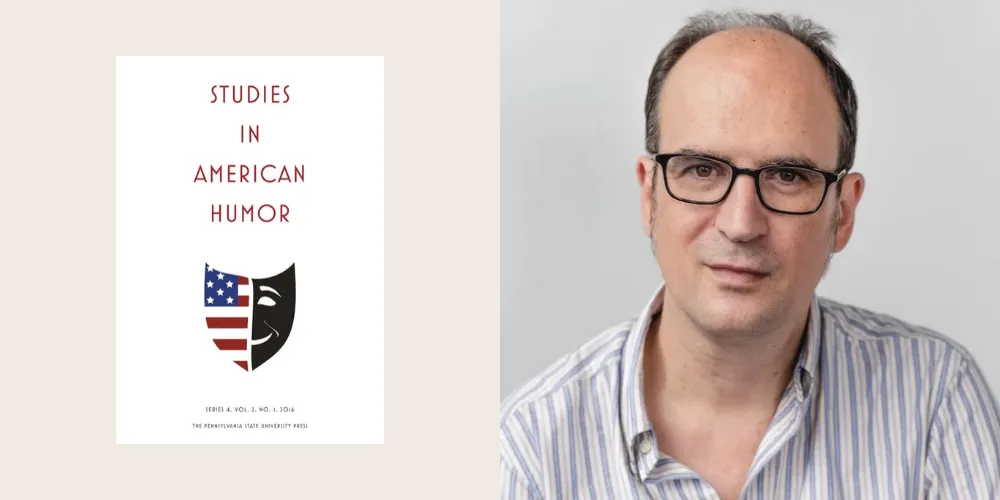
A special edition of Studies in American Humor (StAH), edited by Professor and Head of Film and Media Studies Rob King, was published last month. This journal—the official peer-reviewed publication of the American Humor Studies Association published by Penn State University Press—was established in 1974. The publication supports humanistic research on American humor across print, media, and public life. “StAH specializes in humanistic research on humor in America (loosely defined),” according to the publication’s website, “because the universal human capacity for humor is always expressed within the specific contexts of time, place, and audience that research methods in the humanities strive to address.” This particular issue, titled “AI and Humor,” looks at the encroachment of AI on humor computation, which King outlines in his introductory essay, “Humor In The Loop.”
“AI is a cultural obsession these days, but it’s been trying to be funny for decades,” King’s chapter begins. Using examples of semantic ambiguity jokes—jokes whose humor lies in the confusion about the meaning of words– King compares two eras in AI engagement with computational humor: the “Symbolic” approach of the 90s—via Joke Analysis and Production Engine (JAPE), a 1994 model created by computer scientist Kim Binstead—with the "Statistical" method of the large language model (LLM). As AI has progressed, the approach of humor-creation has gone from an attempt to generate jokes based on explicit linguistic theories, the “Symbolic” period, to a reliance on pattern recognition of the structure of jokes without accurately applying the mechanics needed to make a joke work, the “Statistical” period. “In other words,” King writes in the introduction, “the first wave of computational humor implementations was inseparable from theoretical inquiry into how humor works. These days? Not so much. To survey the field today is to become aware of a seismic shift in energies, a move away from the linguistic models that informed the early GOFAI (“Good Old Fashioned AI”) generators and toward a more math-driven paradigm shaped by the probability calculations that structure today’s LLMs.”
“My interest in AI and humor has been a long-standing one,” King said. “As a comedy scholar, I was always aware of computational research into humor; but the advent of commercially available LLM platforms in 2022 inspired me to catch up on what had been going on. And I don't think anything's made me laugh quite as reliably as the kind of hallucinations that AI generated early on. Fundamentally, I think the possibility of AI-generated humor represents a profound moment for humor studies. It's long been a cliché that humor is a specifically human property. But we're on the brink of that no longer being true. That's something I thought worth exploring.”
To do this, King reached out to a number of “foundational figures in computational humor research from the 90s” for contributions to this special edition of the journal. “I wanted to put their work in dialogue with the new avenues that contemporary AI is opening up,” he said. What Kind ended up creating, as editor, was a journal edition marked by an interdisciplinary approach and analysis to the question at hand. Kim Binstead—a Computer Scientist, pioneer in the field, and Professor at The University of Hawaii—contributed a chapter focused on AI’s potential to generate more complicated forms of jokes in the style of “the shabby-dog story,” a type of joke with an inanely complicated backstory and underwhelming payoff. Salvatore Attardo—Professor of Applied Linguistics at East Texas A&M—has a chapter co-authored with Stephen Skalicky— a social scientist at The University of Wellington—investigating if LLMs are better at evaluating existing theories about humor than generating jokes. Julia Rayz, a computer scientist based at Purdue University, distinguishes between “the formal linguistic ability to produce humor and the functional ability to use humor appropriately.” Another chapter by Professor Literature at MIT, Benjamin Mangrum, explores the question of humor being “AI-complete.” In her chapter, Lindsay Rogers, Professor of Communications and Knowledge Mobilizer at Concordia’s Applied AI Institute, considers how biases within AI training data reproduce cultural prejudices, particularly concerning feminist comedy. The issue includes reviews of Funny Because It’s True: How The Onion Created Modern American News Satire (Running Press, 2025) by Christine Wenc and Pleasure, Play, and Politics: A History of Humor in U.S. Feminism (University of Nebraska Press, 2026) by Kirsten Leng, among others.
Professor King is a film historian exploring American genre cinema, popular culture, and cultural history. His latest book, Man Of Taste: The Erotic Cinema of Radley Metzger, published by Columbia University this past March, looks at one of the foremost American directors of adult cinema during the ‘porno-chic’ period in the 70s. King’s past publications include two other books: The Keystone Film Company and the Emergence of Mass Culture (University of California Press, 2009), which examined how The Keystone’s Film Company, founded in 1912, contributed to a new style of slapstick comedy films in the 1910s; and Hokum! The Early Sound Slapstick Short and Depression-Era Mass Culture (University of California Press, 2017), where King argues against the idea that sound ruined the slapstick cinematic tradition. King has also published articles on early cinema, class, and comedy in a number of journals and has co-edited five anthologies: Early Cinema and the National (2008), Slapstick Comedy (2010), Beyond the Screen: Institutions, Networks, and Publics of Early Cinema (2012), Cornell Woolrich and Transmedia Noir (2023), and The Oxford Handbook of Silent Cinema (2024). In 2025, he contributed the chapter “Cyborg Laughter” to The Oxford Handbook of Screen Comedy. He is currently at work on a book on the history of computational humor.
After the release of Nathan Fielder’s film You Can See Everything, semantic ambiguity, and particularly jokes about semantic ambiguity, have gotten a lot of attention. I couldn’t help but use the opportunity of writing this piece to ask Professor King what he thought about the use of Abbott and Castello's classic bit “Who’s on First?” in the film. “Do you think Elizabeth Holmes understood who’s on first?” I emailed him. “No I don’t,” he told me, “That said, I don't think Fielder did a good job of setting the routine up."