Minna Zallman Proctor '98 Wins the 2026 PEN Translation Prize
Update:
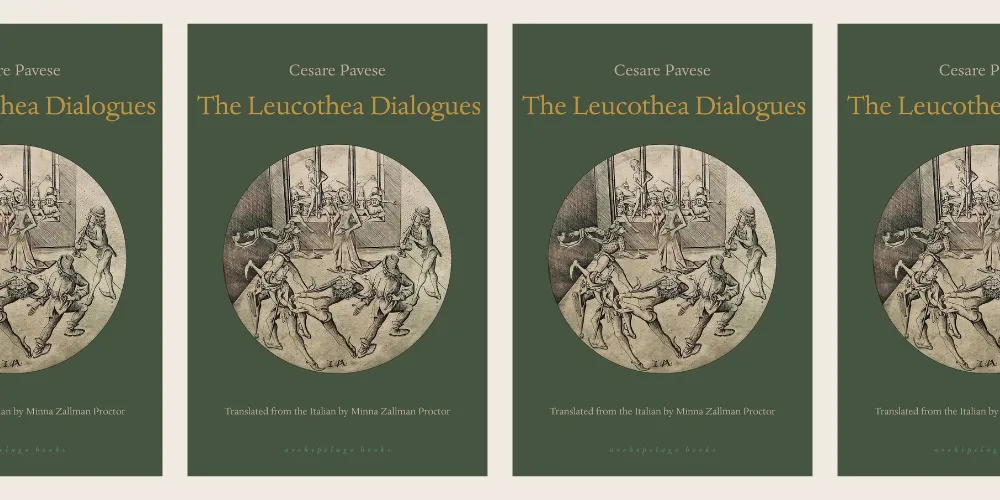
Minna Zallman Proctor '98 has won the PEN Translation Prize for her translation from Italian of The Leucothea Dialogues by Cesare Pavese. In the Dialogues, published by Archipelago Books, Pavese puts figures from Greek mythology in conversation in order to process his personal, even private, concerns.
If Pavese transformed these original myths from Greek, Proctor has reinvigorated Pavese's Italian: she uses her "consistently fresh and contemporary tone and rhythm, [and] makes the book come alive for readers today," PEN America wrote.
The PEN America Literary Awards are likened to the Oscars of literature, and stars came out to celebrate the written work pushing the boundaries of art today. Actor and director Emmy Rossum arrived on stage to present the awards in translation and translated poetry.
"It is such a joy to be here tonight, celebrating translators," Emmy Rossum said as she presented the award on stage, "the people who quietly, powerfully, expand the way we see the world through language—especially those working in the early- and mid-stages of their careers who are shaping what stories get to travel and be heard."
"Minna Zallman Proctor’s vigorous retranslation from Italian of Cesare Pavese’s singular yet multiplicitous The Leucothea Dialogues stands out from a superb shortlist as a brilliant meditation on, as well as in, translation," PEN America wrote. They highlighted Proctor's elegant introduction, where she uses a mythological register, the figure of Arachne, to comment on the nature of translation.
"When you start changing things like that, someone might complain that you’re challenging the real author," Proctor writes, in the voice of Arachne. "I’ve ‘heard’ that comparing yourself to gods can make them mad.”
"Arachne certainly has “heard” that—she has lived it, insofar as she’s lived at all," PEN America wrote. "Meanwhile, Proctor has heard Pavese, too, and stepped up to the challenge of his book, doing something of her own with her Italian original no less than Pavese did with his Greek material.”
Minna Zallman Proctor is the author of the memoirs Landslide: True Stories and Do You Hear What I Hear? My Father, the Priesthood, and Religious Calling and co-author of Bethany Beardslee’s autobiography, I Sang The Unsingable: My Life in 20th Century Music. She is an acclaimed translator from Italian, including Happiness, As Such by Natalia Ginzburg and These Possible Lives by Fleur Jaeggy. Her short stories, lyrical essays, and writing about art and literature have appeared in Conjunctions, Bookforum, Aperture, The Nation, and American Scholar, among other publications. She taught creative writing at the graduate and undergraduate level at Fairleigh Dickinson University for many years, where she was Editor of the now-defunct The Literary Review and then Director of the Low Residency MFA in Creative Writing. She was Editor and Co-Founder of the local lifestyle magazine yogacitynyc.com and worked for many years in magazines—including COLORS, BOMB, LUCKY, and GOOD—where she developed her skills in design, branding, and communications strategy. She is working on a collection of short stories, handmade chapbooks, and block printing.
See a full list of PEN American Literary Award winners here.
—
Original: February 16, 2026
Five Columbia writers have made the shortlist for the 2026 PEN America Literary Awards. Writing alums Cecily Parks '05, Joseph Lee '17, Minna Zallman Proctor '98, and Rose Waldman '14 are finalists in categories including Poetry, Nonfiction, and Translation. Associate Professor Shane McCrae is a finalist in Poetry. Winners will be announced at the 62nd Literary Awards Ceremony at Town Hall in Midtown on March 31, 2026, 7:30 PM.
Parks earned a nomination for her third poetry collection The Seeds, published by Alice James Books. The Seeds uses pastoral imagery and the natural world to weave a layered fabric of hope and its consequences.
"Women and the natural world take center stage in these precise and visionary poems by Parks (O’Nights). The collection interrogates interiority, motherhood, and the choices of famous female figures," said Publishers Weekly in their review. "Parks memorably evokes the textures and intricacies of life on earth."
McCrae is also honored in the Poetry category for his tenth book, New and Collected Hell: A Poem, from Farrar, Straus and Giroux. McCrae takes on Dante's journey to hell in the new millennium, turning to the metaphysical to contend with the paradoxes and suffering in our real, political world.
"In 'New and Collected Hell,' McCrae exploits, in a way that few other modern poets have been able to, the power of allegory: it thrives on its ability to sustain contradiction," wrote Elisa Gonzales for The New Yorker. "We read about the journey not for its literal meaning, nor for its figurative one. Rather, we read it for the way its multiple meanings, overlaid, invite us to consider the metaphysical heft of our painful lives. Is Hell real? As McCrae knows, sometimes the questions we can’t answer are the ones we most need to ask."
Joseph Lee's memoir in reportage Nothing More of This Land is a finalist in the Nonfiction category. The book investigates big questions about the nature of tribal identity in America through Lee’s perspective as an Aquinnah Wampanoag growing up in the Boston suburbs and on Martha’s Vineyard. Published by Atria, Nothing More of This Land earned starred reviews from Publishers Weekly and Kirkus Reviews, earned Tribal College's Best Native Studies Book of 2025, and was one of TIME magazine's 10 Best Memoirs of that year.
Associate Professor Leslie Jamison said of Nothing More of This Land, "Lee has given us a timely reckoning with Native sovereignty and community that is adroitly committed to the mess and nuance of lived experience, rather than sentimentalized accounts of victimhood or resilience. Nothing More of this Land is tender, ferocious, surprising, and tenaciously thoughtful; its existence makes the world a bigger and truer place."
Columbia alums earned two of the five finalist spots for the PEN Translation Prize. Proctor translated Cesare Pavese's The Leucothea Dialogues from Italian for Archipelago Books. In the dialogues, Pavese conjures figures from Greek mythology, who discuss human nature from an immortal distance.
The Paris Review lauded Proctor for shaking the dust off of the last, stodgy, mid-century translation of the dialogues: "Many of Proctor’s phrases…have an informality that’s closer to contemporary speech without being overly naturalistic," wrote Alec Mapes-Frances in his review. "Classics like the Dialogues are texts populated by statue-like beings, characters that might as well be made of white, smooth marble, with vacant eyes. They speak in a stilted, cryptic, wooden manner. This is precisely why brief instants of animation, in the hands of Pavese and Proctor, are miraculous."
Waldman is shortlisted for her translation of Yiddish writer Chaim Grade's Sons and Daughters for Penguin Random House. Originally a serial published in New York's Yiddish newspapers, the book follows rabbis and the children who push into the modernity of 1930s Poland and Lithuania.
Sons and Daughters memorializes a generation lost to the Holocaust in "a melancholy book that also happens to be hopelessly, miraculously, unremittingly funny," wrote critic Dwight Garner for The New York Times. "The language is crisp and clean; it is also bright, like a painting that has been restored. The sentences stack up deliriously."
The PEN Literary Awards will honor a slate of contemporary writers, from debut novelists to established luminaries, recognizing their contributions to the field with over $350,000 in awards. See a full list of finalists here.