Forrest Gander and Professor Dorothea Lasky Light Up Lenfest at the Max Ritvo Poetry Series
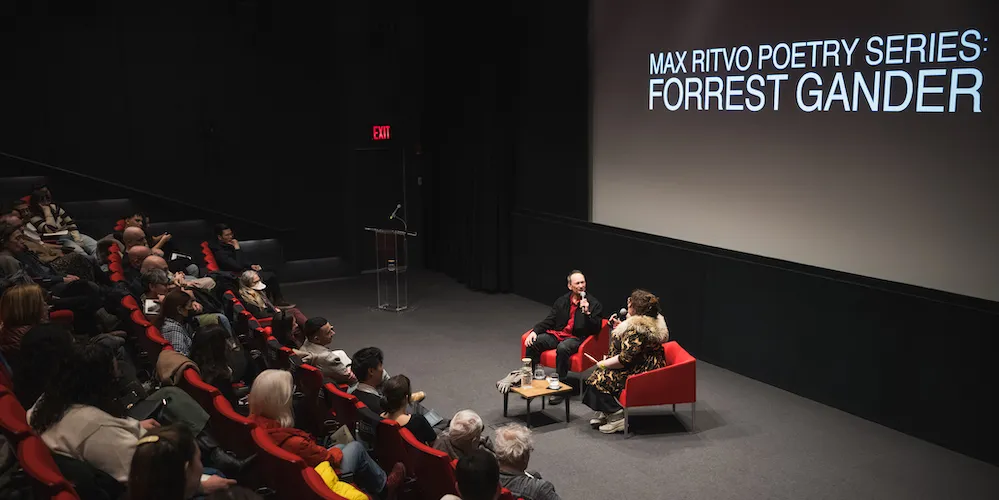
Joining faculty, students, and friends in the audience of the Lenfest Center for the Arts the evening of February 12, were several ghosts.
"We're given to think that reality presents itself as a narrative," Forrest Gander, Pulitzer Prize winning poet, said to Dorothea Lasky, Associate Professor of Writing and Concentration Head of Poetry. "And it really doesn't."
Even while he and Lasky chatted amiably about his life in poetry, he explained that he was simultaneously aware of other things going on inside him, like the presence of his ghosts—namely his late wife, the influential and decorated poet C.D. Wright—and that while we in the audience were listening to the conversation, we were also thinking about our ghosts or what we might eat later or how the rest of our evening might unfold. "That's what reality really is," he said. "A palimpsest of experience."
Organized in memory of Max Ritvo '16—Poetry alum, author of Four Reincarnations (Milkweed Editions, 2016) and The Final Voicemails, edited by Louise Glück (Milkweed Editions, 2018), and co-author of Letters from Max with Sarah Ruhl (Milkweed Editions, 2019)—the Max Ritvo Poetry Series is supported by an endowment established by Ariella Riva Ritvo and the Alan B. Slifka Foundation. The night began with a touching reading of two Ritvo poems, selected and performed by William Duanmu and Miranda Gershoni, recipients of the Max Ritvo Fellowship for graduate students in Poetry.
Gershoni read the slight, gorgeous poem "Hi, Melissa" from Four Reincarnations; softly, her voice filled the space with Ritvo’s words:
"Listening to you makes me naked. / When I kiss your ankle I am silencing an oracle. / The oracle speaks from the hill of your ankle."
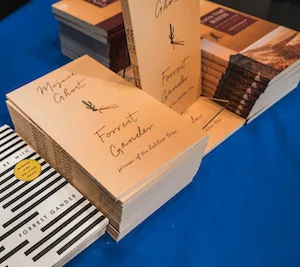
These lines opened up a portal to the world of Gander's poetry, in which intimacy is multiplicitous, always occurring between humans and their environments simultaneously. A poet trained as a geologist, Gander read from his most recent book of poetry, Mojave Ghost (New Directions, 2023), a "novel poem" that chronicles the poet's movements through grief toward renewal over the course of a physical journey: a walk along much of the 800-mile San Andreas fault toward the desolate Mojave Desert town of his birth.
"But how to sustain attentiveness?" he asked the silent room, shifting the weight in his feet as though walking in place. "How to keep the mind from dropping its needle into the worn grooves of association?" He punctuated sections of the book-length poem with measured exhales, simulating a desert wind.
"At first it seems empty, silent—then your senses start to open—you hear more, smell more," said Gander, describing to Lasky what attracts him to the desert. "It draws you out of yourself with a humility that reorients."
As Gander moved through time and space, he found that the distance between his interior and exterior landscapes—both sites of ongoing metamorphoses—began to collapse. The final page of the book is a testament to resiliency—both of the human heart and the desert ecology:
"in the hours following a brief rain, / cracks at the edges of long wounds / in the terrain begin ferning."
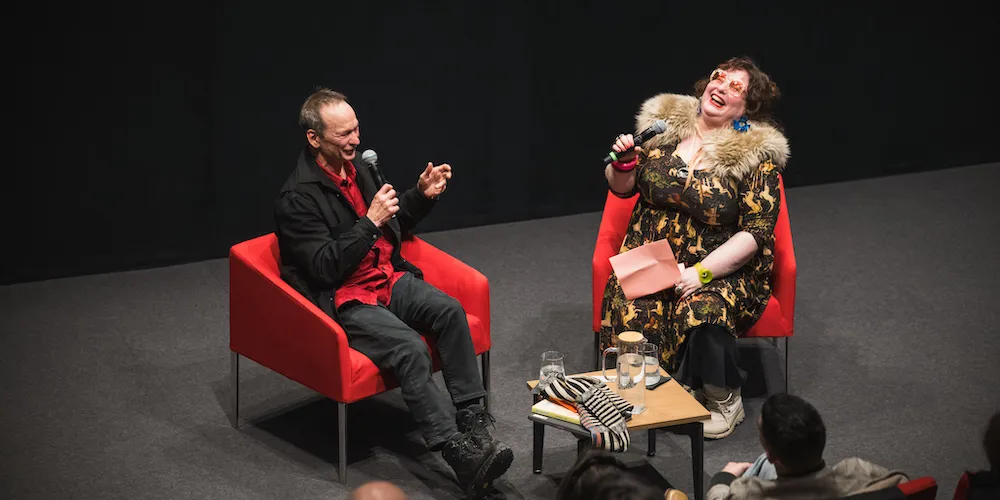
Poetry's emotional aftershock can be vast, reverberating through hours, days—sometimes lifetimes—after the poem ends. In contrast, the poetry world can feel quite small at times. Jovial and genuine, Lasky and Gander lit up the space, making it feel more like a friend's living room than an auditorium. Lasky opened the conversation by telling Gander about her experience reading him when she was applying for a prize he was judging: "You were one of the first poets who really made me think about poetry," she said.
For Gander, that person was his mother, an amateur naturalist who would read him Edgar Allen Poe and Carl Sandburg poems. "The rhythms of the language got into my ear," he said. He had been writing poems through his adolescence, though he didn't start studying poetry seriously until his professor at William & Mary offered some words of encouragement that he shared with us, chuckling: "Forrest, these poems are terrible!"
When Lasky asked Gander why he chose the "novel poem" as the form for his fifteenth book of poetry, he turned to the audience and imparted some crucial advice on the young poets present: "First off, we should all do whatever we want to."
"Well, I was going to anyway," Lasky retorted, sending a wave of laughter through the Katharina Otto-Bernstein Screening Room.
Returning to form in a serious yet lighthearted tone, Gander explained how the long poem in untitled sections enacts duration—an act of sustained attentiveness—in a way that a typical book of discrete, titled poems cannot. He saw his own travels within a long history of spiritual journeys through the desert: "It was like a secular version of the stations of the cross," he said. "I didn't want to interrupt that."
"The white flower of breath" is the literal translation for the essence of life in many Maya glyphs, Gander shared in a fascinating tangent (of which there were many), but colonial translators christianized the term as "soul." In Mojave Ghost, Gander returns to an embodied reading experience, choosing to punctuate sections with breaths (or, on paper, with dinkuses) rather than titles.
The evening's energy spilled into a workshop for Poetry students hosted by Gander the next afternoon, which he began by asking the room what we hoped to learn. A vast array of interests flooded the Lantern—a huge sunlit room on the eighth floor of the Lenfest Center usually reserved for receptions—each of which Gander gave his full consideration. Between conversations about ecopoetics and manuscript construction, we completed writing exercises in which we described our rooms from the point of view of our ghosts and responded to the exigencies of our moment.
Throughout the workshop, literary translation became a touchstone around which our conversations revolved: how do different languages shape our perceptions of the world around us, and vice versa? How might you translate the call of a meadowlark, a physical gesture, or a breath? One such exchange took place in Japanese. For Gander—whose many translations include Alice Iris Red Horse: Selected Poems of Yoshimasu Gozo (New Directions, 2016) and Then Come Back: The Lost Neruda (Copper Canyon Press, 2016)—translation is another form of intimacy—between writers, across languages and sometimes centuries.
"Poetry is a kind of generosity," he told us. "Offering your own world to others, and advocating for theirs."
This summed up the ethos of the evening and afternoon with Gander: a coming together of writers, living and dead, hoping to expand one another's worlds, and in doing so, reach new places in our own writing.
Forrest Gander is the author of twenty books, including Mojave Ghost; Twice Alive; Be With, which won the 2019 Pulitzer Prize; and Core Samples from the World, a finalist for both the Pulitzer Prize and the National Book Critics Circle Award. He's the translator of just as many. For twenty years, he operated Lost Roads Publishers with his wife, the poet C.D. Wright. He has taught at Harvard and Brown University.