Creative Writing Lecture Series Welcomes Author Namwali Serpell
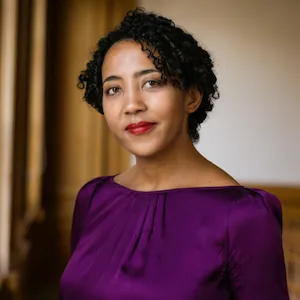
The Writing Program welcomed Namwali Serpell to its Creative Writing Lecture series last week. Serpell is a Zambian writer and Professor of English at Harvard. Her first novel, The Old Drift (Hogarth, 2019), won the Anisfield-Wolf Book prize for fiction “that confronts racism and explores diversity,” the Arthur C. Clarke Award for science fiction, and the L.A. Times’ Art Seidenbaum Award for First Fiction in 2020. She is a recipient of a 2020 Windham-Campbell Prize for fiction, and in 2014, she was chosen as one of the Africa 39, a Hay Festival project to identify the most promising African writers under 40. Her first book of literary criticism, Seven Modes of Uncertainty, was published in 2014 by Harvard University Press. Her latest nonfiction book, American Psycho Analysis, is forthcoming with Columbia University Press.
Over 135 people attended the event, which was moderated by Professor Ben Marcus. Marcus, who has been a member of the faculty at Columbia since 2000, is the author of several books, including The Flame Alphabet, The Age of Wire and String, and Notes from the Fog. Among his honors are a Whiting Writers Award, a Creative Capital Award, an NEA Fellowship in fiction, a literature award from the American Academy of Arts and Letters, and three Pushcart Prizes. “The Creative Writing Lecture Series was conceived as a way to have a chance to hear writers, whose work we love, not read their fiction necessarily, but to talk about the process of making it,” Marcus said. “We can go and hear writers read all the time, but it’s a little harder to get inside writers' heads.” The lecture series provides such an opportunity.
Serpell’s lecture, entitled “Beyond Empathy,” both points to and expands upon the thoughts she expressed in her 2019 essay “The Banality of Empathy,” which was published in The New York Review of Books. As Serpell said, her essay “tried to establish that the empathy model of fiction has become a kind of unthinking platitude in our time.” Serpell carefully weighs the limits of that model: “If witnessing suffering firsthand doesn’t necessarily spark good deeds, why do we think that art about suffering will?” Serpell queries. “The empathy model of art can bleed too easily into the relishing of suffering by those who are safe from it. It’s a gateway drug to white saviorism, with its familiar blend of propaganda, pornography, and paternalism. It’s an emotional palliative that distracts us from real inequities, on the page and on screen, to say nothing of our actual lives. And it has imposed upon readers and viewers the idea that they can and ought to use art to inhabit others, especially the marginalized.”
Serpell also discussed some of the connective antecedents to her essay which she hasn’t previously talked about. “[English Professor] Saidiya Hartman’s 1997 Scenes of Subjection considers how John Rankin, who is white, in trying to convey to his audience the horrors of American slavery, goes so far as to imagine himself, his wife, and his child as slaves,” Serpell said. “Hartman points out that not only are there filaments of masochism in this purported act of empathy, but that empathy itself—who empathizes, with whom, and why—is also thrown into question.” Hartman’s book takes on the difficulty of empathy and its “slipperiness,” a critique Serpell herself shares. Serpell also shared how both she and Hartman owe a debt to James Baldwin’s essay “Everybody’s Protest Novel,” which was published when he was just 24.
The repetition across years of such arguments and critiques of empathy strikes Serpell in particular. “Why doesn’t this critique sink in?” Serpell asked. “Why are we still beating the drum of empathy—but make it multicultural? Why, despite these trenchant critiques of the idea that empathy is the purpose for narrative art do we keep saying, as Roger Ebert once said, ‘The movies are like a machine that generates empathy,’ or, as [George] Saunders once put it, ‘Fiction is kind of like empathy training wheels,’ or, as Obama, paraphrased by the New York Times, says, there’s ‘a role that storytelling can play as a tool of radical empathy to remind people to what they have in common’?” Serpell pointed to several possible culprits: neoliberalism, the affect machine of the media, the fact that feelings often sell books, among others. Or, is it because, as Serpell discusses in her essay, “narrative art is indeed an incredible vehicle for virtual experience. We think and feel with characters. It simulates empathy, so we believe it stimulates it.”
During the Q&A portion of the event, one student asked Serpell how she approaches organizing the work of writing a novel. “It took me a very long time between the conception of the novel and the publication of the novel,” Serpell said, “and I wasn’t writing it the entire time...there are aspects, I realized later on, of the novel that I was carrying in my head.” Serpell happened upon this realization when she discovered some old notebooks that contained traces of the ideas that made their way into The Old Drift. “I had a kind of plot of land, an idea of what I wanted to happen across these generations [in the novel] and different genres, and then I was growing the plants at different times. “ Serpell did not write in order, and spent time after selling the novel not only writing, but also tackling the larger-scale structural work that mapped out the shape of the book, both within each chapter, and across the book as a whole.
“I think as writers, we have a responsibility to think beyond the empathy model and move toward more bold, and more nuanced, analyses of the relationships between form, affect, and ethics,” Serpell said.
The Creative Writing Lecture Series brings distinguished writers to Columbia for original talks on craft. Recent guests have included John Keene, Sarah Manguso, Lynne Tillman, and Carmen Maria Machado, and Rachel Cusk. The series will host author and Professor NoViolet Bulawayo on Wednesday, April 14, 2021 at 7:30 pm ET.