Columbia Faculty & Alumni on 2026 National Book Award Longlists
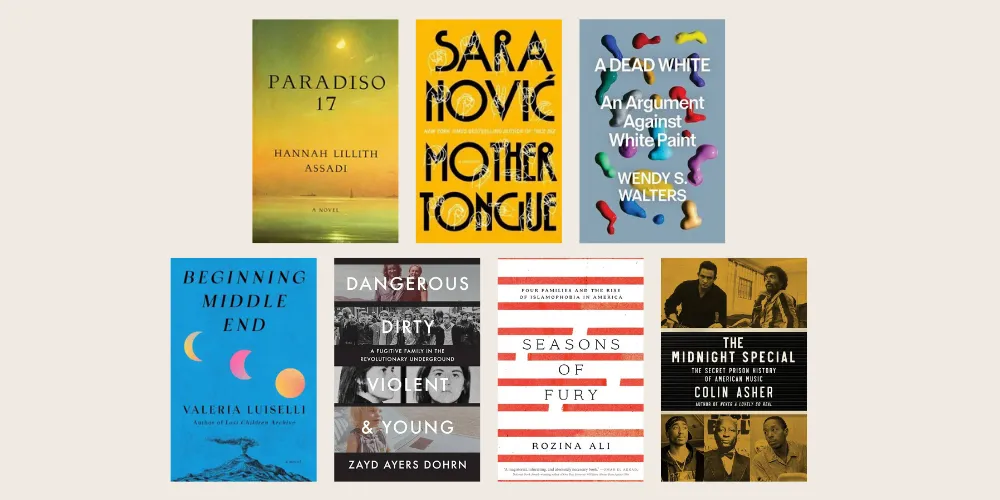
2026 marks the National Book Award's 77th year, and several Columbia writers are included in the longlist in both fiction and nonfiction. The National Book Award, founded in 1950 to celebrate the best of American writing, is considered the pinnacle of literary achievement in the United States and gives prizes in five different categories: Fiction, Nonfiction, Poetry, Translated Literature, and Young People’s Literature. Past recipients of the awards include writers like Ralph Ellison, William Faulkner, Flannery O’Connor, Toni Morrison, and Philip Roth.
Paradiso 17 (Fiction, Knopf, 2026), by alum and Adjunct Assistant Professor in Writing Hannah Lillith Assadi '13, was inspired by the life of Assadi’s late Palestinian father. The story follows a man named Sufien, forced to leave his home—the only one he’s ever known—in anticipation of the 1948 Nakba. From this escape, Sufien’s life is set into perpetual motion with its target becoming increasingly hazy. He makes stops in Kuwait, where he meets his first love, before leaving for a small Italian university town, where “he spends his youth wrapped up in the sweet promise of the West and the forgetful assurance of wine,” according to the publisher’s summary. Eventually, Sufien falls for a Jewish woman in New York before ending up in Arizona, a recall to the wild open plains of his youth. Sufien’s life spans friendships lost and gained, a plethora of professional experiences, and the unreliable company of cats. Paradiso 17’s lyrical pages present a narrative imbued with the pacing and teachings of a myth, weaving in past and present, and challenging the natural order of narrative unfolding.
Mother Tongue (Nonfiction, Random House, 2026), a memoir by Sara Novic '14, recounts Novic’s journey from the hearing world—a childhood immersed in bible study and music—to the deaf one when she fails her school’s mandatory hearing test, leading her to embrace the community of American Sign Language and attempt to cement a place in her past and present lives. Now a mother raising two children—one biological and hearing, the other deaf and adopted—this book tracks Novic’s attempt to both offer her children the resources her younger self needed while understanding that their own paths will break and branch off from her own experience.
It’s hard to imagine a more ubiquitous material than white paint, argues Associate Professor of Nonfiction Wendy S. Walters in A Dead White (Nonfiction, Scribner, 2026). Despite the material's prevalence, Walters posits, there's shockingly little examination dedicated to the material. Given its role as a default color in our built environments, we’re meant to perceive it as neutral, that it is without signifiers or that whatever significance it might hold is valueless. “In this expansive, impassioned examination, cultural critic Wendy S. Walters interrogates all that we have taken for granted about the substance that colors, or fails to color, the structures and objects that surround us—and what the collective impulse toward white paint can tell us about culture, politics, and individual desire,” writes Walters’s publisher Simon & Schuster. Weaving together multiple narratives and associations, exploring the paint color through art, architecture, and consumer culture, the book traces examinations through the home, walls of the workplace, and galleries, as well as spaces of mass culture and national identity, never losing focus on the question of how this cultural inclination exists as a manifestation of choice and our habits as individuals.
Additional titles on the longlist include Beginning Middle End (Fiction, Knopf, 2026), a novel by Valeria Luiselli (GSAS '15) about a multi-generational story of inheritance, attempting to find and comprehend a family’s origin and starting over again, told, partially, on a mother-daughter trip to Sicily; Dangerous, Dirty, Violent, and Young: A Fugitive Family in the Revolutionary Underground (nonfiction, W.W. Norton, 2026), a memoir by Zayd Ayers Dohrn (GSAS '06) about his parents’ involvement in The Weather Underground; Seasons of Fury: Four Families and the Rise of Islamophobia in America (Nonfiction, Crown, 2026) by Rozina Ali (SIPA '09), examining the long-existing conflict between American law enforcement and Muslim communities predating the terrorist attacks on September 11, 2001; and The Secret Prison History of American Music (Nonfiction, W.W. Norton, 2026) by Colin Asher (JRN '09) which examines the historic glorification of rebellion and “outlaws” within the music industry told through portraits of five artists: “Lead Belly” Ledbetter, Elmo Hope, Johnny Cash, Ike White, and Tupac Shakur.
The nominations were announced between September 15 and 17, 2026. Finalists will be announced October 6, and winners will be announced at the annual award ceremony and benefit dinner on November 18 at Cipriani Wall Street.
Read more about the National Book Award longlist for fiction here and nonfiction here.