Between Two Worlds: Directing Student Tanasia Lewis Reflects on 'Fabulation'
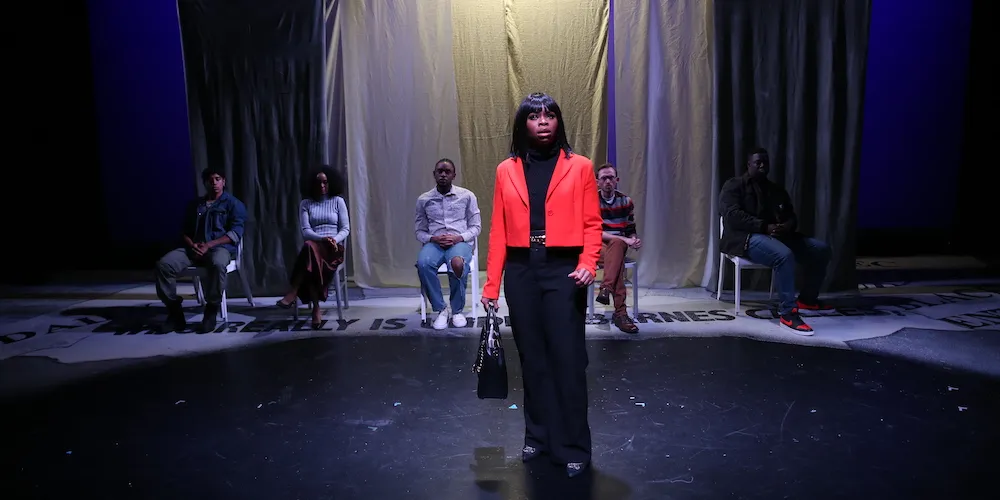
When we first meet Undine Barnes-Calles (Acting student Sarah-Michele Seison Guei) in the breathless opening of Fabulation or the ReEducation of Undine, she is at the zenith of a life she has fashioned for herself out of thin air. She has invented a new name, started a high-powered PR firm, and is living with a massive foundational lie: she’s told everyone she’s ever met that her family died in a fire, though they are still very much alive.
Directing student Tanasia Lewis staged her energetic take on Fabulation, the wickedly warm, wide-ranging satire written by Associate Professor of Theater Lynn Nottage, this past February as her thesis. It’s a show that’s been on her mind for a long time.
“The first time I encountered the play, I was in undergrad at the University of Albany, taking a course in contemporary theater,” Lewis told me in an interview. “It was the first time I’d ever read a play where I felt like I was represented. Undine is a Black woman, I’m a Black woman; she’s from Brooklyn, I’m from Brooklyn. I was fascinated even with the language—I’d never read a play that had language that I resonated with.”
The rug is swiftly pulled out from the Devil-Wears-Prada-style fantasy Undine has created when she learns that not only has her frivolous cad of a husband absconded with all her assets—she’s also pregnant.
Just like that, Undine is in free fall; her PR firm evaporates, her last friend and even her last wine glass are whisked away. She winds up back at the door of her family home in Brooklyn, where she hasn’t set foot in fourteen years.
“Through losing everything,” Lewis said, “Undine gains a better sense of who she is. She re-learns who she is and what she thinks the world is, and what it means to be a Black woman in this world.”
The show is a deeply personal one for Lewis on many levels. “It spoke to my personal experience at Columbia, going to a PWI [predominantly white institution] because that’s also how my life feels—that I’m living in between these two different worlds.”
Undine moves back in with her family—her brother (Jaucqir LaFond), mother (Yvonne Jessica Pruitt), father (Ruben St.Vilus) and grandma (Ominira (Chiquita Camille), now faced with the challenges of keeping her pregnancy, navigating her old neighborhood, dreaming of canapes while in the unemployment line, or running into her former assistant (Lanae Richelle) stocking shelves in a Walgreens. The many settings are reflective of New York’s own deeply class-based geography.
“I currently live in the house I was raised in. Every day, I travel 90 minutes to get to Columbia, and I have for the [past] three years,” Lewis said. “This is what I’ve seen from the beginning; different social classes, different environments—that’s also what Undine is experiencing.”
“I had a lot of conversations about how low-income communities are really different from gentrified areas, so we tried to show that with every detail, down to the sound design…In the very beginning [of the show] there’s not a lot of social or sound atmosphere. Then as we get into Brooklyn, there’s constant sound.”
Fabulation’s engine is a wicked sense of humor, fueled by insight and humanity. It allows the show to corner some tricky turns: in any other show, Undine getting arrested while trying to score for her heroin-dependent grandmother—and being sent to court-appointed drug therapy—might lapse into melodrama. But in Nottage’s world and Lewis’ production, both the writing and the cast lean into these challenges with verve.
The electric-shock quality of the humor is one of Lewis’ favorite aspects of the show: “I like to say, it smacks you in the face—but before you realize you’ve been smacked in the face, you’re laughing because something else has happened.”
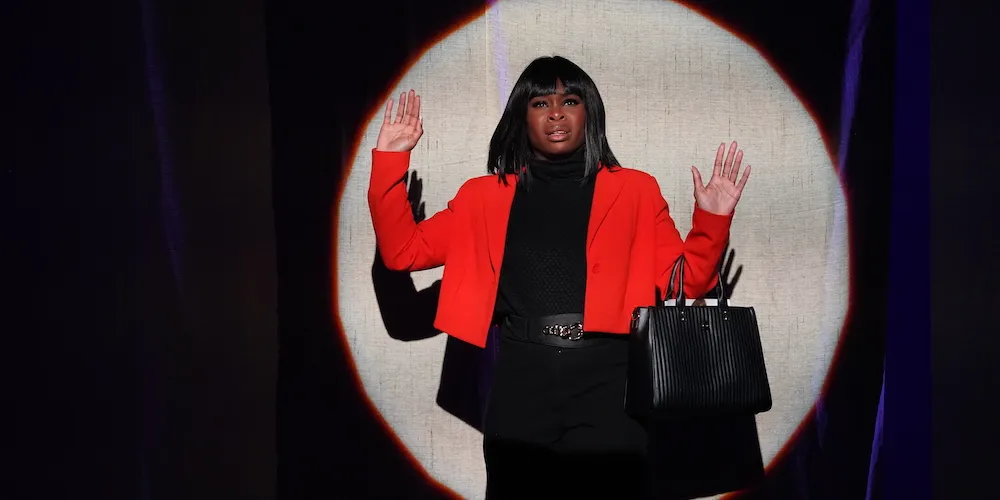
Stabilizing this heightened world is Guei’s charming and tender performance as Undine. When Undine gets arrested, she faces the audience, raising her hands in the blazing red and blue police lights, her designer bag aloft on her elbow. She tells us, ''My entire life has been engineered to avoid this very moment,” and Guei’s face is a perfect crisis of incredulity, resignation, and dissociation.
Primly taking her seat at her drug therapy meeting, wearing Jackie O. sunglasses and a kerchief over her bob, her pregnant belly now enormous, Guei radiates the high-achiever’s disbelief at decline. In the end, she can’t help her Type-A impulse to win: she invents a story of her own addiction, so convincingly, she tells us, that she wins even her own sympathies.
“[Guei] was extremely invested in Undine,” Lewis enthused. “She did her own research—I’m talking like 40 pages of what Undine would listen to, what Undine would wear, questions she had about the script…all of that passion was underlying in her audition.”
The rest of the cast pulls double and triple duty, playing inmates, family members, accountants, doctors, movers, assistants, and neighborhood personalities. Pruitt gives megawatt energy in every scene, whether she’s Undine’s socialite bestie, or hilariously menacing Undine in a jail cell. Mark Dessaix gives professorial Addict #1 a gleefully feral twist, and St. Vilius turns in a warm, restrained monologue as Undine’s father.
Transitions between scenes depend on their swift, coordinated teamwork, flowing from office to home to jail cell to restaurant. Hanging sheets of fabric layer the stage, suspended from the ceiling. During each transition, the cast tears a sheet down, allowing scenes to move deeper and deeper upstage, progressively laying the set bare. It was a concept generated by Set Designer Laura Valenti from conversations with Lewis.
“[Undine] starts the play as a woman with so much power, so much control,” Lewis explained, “She feels like she can do anything. And then little by little she sees how easily it all gets taken away, and how could we physically show that process?”
In another story, we might expect Undine to ascend to the chilly heights of her monied world once again. Instead, by the end of the show, Undine has found love and a new beginning with Guy, an attentive, supportive man from her drug-therapy group, who wants to be there for her and her baby. I asked Lewis what she thought of this quietly romantic ending.
“It’s another sign of Undine surrendering. Up until that point she’s always done what she felt she should do…it’s the first time where she goes against logic…and does what feels right to her.”
As we spoke about Undine’s surrender, I was reminded of something else Lewis told me about her own journey.
“I didn’t think that I was going to be in theater at all,’ she said. “I always loved theater, but I didn’t want to be a starving artist. As I went through life, I realized I kept putting theater in everything I did. Before I came to Columbia I was a teacher, and I would have my students doing plays for every activity. I had a moment where I thought, I should do it for real.”
It is Columbia’s good fortune, and the good fortune of her future audiences, that Tanasia Lewis listened to what felt right.